Cost-effectiveness of an educational intervention to reduce potentially inappropriate medication
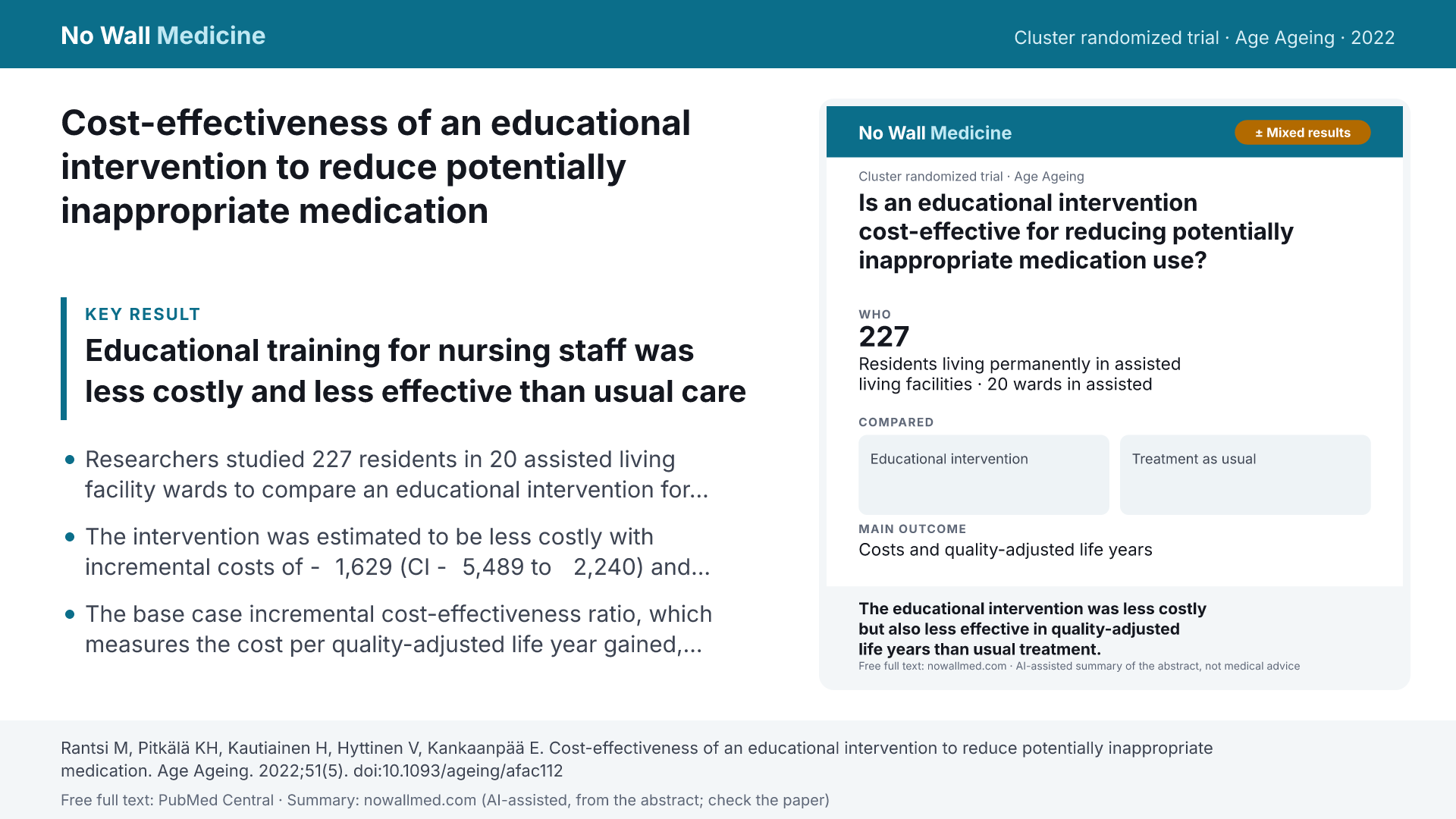
Key result: Educational training for nursing staff was less costly and less effective than usual care
Cluster randomized trialMixed results
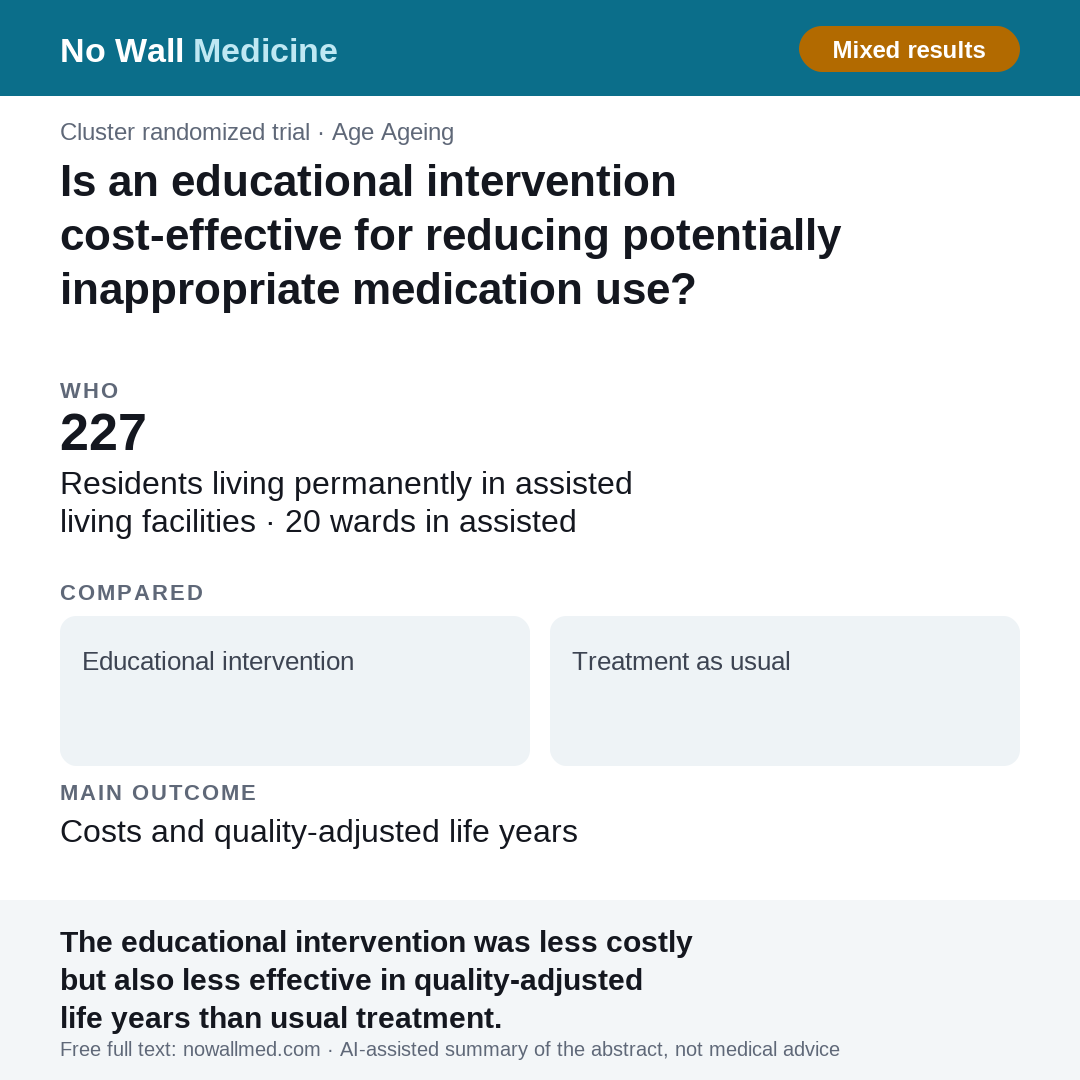
Is an educational intervention cost-effective for reducing potentially inappropriate medication use?
Who
227
Residents living permanently in assisted living facilities · 20 wards in assisted living facilities
Compared
Educational intervention
Treatment as usual
Main outcome
Costs and quality-adjusted life years
Result: incremental costs -€1,629, confidence interval -€5,489 to €2,240; incremental effect -0.02, CI -0.06 to 0.02
Bottom line: The educational intervention was less costly but also less effective in quality-adjusted life years than usual treatment.
Age Ageing · 2022-05-23Download image
Key points
- Researchers studied 227 residents in 20 assisted living facility wards to compare an educational intervention for staff against treatment as usual.
- The intervention was estimated to be less costly with incremental costs of -€1,629 (CI -€5,489 to €2,240) and less effective with an incremental effect of -0.02 (CI -0.06 to 0.02).
- The base case incremental cost-effectiveness ratio, which measures the cost per quality-adjusted life year gained, was >€80,000/QALY.
Discussion prompts
- Would these patients look like yours? Who was left out?
- Is the main outcome one that matters to patients?
- Is the difference large enough to change what you do?
Cite: Rantsi M, Pitkälä KH, Kautiainen H, Hyttinen V, Kankaanpää E. Cost-effectiveness of an educational intervention to reduce potentially inappropriate medication. Age Ageing. 2022. doi:10.1093/ageing/afac112
Free full text: PubMed Central · Summary and visual abstract: nowallmed.com/a/cost-effectiveness-of-an-educational-intervention-to-reduce-1pxpjhb/ (AI-assisted from the abstract; check the paper before relying on it).