Community-based tuberculosis management for children is cost-effective in Cameroon and Uganda
Cost-effectiveness of community-based household tuberculosis contact management for children in Cameroon and Uganda: a modelling analysis of a cluster-randomised trial
Decision-analytical modelling analysisBenefit found
Is community-based household tuberculosis contact management cost-effective for children?
Who
Children who are household contacts of tuberculosis index patients · Cameroon and Uganda
Compared
Community-based household contact management
Facility-based standard of care
Main outcome
Disability-adjusted life-years averted
Result: $620 per disability-adjusted life-year averted in Cameroon and $970 in Uganda
Bottom line: Community-based approaches are cost-effective for reducing child tuberculosis deaths in Cameroon and Uganda.
Funded by: Unitaid and UK Medical Research Council
Lancet Glob Health · 2023-10-30Download image
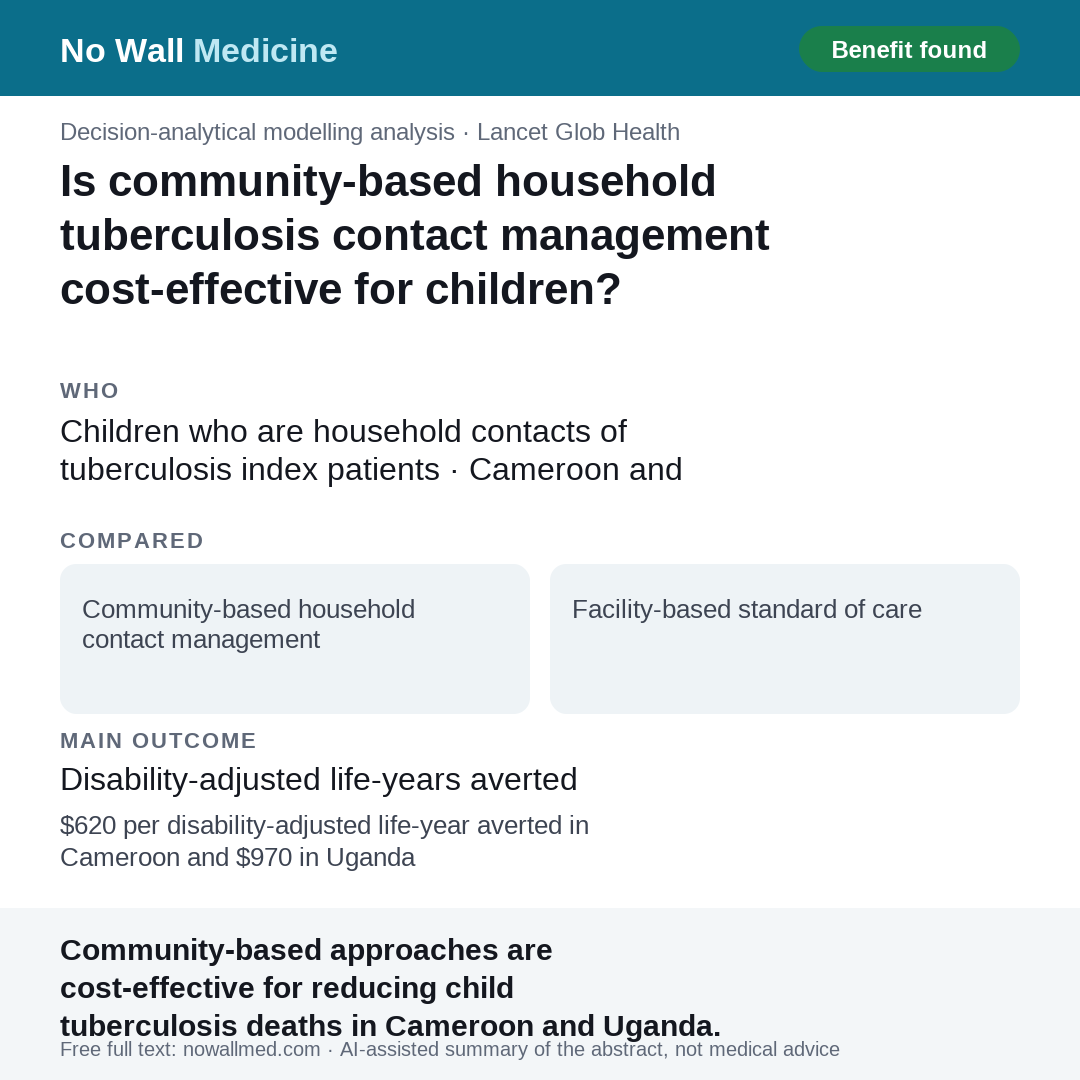
Clinical question: Is community-based household tuberculosis contact management cost-effective for children?
Why it matters: It was unknown if community-based household contact management for children is cost-effective compared to facility-based models of care.
Key points
- Researchers used a modelling analysis of the CONTACT trial to compare community-based versus facility-based household contact management for children in Cameroon and Uganda.
- For every 1000 index patients, the intervention increased tuberculosis-preventive treatment courses by 1110 (95% uncertainty interval 894 to 1227) in Cameroon and 1078 (796 to 1220) in Uganda.
- The incremental cost-effectiveness ratio was $620 per disability-adjusted life-year averted in Cameroon and $970 per disability-adjusted life-year averted in Uganda.
Headline and key points written with AI from the paper’s abstract, with every number checked against it. Read the paper before relying on them.
Was this summary helpful?
Abstract
Background
WHO recommends household contact management (HCM) including contact screening and tuberculosis-preventive treatment (TPT) for eligible children. The CONTACT trial found increased TPT initiation and completion rates when community health workers were used for HCM in Cameroon and Uganda. Methods
We did a cost-utility analysis of the CONTACT trial using a health-system perspective to estimate the health impact, health-system costs, and cost-effectiveness of community-based versus facility-based HCM models of care. A decision-analytical modelling approach was used to evaluate the cost-effectiveness of the intervention compared with the standard of care using trial data on cascade of care, intervention effects, and resource use. Health outcomes were based on modelled progression to tuberculosis, mortality, and discounted disability-adjusted life-years (DALYs) averted. Health-care resource use, outcomes, costs (2021 US$), and cost-effectiveness are presented. Findings
For every 1000 index patients diagnosed with tuberculosis, the intervention increased the number of TPT courses by 1110 (95% uncertainty interval 894 to 1227) in Cameroon and by 1078 (796 to 1220) in Uganda compared with the control model. The intervention prevented 15 (-3 to 49) tuberculosis deaths in Cameroon and 10 (-20 to 33) in Uganda. The incremental cost-effectiveness ratio was $620 per DALY averted in Cameroon and $970 per DALY averted in Uganda. Interpretation
Community-based HCM approaches can substantially reduce child tuberculosis deaths and in our case would be considered cost-effective at willingness-to-pay thresholds of $1000 per DALY averted. Their impact and cost-effectiveness are likely to be greatest where baseline HCM coverage is lowest. Funding
Unitaid and UK Medical Research Council.
Abstract reproduced under the article’s CC BY licence.
Subject terms
Cite this article
Mafirakureva N, Tchounga BK, Mukherjee S, Tchakounte Youngui B, Ssekyanzi B, Simo L. Cost-effectiveness of community-based household tuberculosis contact management for children in Cameroon and Uganda: a modelling analysis of a cluster-randomised trial. Lancet Glob Health. 2023. doi:10.1016/S2214-109X(23)00451-5
Spotted a mistake? Suggest a correction
Top studies every Monday
The week’s key trials and guidelines in your specialties, plus any topics you follow. By email, free.
Get the weekly digest