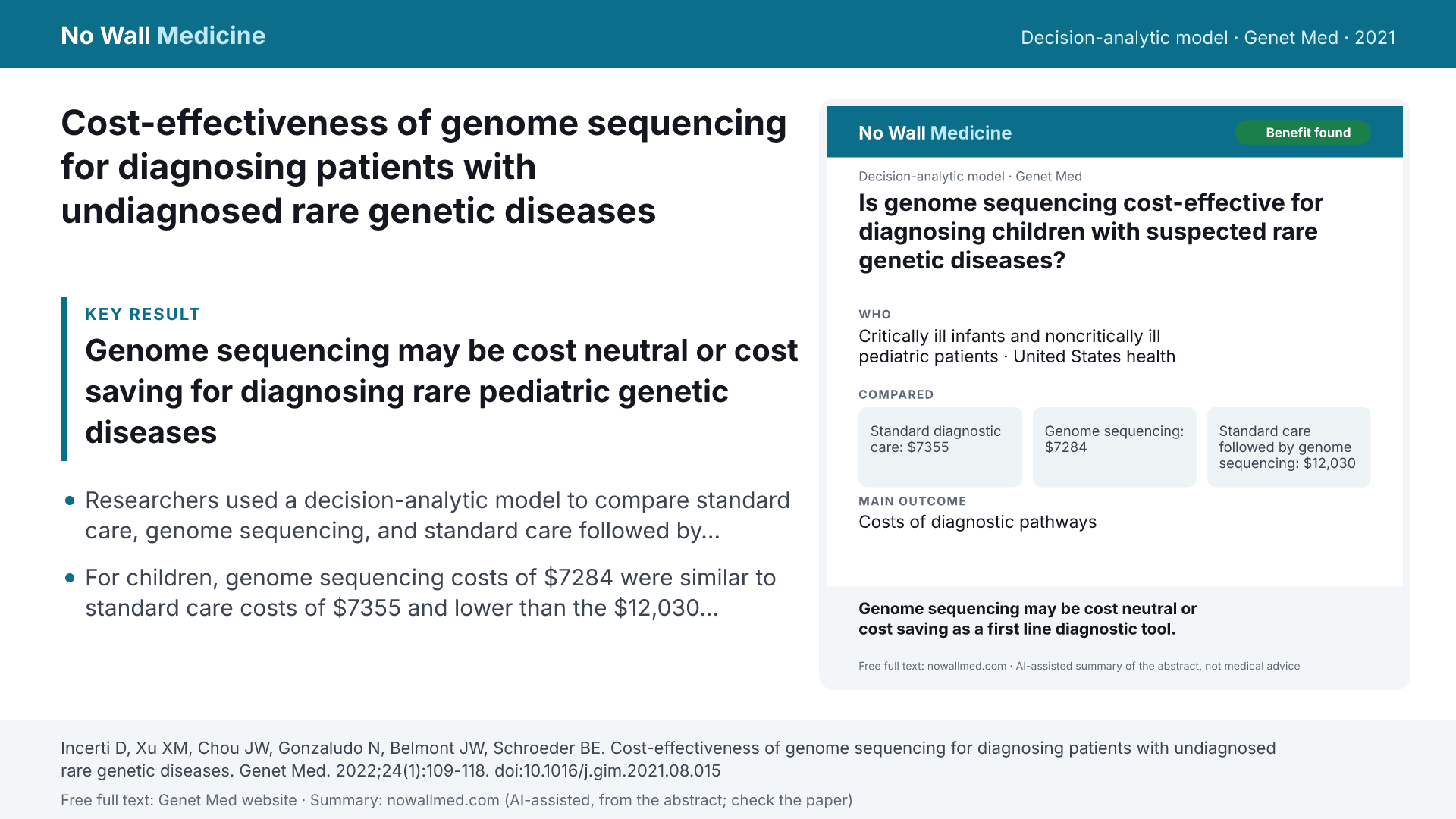
Genome sequencing may be cost neutral or cost saving for diagnosing rare pediatric genetic diseases
Cost-effectiveness of genome sequencing for diagnosing patients with undiagnosed rare genetic diseases
Decision-analytic modelBenefit found
Is genome sequencing cost-effective for diagnosing children with suspected rare genetic diseases?
Who
Critically ill infants and noncritically ill pediatric patients · United States health sector
Compared
Standard diagnostic care: $7355
Genome sequencing: $7284
Standard care followed by genome sequencing: $12,030
Main outcome
Costs of diagnostic pathways
Bottom line: Genome sequencing may be cost neutral or cost saving as a first line diagnostic tool.
Genet Med · 2021-11-30Download image
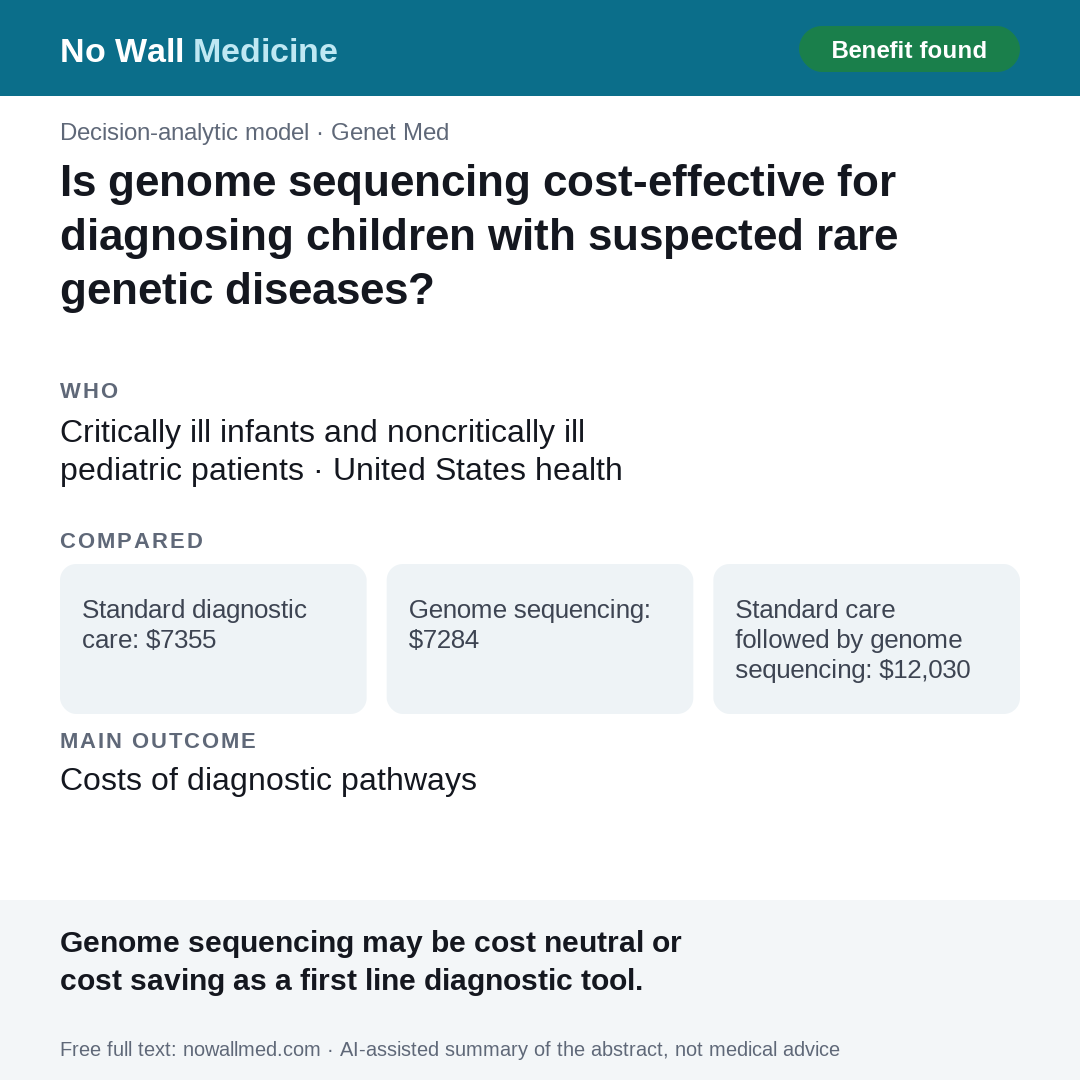
Clinical question: Is genome sequencing cost-effective for diagnosing children with suspected rare genetic diseases?
Why it matters: The cost-effectiveness of using genome sequencing as a first-line diagnostic tool for children and critically ill infants with suspected rare genetic diseases is unknown.
Key points
- Researchers used a decision-analytic model to compare standard care, genome sequencing, and standard care followed by genome sequencing for children and critically ill infants.
- For children, genome sequencing costs of $7284 were similar to standard care costs of $7355 and lower than the $12,030 for standard care followed by genome sequencing.
- In critically ill infants, the lowest cost pathway was genome sequencing at $209,472 when based on the length of stay in the neonatal intensive care unit.
Headline and key points written with AI from the paper’s abstract, with every number checked against it. Read the paper before relying on them.
Was this summary helpful?
Subject terms
Cite this article
Incerti D, Xu XM, Chou JW, Gonzaludo N, Belmont JW, Schroeder BE. Cost-effectiveness of genome sequencing for diagnosing patients with undiagnosed rare genetic diseases. Genet Med. 2021. doi:10.1016/j.gim.2021.08.015
Spotted a mistake? Suggest a correction