Cost-effectiveness of genome sequencing for diagnosing patients with undiagnosed rare genetic diseases
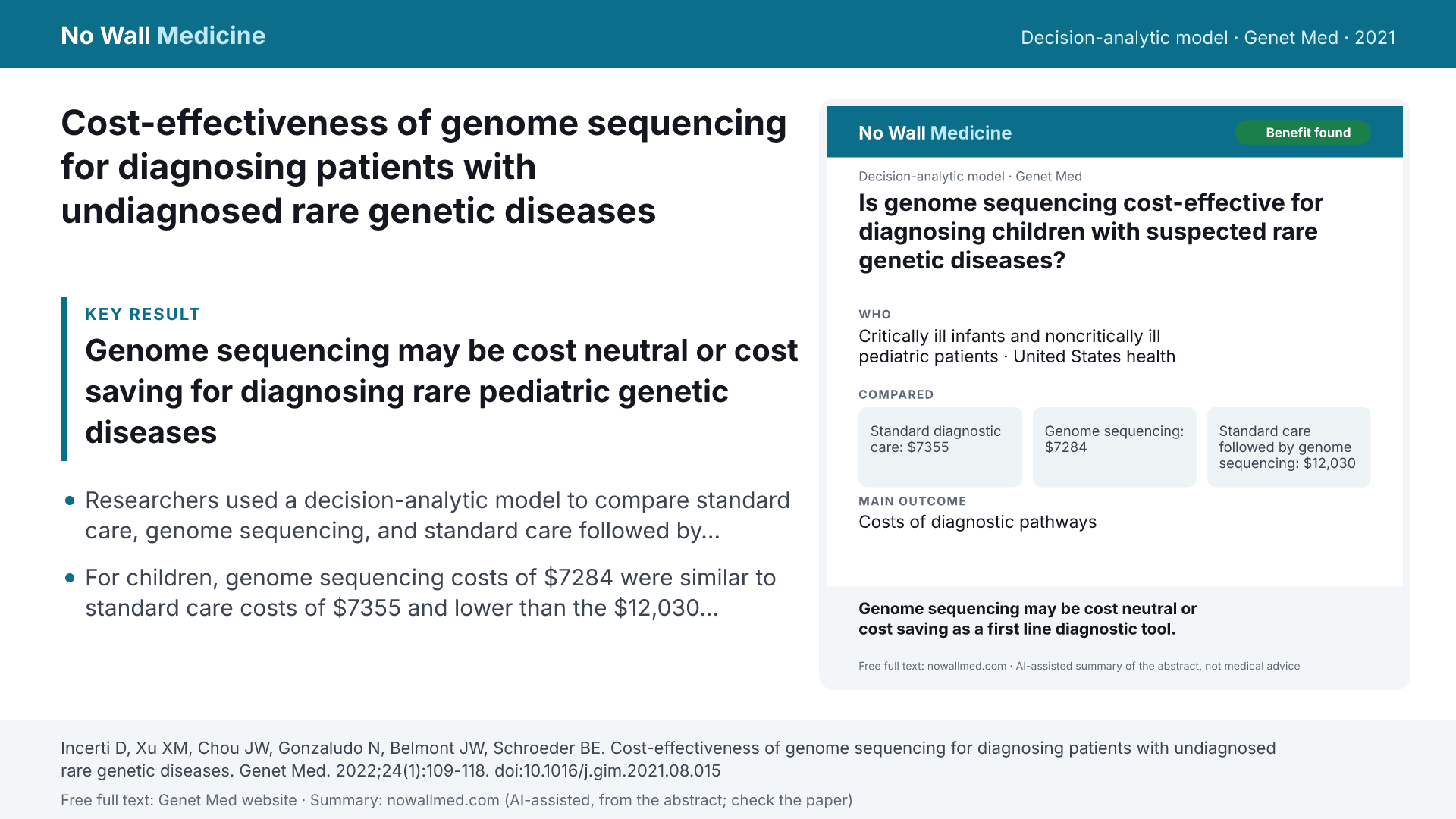
Key result: Genome sequencing may be cost neutral or cost saving for diagnosing rare pediatric genetic diseases
Decision-analytic modelBenefit found
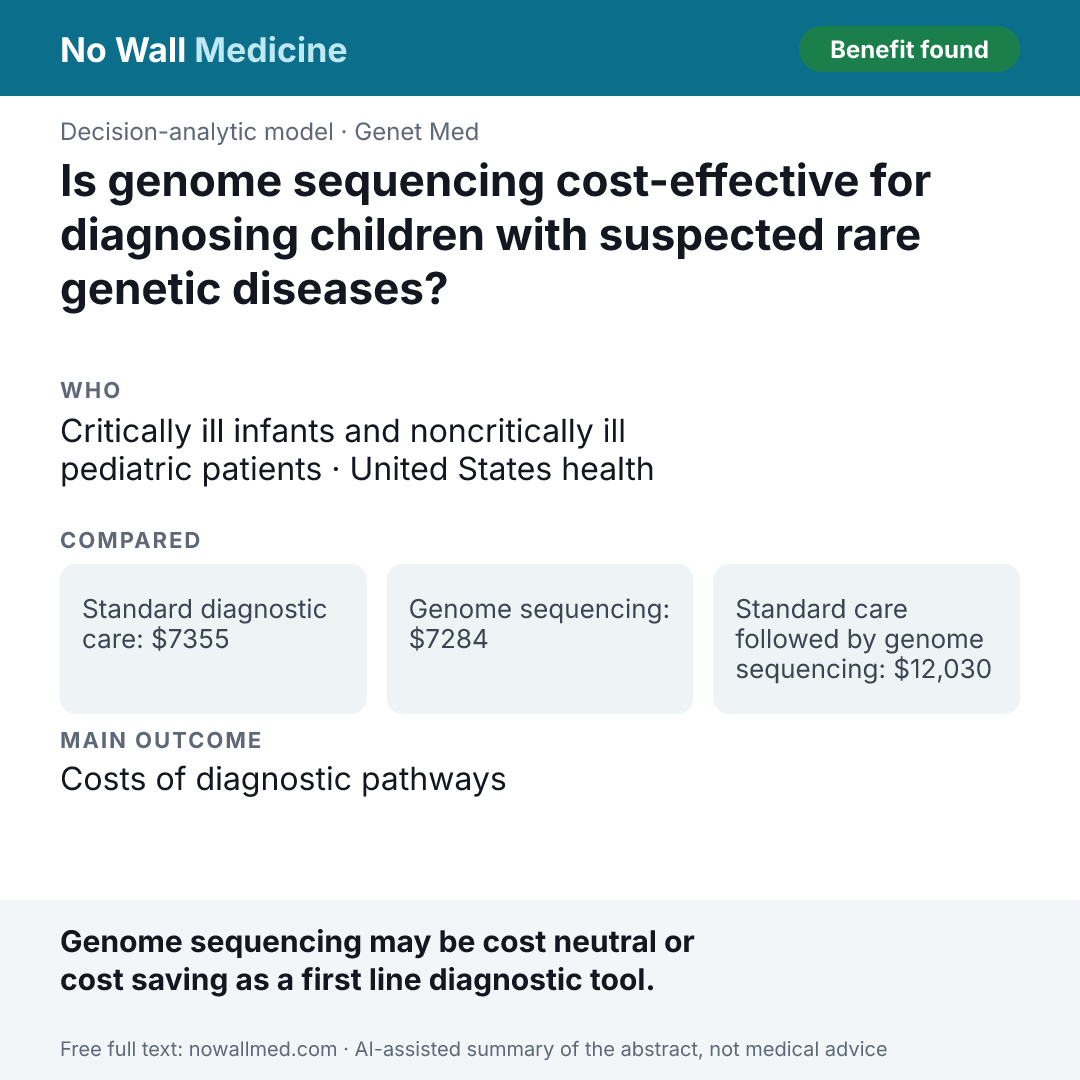
Is genome sequencing cost-effective for diagnosing children with suspected rare genetic diseases?
Who
Critically ill infants and noncritically ill pediatric patients · United States health sector
Compared
Standard diagnostic care: $7355
Genome sequencing: $7284
Standard care followed by genome sequencing: $12,030
Main outcome
Costs of diagnostic pathways
Bottom line: Genome sequencing may be cost neutral or cost saving as a first line diagnostic tool.
Genet Med · 2021-11-30 · Save PNG
Key points
- Researchers used a decision-analytic model to compare standard care, genome sequencing, and standard care followed by genome sequencing for children and critically ill infants.
- For children, genome sequencing costs of $7284 were similar to standard care costs of $7355 and lower than the $12,030 for standard care followed by genome sequencing.
- In critically ill infants, the lowest cost pathway was genome sequencing at $209,472 when based on the length of stay in the neonatal intensive care unit.
Discussion prompts
- Would these patients look like yours? Who was left out?
- Is the main outcome one that matters to patients?
- Is the difference large enough to change what you do?
Cite: Incerti D, Xu XM, Chou JW, Gonzaludo N, Belmont JW, Schroeder BE. Cost-effectiveness of genome sequencing for diagnosing patients with undiagnosed rare genetic diseases. Genet Med. 2022;24(1):109-118. doi:10.1016/j.gim.2021.08.015
Free full text: Genet Med website · Summary and visual abstract: nowallmed.com/a/cost-effectiveness-of-genome-sequencing-for-diagnosing-patients-with-a60e7h/ (AI-assisted from the abstract; check the paper before relying on it).