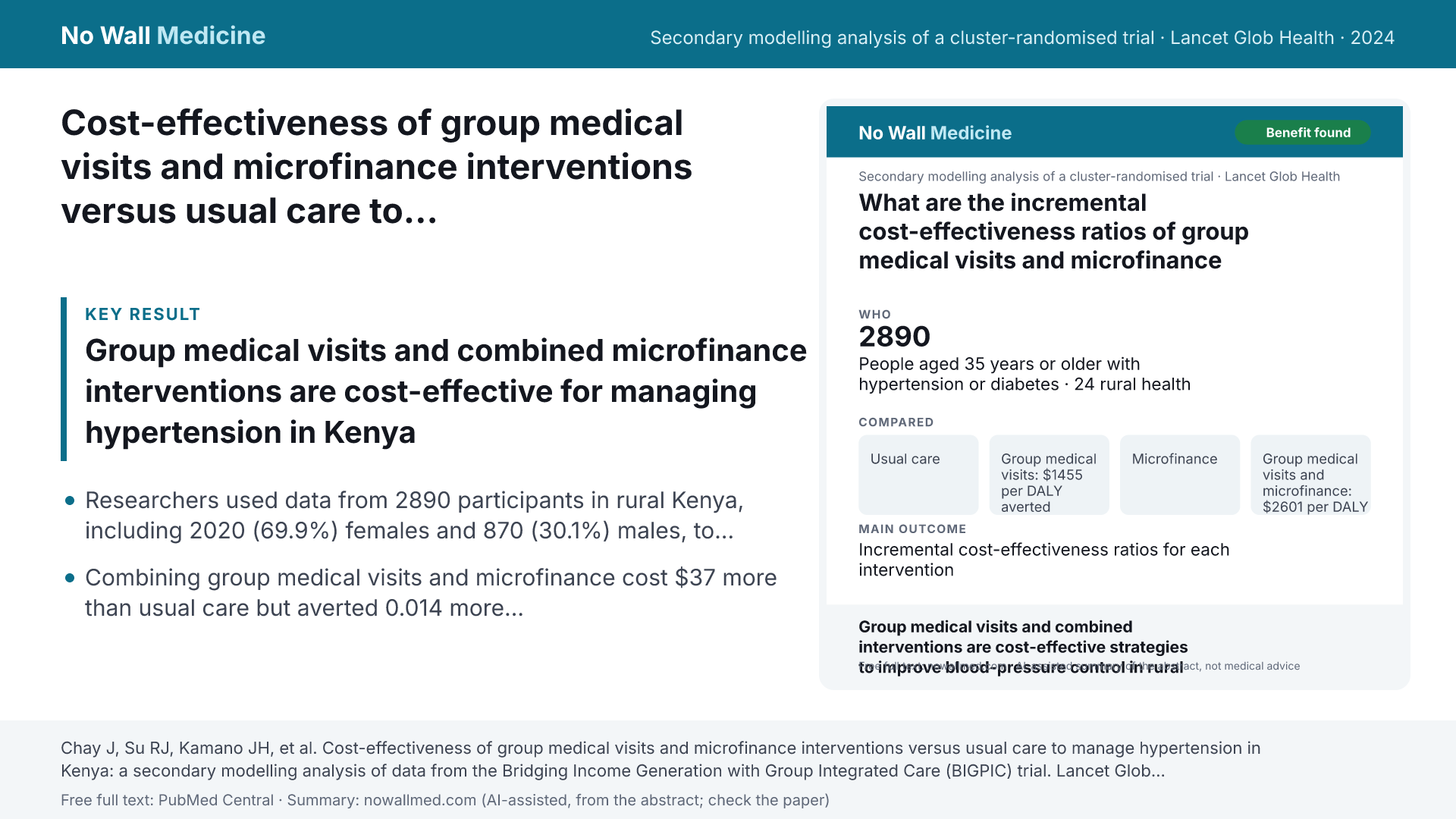
Group medical visits and combined microfinance interventions are cost-effective for managing hypertension in Kenya
Cost-effectiveness of group medical visits and microfinance interventions versus usual care to manage hypertension in Kenya: a secondary modelling analysis of data from the Bridging Income Generation with Group Integrated Care (BIGPIC) trial
Secondary modelling analysis of a cluster-randomised trialBenefit found
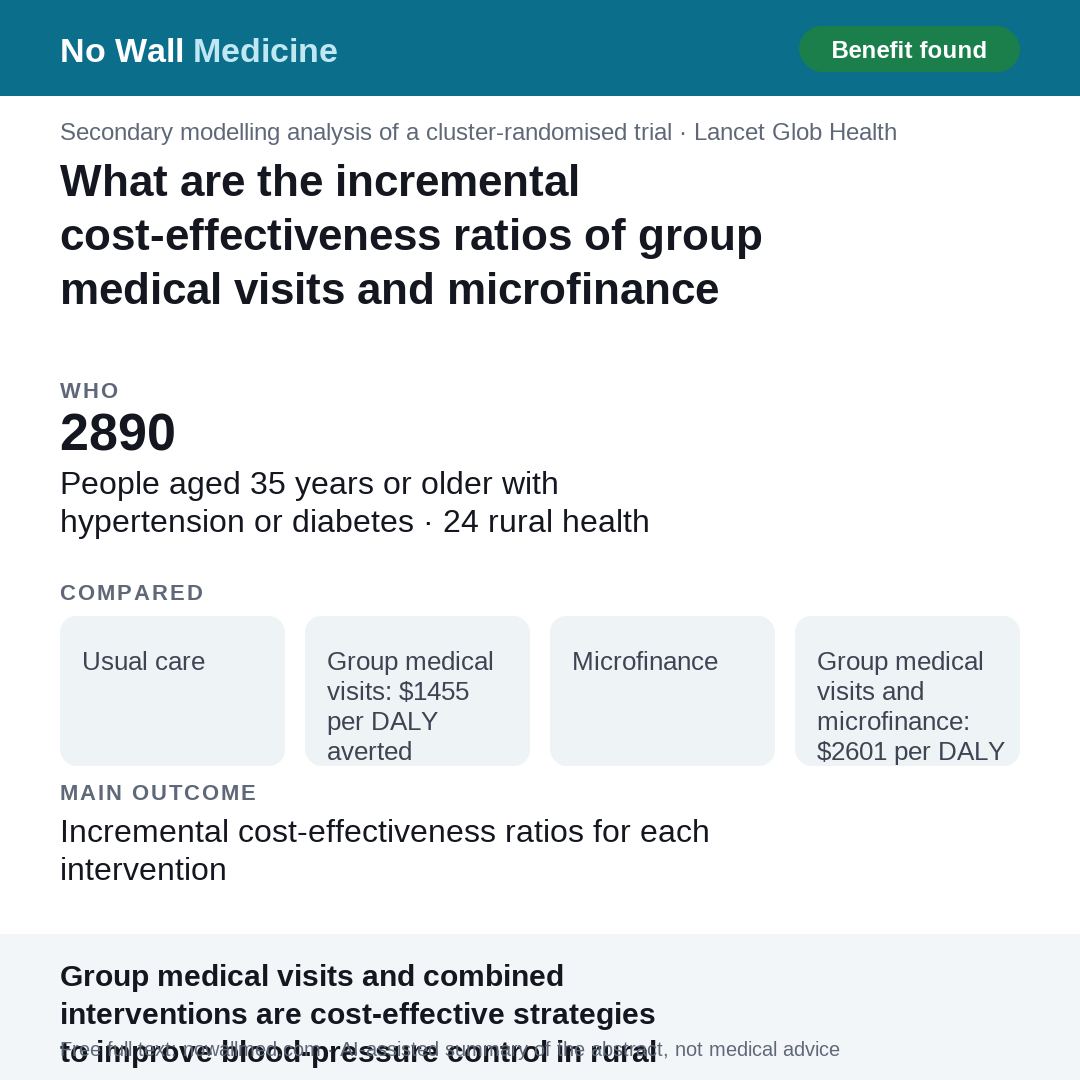
What are the incremental cost-effectiveness ratios of group medical visits and microfinance interventions for hypertension?
Who
2890
People aged 35 years or older with hypertension or diabetes · 24 rural health facilities in western Kenya
Compared
Usual care
Group medical visits: $1455 per DALY averted
Microfinance
Group medical visits and microfinance: $2601 per DALY averted
Main outcome
Incremental cost-effectiveness ratios for each intervention
Bottom line: Group medical visits and combined interventions are cost-effective strategies to improve blood-pressure control in rural Kenya.
Funded by: US National Institutes of Health
Lancet Glob Health · 2024-07-20Download image
Clinical question: What are the incremental cost-effectiveness ratios of group medical visits and microfinance interventions for hypertension?
Why it matters: The cost-effectiveness of integrating group medical visits and microfinance into standard hypertension care in rural Kenya was unknown.
Key points
- Researchers used data from 2890 participants in rural Kenya, including 2020 (69.9%) females and 870 (30.1%) males, to model the costs and health benefits of different hypertension management strategies.
- Combining group medical visits and microfinance cost $37 more than usual care but averted 0.014 more disability-adjusted life-years, which is a measure of healthy life years lost.
- Group medical visits cost $7 more per person than usual care and averted 0.005 more disability-adjusted life-years, resulting in an incremental cost-effectiveness ratio of $1455 per disability-adjusted life-year averted.
Headline and key points written with AI from the paper’s abstract, with every number checked against it. Read the paper before relying on them.
Was this summary helpful?
Abstract
Background
The Bridging Income Generation with Group Integrated Care (BIGPIC) trial in rural Kenya showed that integrating usual care with group medical visits or microfinance interventions reduced systolic blood pressure and cardiovascular risk in participants. We aimed to estimate the incremental cost-effectiveness of three BIGPIC interventions for a modelled cohort and by sex, as well as the cost of implementing these interventions. Methods
For this analysis, we used data collected during the BIGPIC trial, a four-group, cluster-randomised trial conducted in the western Kenyan catchment area of the Academic Model Providing Access to Healthcare. BIGPIC enrolled participants from 24 rural health facilities in rural western Kenya aged 35 years or older with either increased blood pressure or diabetes. Participants were assigned to receive either usual care, group medical visits, microfinance, or a combination of group medical visits and microfinance (GMV-MF). Our model estimated the incremental cost-effectiveness of the three BIGPIC interventions via seven health states (ie, a hypertensive state, five chronic cardiovascular-disease states, and a death state) by simulating transitions between health states for a hypothetical cohort of individuals with hypertension on the basis of QRISK3 scores. In every cycle, participants accrued costs and disability-adjusted life-years (DALYs) associated with their health state. Incremental cost-effectiveness ratios (ICERs) were calculated for the entire modelled cohort and by sex by dividing the incremental cost by the incremental effectiveness of the next most expensive intervention. The main outcome of this analysis was ICERs for each intervention evaluated. This analysis is registered at ClinicalTrials.gov (NCT02501746). Findings
Between Feb 6, 2017, and Dec 29, 2019, 2890 people were recruited to the BIGPIC trial. 2020 (69·9%) of 2890 participants were female and 870 (30·1%) were male. At baseline, mean QRISK3 score was 11·5 (95% CI 11·1-11·9) for the trial population, 11·9 (11·5-12·2) for male participants, and 11·3 (11·0-11·6) for female participants. For the population of Kenya, group medical visits were estimated to cost US$7 more per individual than usual care and result in 0·005 more DALYs averted (ICER $1455 per DALY averted). Microfinance was estimated to cost $19 more than group medical visits but was only estimated to avert 0·001 more DALYs. Relative to group medical visits, GMV-MF was estimated to cost $29 more and avert 0·009 more DALYs ($3235 per DALY averted). Relative to usual care, GMV-MF was estimated to cost $37 more and avert 0·014 more DALYs ($2601 per DALY averted). In the first year of the intervention, usual care was estimated to be the least expensive intervention to implement ($87 per participant; $10 238 per health-facility catchment area [HFCA]), then group medical visits ($99 per participant; $12 268 per HFCA), then microfinance ($120 per participant; $14 172 per HFCA), with GMV-MF estimated to be the most expensive intervention to implement ($139 per participant; $16 913 per HFCA). Interpretation
Group medical visits and GMV-MF were estimated to be cost-effective strategies to improve blood-pressure control in rural Kenya. However, which intervention to pursue depends on resource availability. Policy makers should consider these factors, in addition to sex differences in programme effectiveness, when selecting optimal implementation strategies. Funding
US National Institutes of Health.
Abstract reproduced under the article’s CC BY licence.
Subject terms
Cite this article
Chay J, Su RJ, Kamano JH, et al. Cost-effectiveness of group medical visits and microfinance interventions versus usual care to manage hypertension in Kenya: a secondary modelling analysis of data from the Bridging Income Generation with Group Integrated Care (BIGPIC) trial. Lancet Glob Health. 2024. doi:10.1016/S2214-109X(24)00188-8
Spotted a mistake? Suggest a correction