High-intensity training was associated with higher costs but greater walking speed gains after stroke
Cost-Effectiveness of High-intensity Training vs Conventional Therapy for Individuals With Subacute Stroke
Randomized controlled trialBenefit found
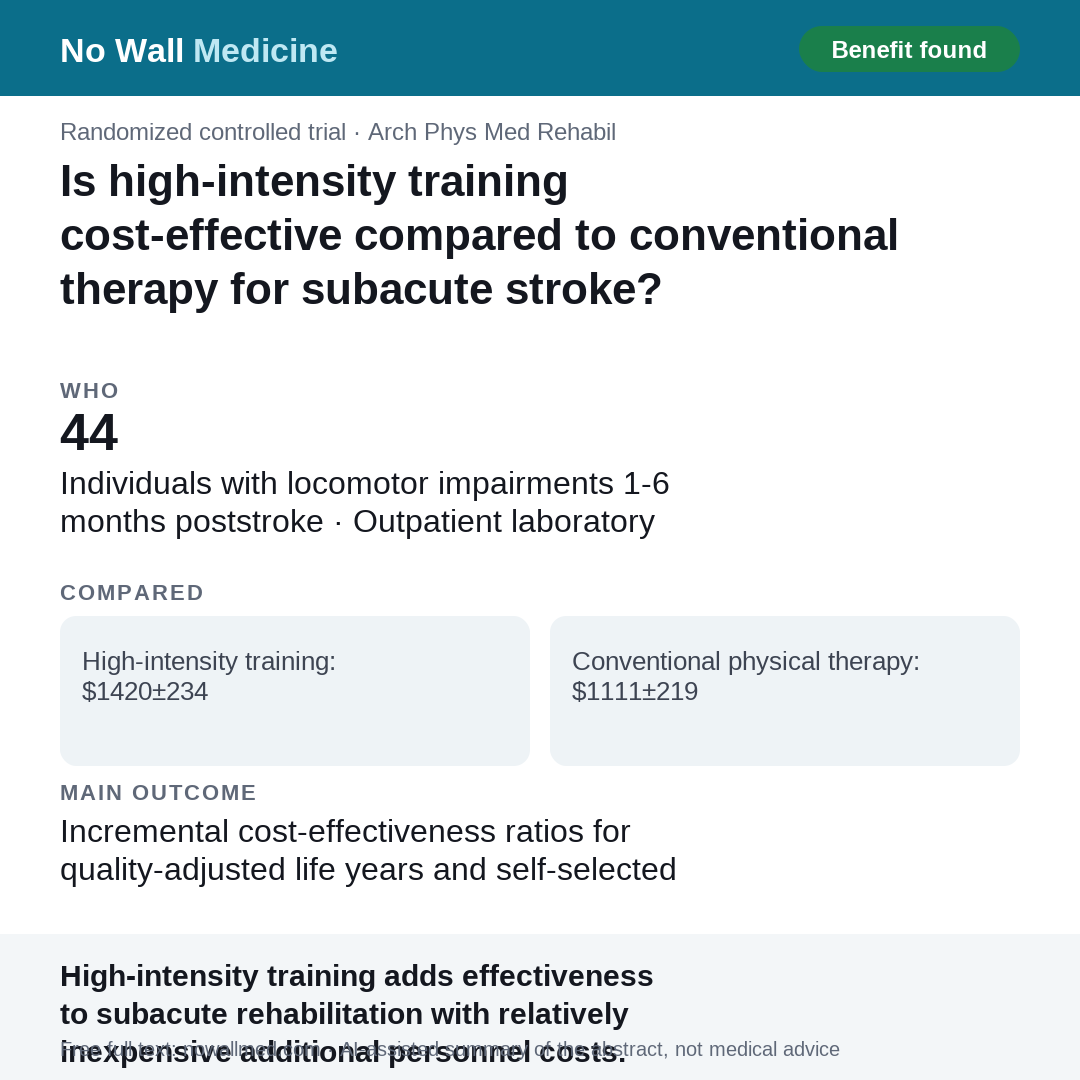
Is high-intensity training cost-effective compared to conventional therapy for subacute stroke?
Who
44
Individuals with locomotor impairments 1-6 months poststroke · Outpatient laboratory setting
Compared
High-intensity training: $1420±234
Conventional physical therapy: $1111±219
Main outcome
Incremental cost-effectiveness ratios for quality-adjusted life years and self-selected speeds
Result: $6180 (95% CI -$96,364 to $123,211) per quality-adjusted life year
Bottom line: High-intensity training adds effectiveness to subacute rehabilitation with relatively inexpensive additional personnel costs.
Arch Phys Med Rehabil · 2021-07-03Download image
Clinical question: Is high-intensity training cost-effective compared to conventional therapy for subacute stroke?
Why it matters: It was unknown if the additional personnel required for high-intensity training is a cost-effective approach for subacute stroke rehabilitation.
Key points
- Researchers analyzed 44 individuals with walking impairments 1-6 months after a stroke, comparing high-intensity training to conventional physical therapy.
- High-intensity training had higher mean personnel costs of $1420±234 compared to $1111±219 for conventional therapy.
- High-intensity training was associated with a 0.20 m/s gain in self-selected walking speed and a 0.05 quality-adjusted life year difference.
Headline and key points written with AI from the paper’s abstract, with every number checked against it. Read the paper before relying on them.
Was this summary helpful?
Subject terms
Cite this article
Hornby TG, Rafferty MR, Pinto D, French D, Jordan N. Cost-Effectiveness of High-intensity Training vs Conventional Therapy for Individuals With Subacute Stroke. Arch Phys Med Rehabil. 2021. doi:10.1016/j.apmr.2021.05.017
Spotted a mistake? Suggest a correction
Top studies every Monday
The week’s key trials and guidelines in your specialties, plus any topics you follow. By email, free.
Get the weekly digest