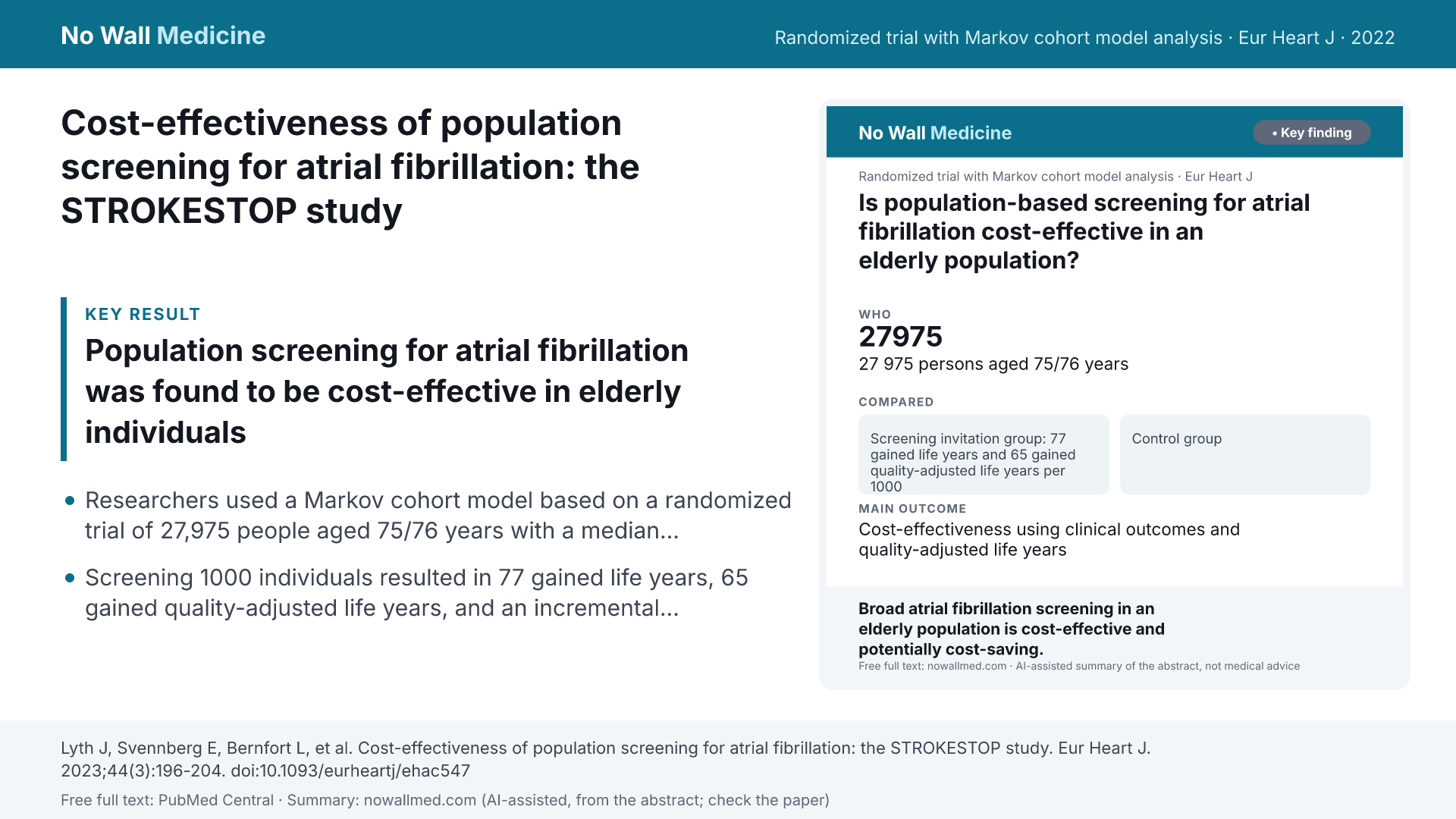
Population screening for atrial fibrillation was found to be cost-effective in elderly individuals
Cost-effectiveness of population screening for atrial fibrillation: the STROKESTOP study
Randomized trial with Markov cohort model analysisBenefit found
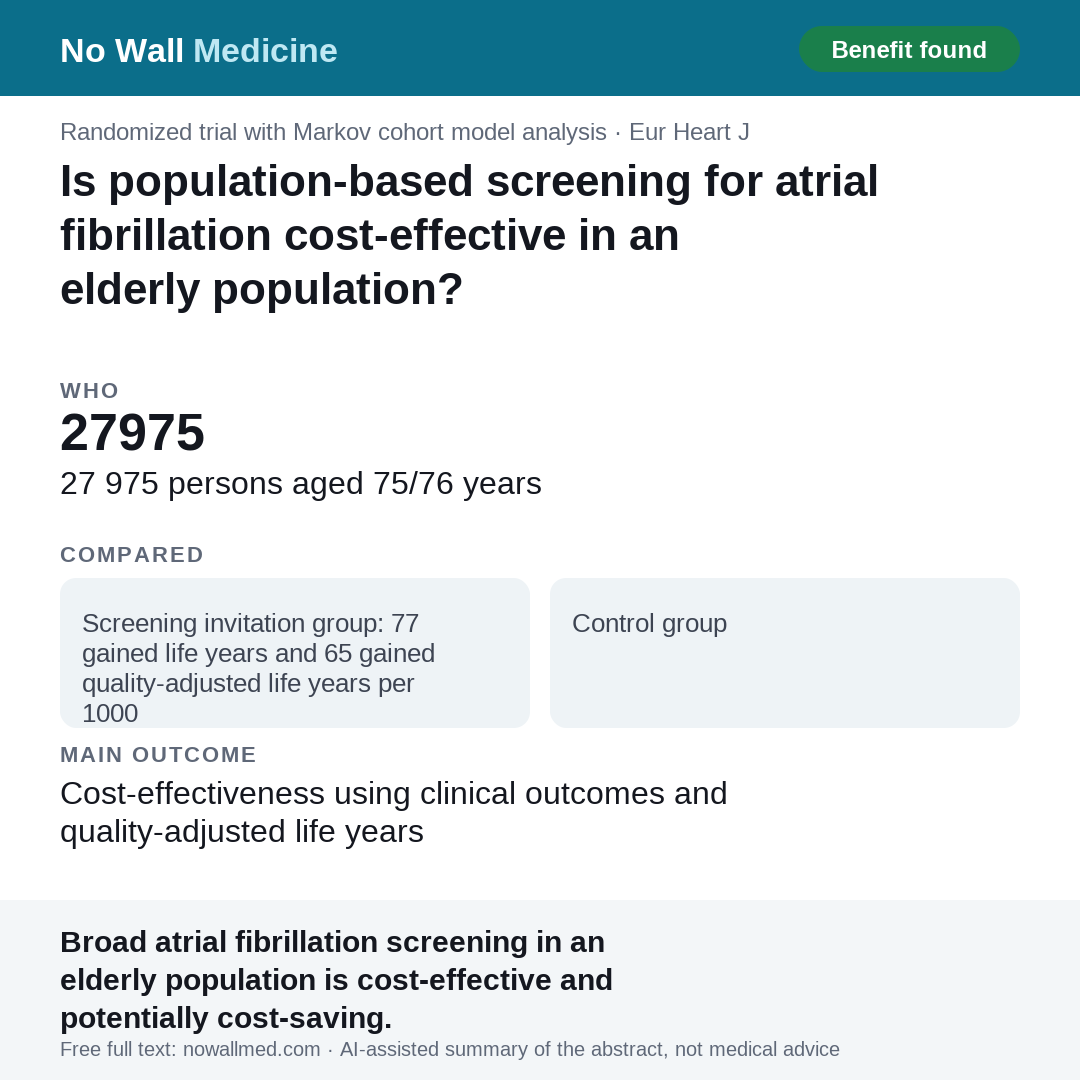
Is population-based screening for atrial fibrillation cost-effective in an elderly population?
Who
27975
27 975 persons aged 75/76 years
Compared
Screening invitation group: 77 gained life years and 65 gained quality-adjusted life years per 1000
Control group
Main outcome
Cost-effectiveness using clinical outcomes and quality-adjusted life years
Result: incremental cost was €1.77 million lower in the screening invitation group
Bottom line: Broad atrial fibrillation screening in an elderly population is cost-effective and potentially cost-saving.
Eur Heart J · 2022-11-10Download image
Clinical question: Is population-based screening for atrial fibrillation cost-effective in an elderly population?
Why it matters: Previous research on the cost-effectiveness of screening for atrial fibrillation relied on assumptions regarding long-term clinical effects rather than observed clinical outcomes.
Key points
- Researchers used a Markov cohort model based on a randomized trial of 27,975 people aged 75/76 years with a median follow-up of 6.9 years.
- Screening 1000 individuals resulted in 77 gained life years, 65 gained quality-adjusted life years, and an incremental cost that was €1.77 million lower.
- In the base-case scenario, screening 1000 people resulted in 10.6 fewer strokes, including 8.4 ischaemic and 2.2 haemorrhagic strokes.
Headline and key points written with AI from the paper’s abstract, with every number checked against it. Read the paper before relying on them.
Was this summary helpful?
Subject terms
Cite this article
Lyth J, Svennberg E, Bernfort L, et al. Cost-effectiveness of population screening for atrial fibrillation: the STROKESTOP study. Eur Heart J. 2022. doi:10.1093/eurheartj/ehac547
Spotted a mistake? Suggest a correction