Cost-effectiveness of population screening for atrial fibrillation: the STROKESTOP study
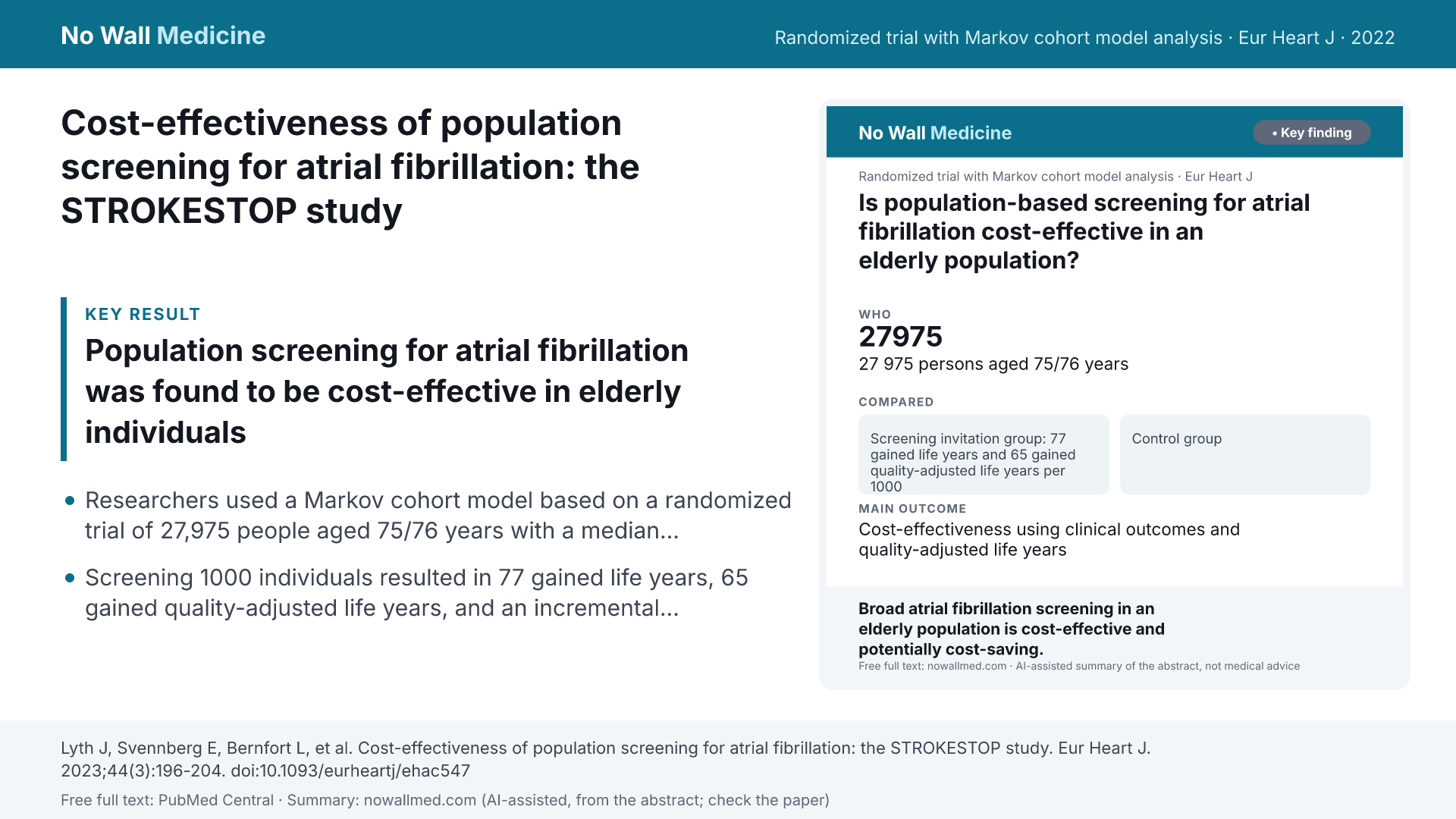
Key result: Population screening for atrial fibrillation was found to be cost-effective in elderly individuals
Randomized trial with Markov cohort model analysisKey finding
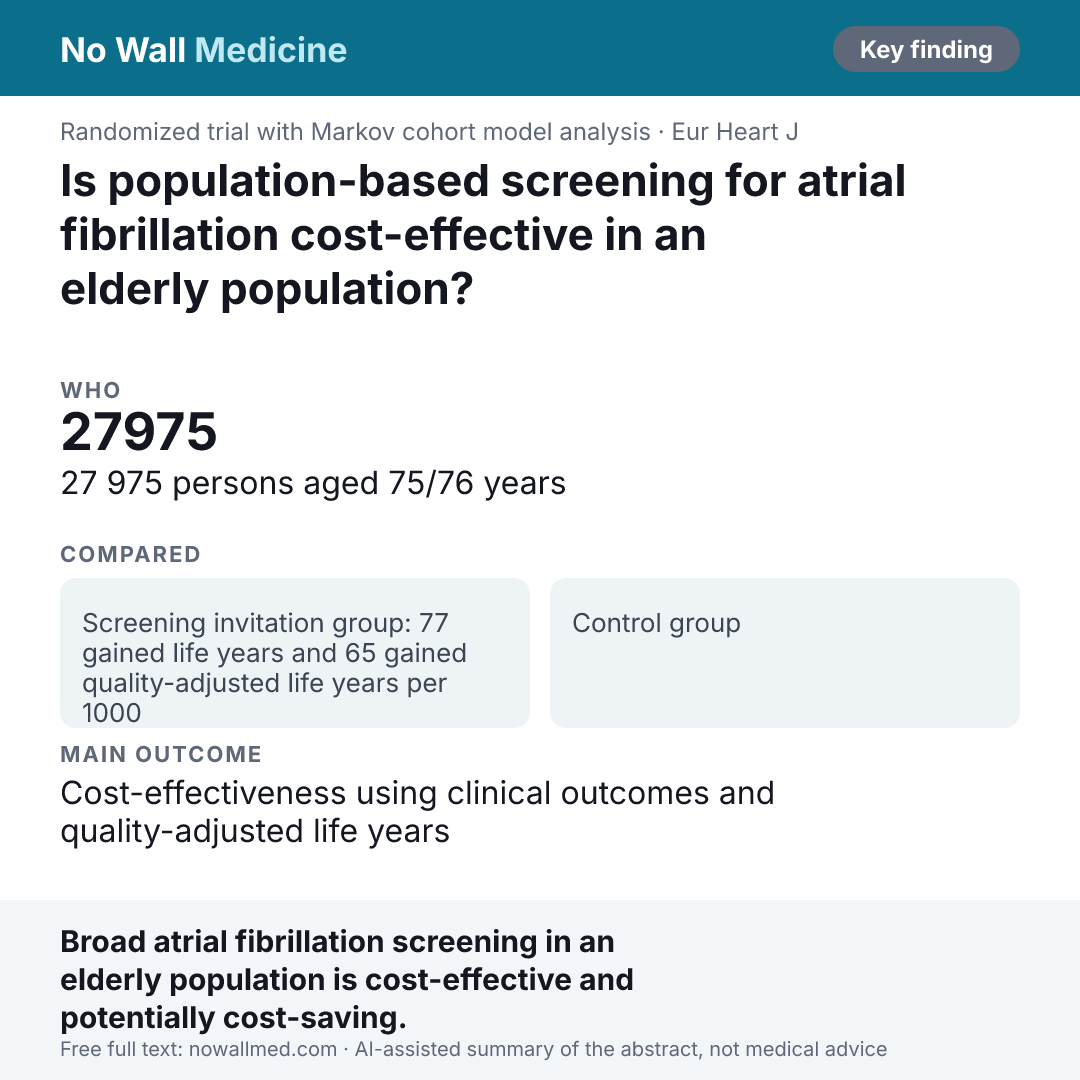
Is population-based screening for atrial fibrillation cost-effective in an elderly population?
Who
27975
27 975 persons aged 75/76 years
Compared
Screening invitation group: 77 gained life years and 65 gained quality-adjusted life years per 1000
Control group
Main outcome
Cost-effectiveness using clinical outcomes and quality-adjusted life years
Result: incremental cost was €1.77 million lower in the screening invitation group
Bottom line: Broad atrial fibrillation screening in an elderly population is cost-effective and potentially cost-saving.
Eur Heart J · 2022-11-10 · Save PNG
Key points
- Researchers used a Markov cohort model based on a randomized trial of 27,975 people aged 75/76 years with a median follow-up of 6.9 years.
- Screening 1000 individuals resulted in 77 gained life years, 65 gained quality-adjusted life years, and an incremental cost that was €1.77 million lower.
- In the base-case scenario, screening 1000 people resulted in 10.6 fewer strokes, including 8.4 ischaemic and 2.2 haemorrhagic strokes.
Discussion prompts
- Would these patients look like yours? Who was left out?
- Is the main outcome one that matters to patients?
- Is the difference large enough to change what you do?
Cite: Lyth J, Svennberg E, Bernfort L, et al. Cost-effectiveness of population screening for atrial fibrillation: the STROKESTOP study. Eur Heart J. 2023;44(3):196-204. doi:10.1093/eurheartj/ehac547
Free full text: PubMed Central · Summary and visual abstract: nowallmed.com/a/cost-effectiveness-of-population-screening-for-atrial-fibrillation-1py3h4/ (AI-assisted from the abstract; check the paper before relying on it).