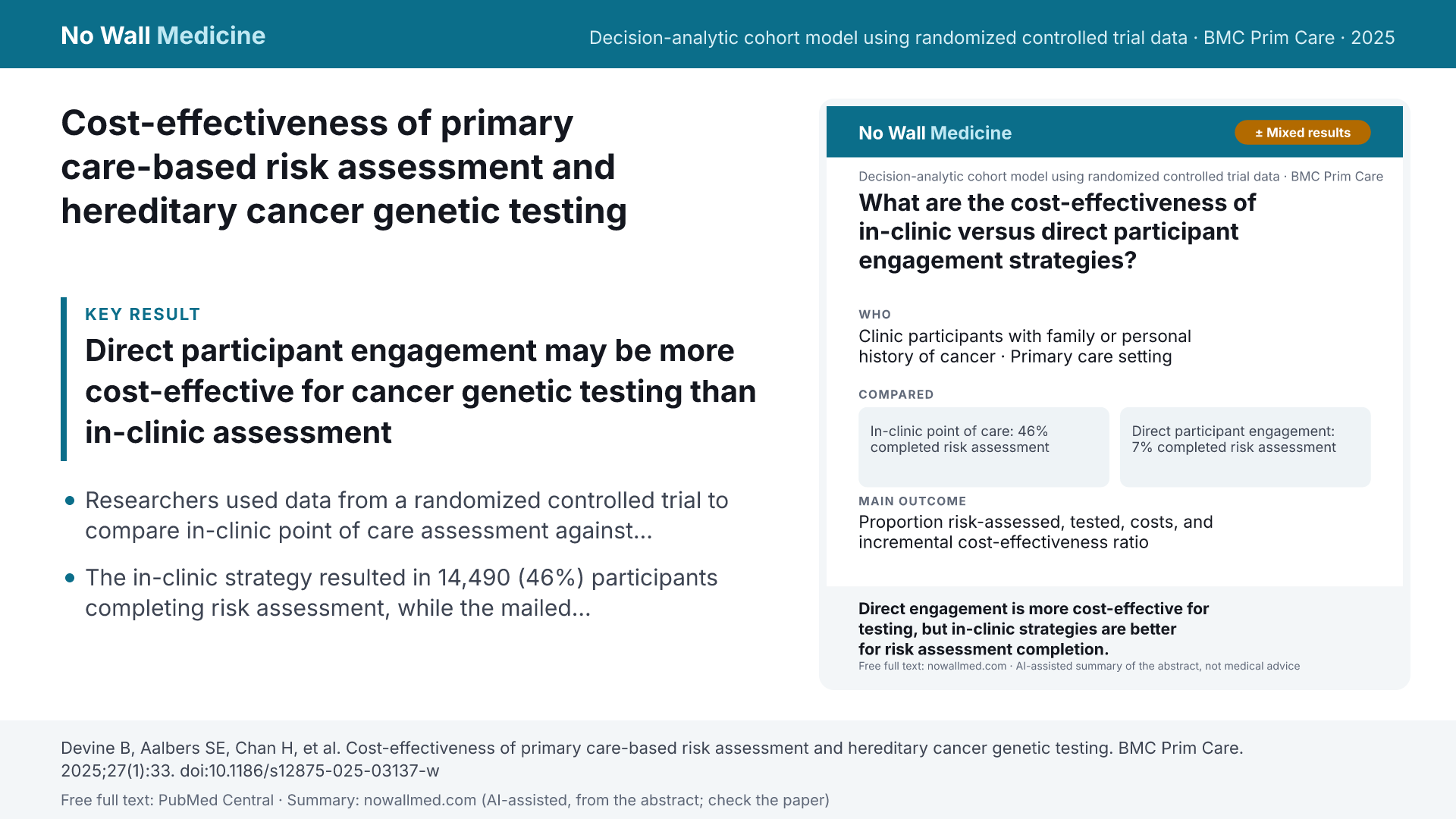
Direct participant engagement may be more cost-effective for cancer genetic testing than in-clinic assessment
Cost-effectiveness of primary care-based risk assessment and hereditary cancer genetic testing
Decision-analytic cohort model using randomized controlled trial dataMixed results
What are the cost-effectiveness of in-clinic versus direct participant engagement strategies?
Who
Clinic participants with family or personal history of cancer · Primary care setting
Compared
In-clinic point of care: 46% completed risk assessment
Direct participant engagement: 7% completed risk assessment
Main outcome
Proportion risk-assessed, tested, costs, and incremental cost-effectiveness ratio
Result: ICER $152 (health-system) and $136 (limited societal) in favor of DPE
Bottom line: Direct engagement is more cost-effective for testing, but in-clinic strategies are better for risk assessment completion.
Limitation: Substantial uncertainty in results
BMC Prim Care · 2025-12-22Download image
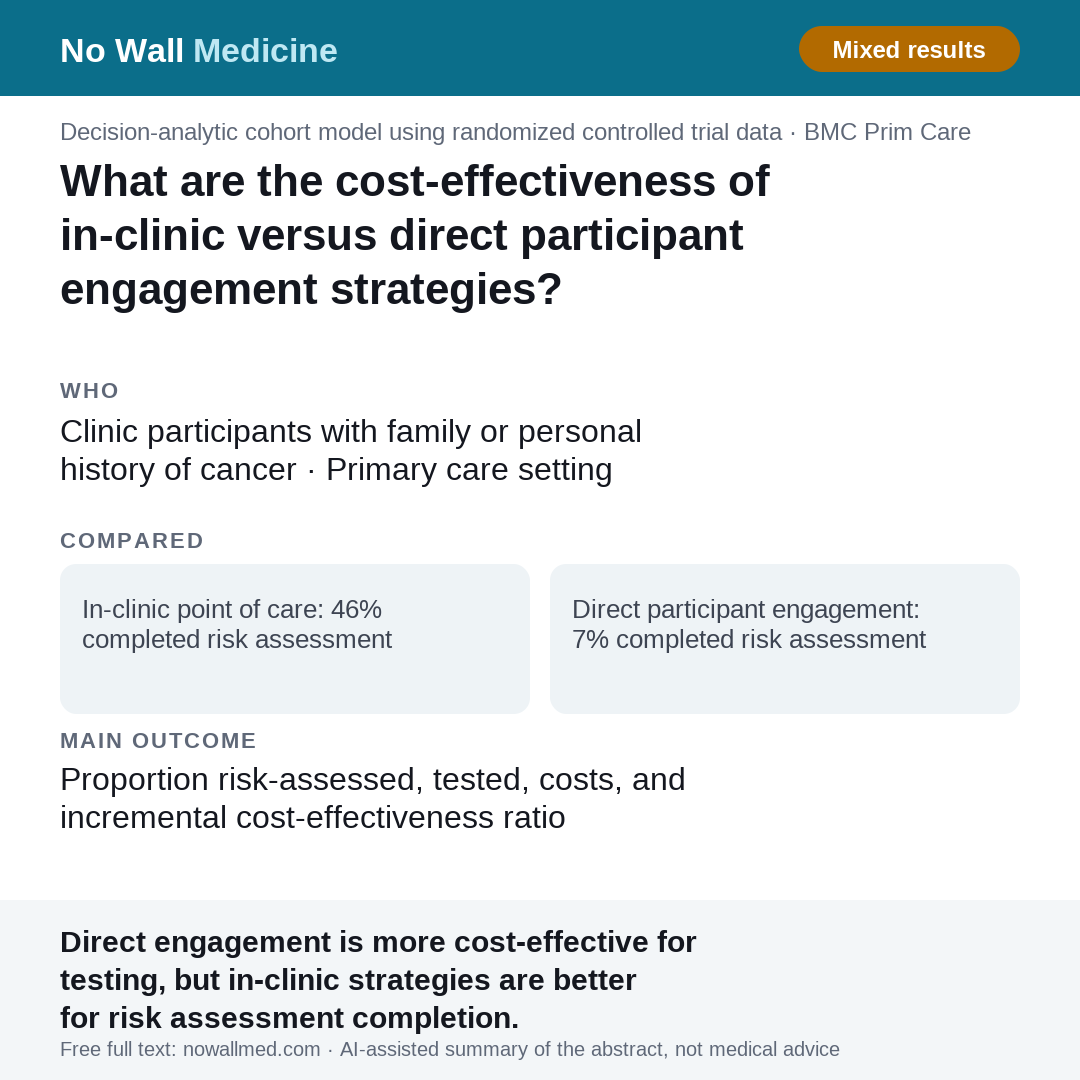
Clinical question: What are the cost-effectiveness of in-clinic versus direct participant engagement strategies?
Why it matters: Risk assessment and genetic testing for cancer remain underutilized in primary care settings and the optimal strategy for engaging individuals is unknown.
Key points
- Researchers used data from a randomized controlled trial to compare in-clinic point of care assessment against direct participant engagement via mailed invitations for 100,000 participants.
- The in-clinic strategy resulted in 14,490 (46%) participants completing risk assessment, while the mailed invitation strategy resulted in 6,385 (7%) participants completing assessment.
- The mailed invitation strategy led to more individuals completing genetic testing, with 1,184 (77%) compared to 780 (73%) in the in-clinic group.
Headline and key points written with AI from the paper’s abstract, with every number checked against it. Read the paper before relying on them.
Was this summary helpful?
Subject terms
Cite this article
Devine B, Aalbers SE, Chan H, et al. Cost-effectiveness of primary care-based risk assessment and hereditary cancer genetic testing. BMC Prim Care. 2025. doi:10.1186/s12875-025-03137-w
Spotted a mistake? Suggest a correction