Cost-effectiveness of primary care-based risk assessment and hereditary cancer genetic testing
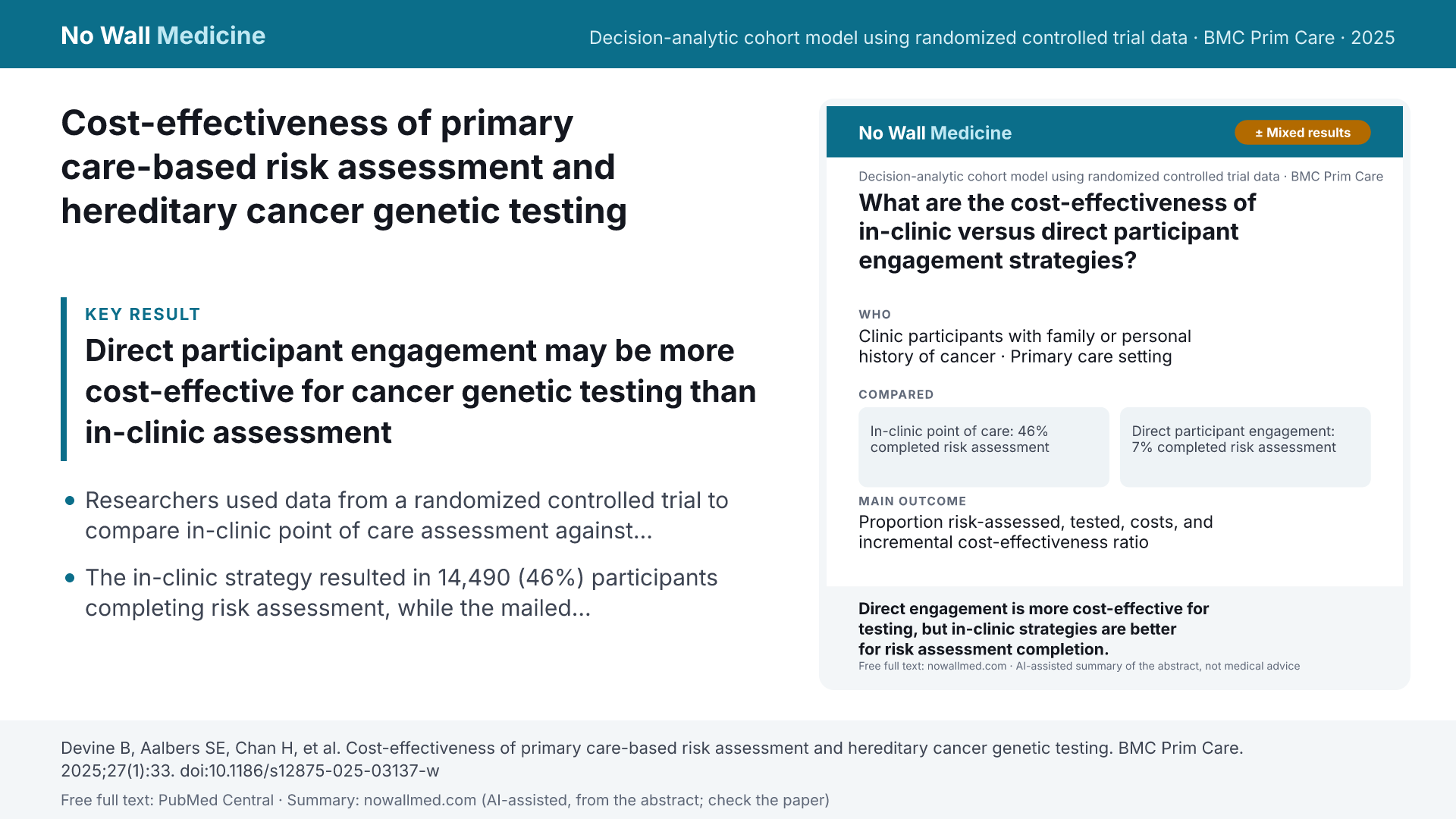
Key result: Direct participant engagement may be more cost-effective for cancer genetic testing than in-clinic assessment
Decision-analytic cohort model using randomized controlled trial dataMixed results
What are the cost-effectiveness of in-clinic versus direct participant engagement strategies?
Who
Clinic participants with family or personal history of cancer · Primary care setting
Compared
In-clinic point of care: 46% completed risk assessment
Direct participant engagement: 7% completed risk assessment
Main outcome
Proportion risk-assessed, tested, costs, and incremental cost-effectiveness ratio
Result: ICER $152 (health-system) and $136 (limited societal) in favor of DPE
Bottom line: Direct engagement is more cost-effective for testing, but in-clinic strategies are better for risk assessment completion.
Limitation: Substantial uncertainty in results
BMC Prim Care · 2025-12-22
Key points
- Researchers used data from a randomized controlled trial to compare in-clinic point of care assessment against direct participant engagement via mailed invitations for 100,000 participants.
- The in-clinic strategy resulted in 14,490 (46%) participants completing risk assessment, while the mailed invitation strategy resulted in 6,385 (7%) participants completing assessment.
- The mailed invitation strategy led to more individuals completing genetic testing, with 1,184 (77%) compared to 780 (73%) in the in-clinic group.
Discussion prompts
- Would these patients look like yours? Who was left out?
- Is the main outcome one that matters to patients?
- Is the difference large enough to change what you do?
Cite: Devine B, Aalbers SE, Chan H, et al. Cost-effectiveness of primary care-based risk assessment and hereditary cancer genetic testing. BMC Prim Care. 2025;27(1):33. doi:10.1186/s12875-025-03137-w
Free full text: PubMed Central · Summary and visual abstract: nowallmed.com/a/cost-effectiveness-of-primary-care-based-risk-assessment-and-19mxy16/ (AI-assisted from the abstract; check the paper before relying on it).