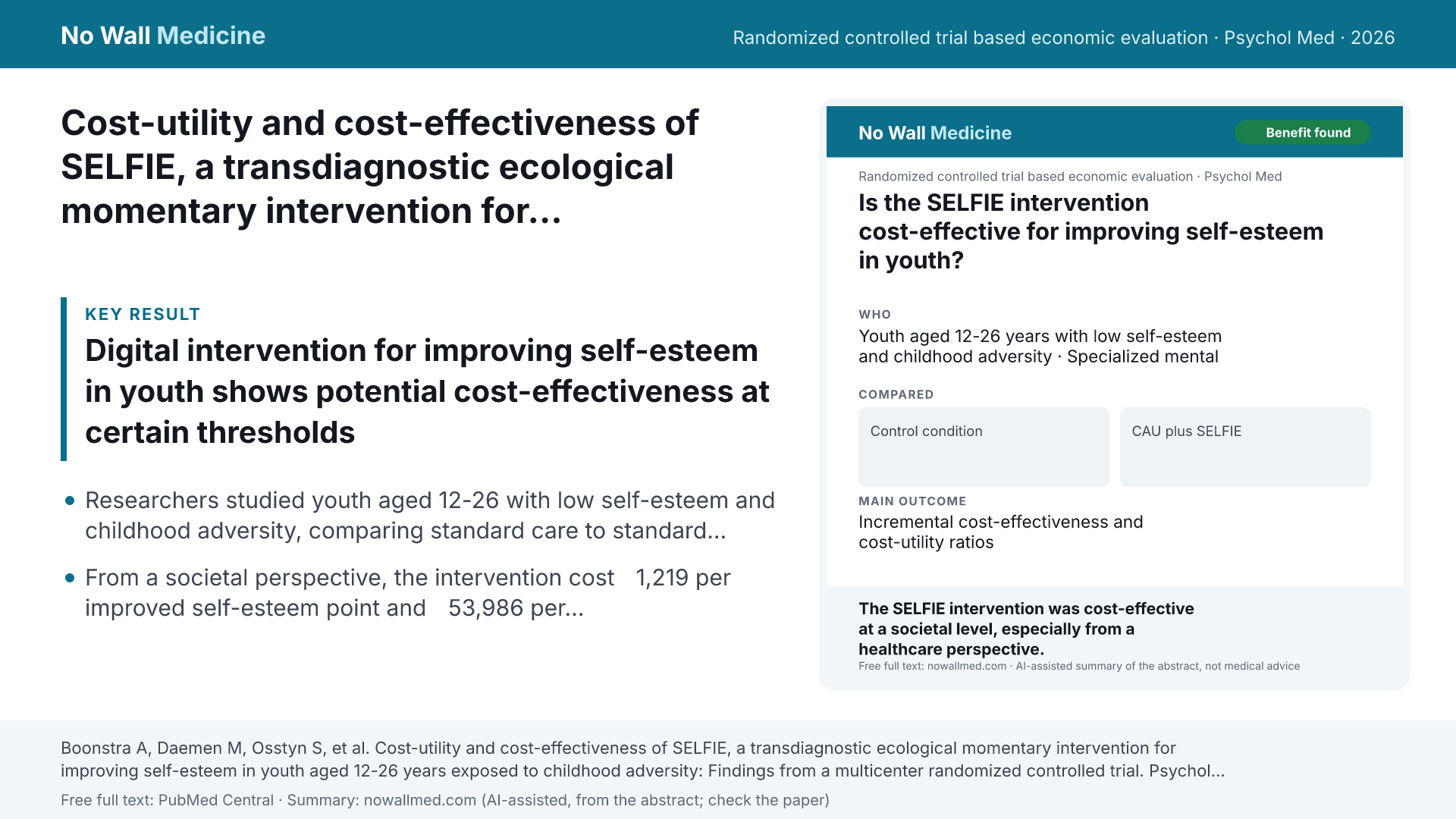
Digital intervention for improving self-esteem in youth shows potential cost-effectiveness at certain thresholds
Cost-utility and cost-effectiveness of SELFIE, a transdiagnostic ecological momentary intervention for improving self-esteem in youth aged 12-26 years exposed to childhood adversity: Findings from a multicenter randomized controlled trial
Randomized controlled trial based economic evaluationBenefit found
Is the SELFIE intervention cost-effective for improving self-esteem in youth?
Who
Youth aged 12-26 years with low self-esteem and childhood adversity · Specialized mental health services and general population
Compared
Control condition
CAU plus SELFIE
Main outcome
Incremental cost-effectiveness and cost-utility ratios
Result: ICUR €53,986 per QALY gained
Bottom line: The SELFIE intervention was cost-effective at a societal level, especially from a healthcare perspective.
Psychol Med · 2026-04-13 · Save PNG
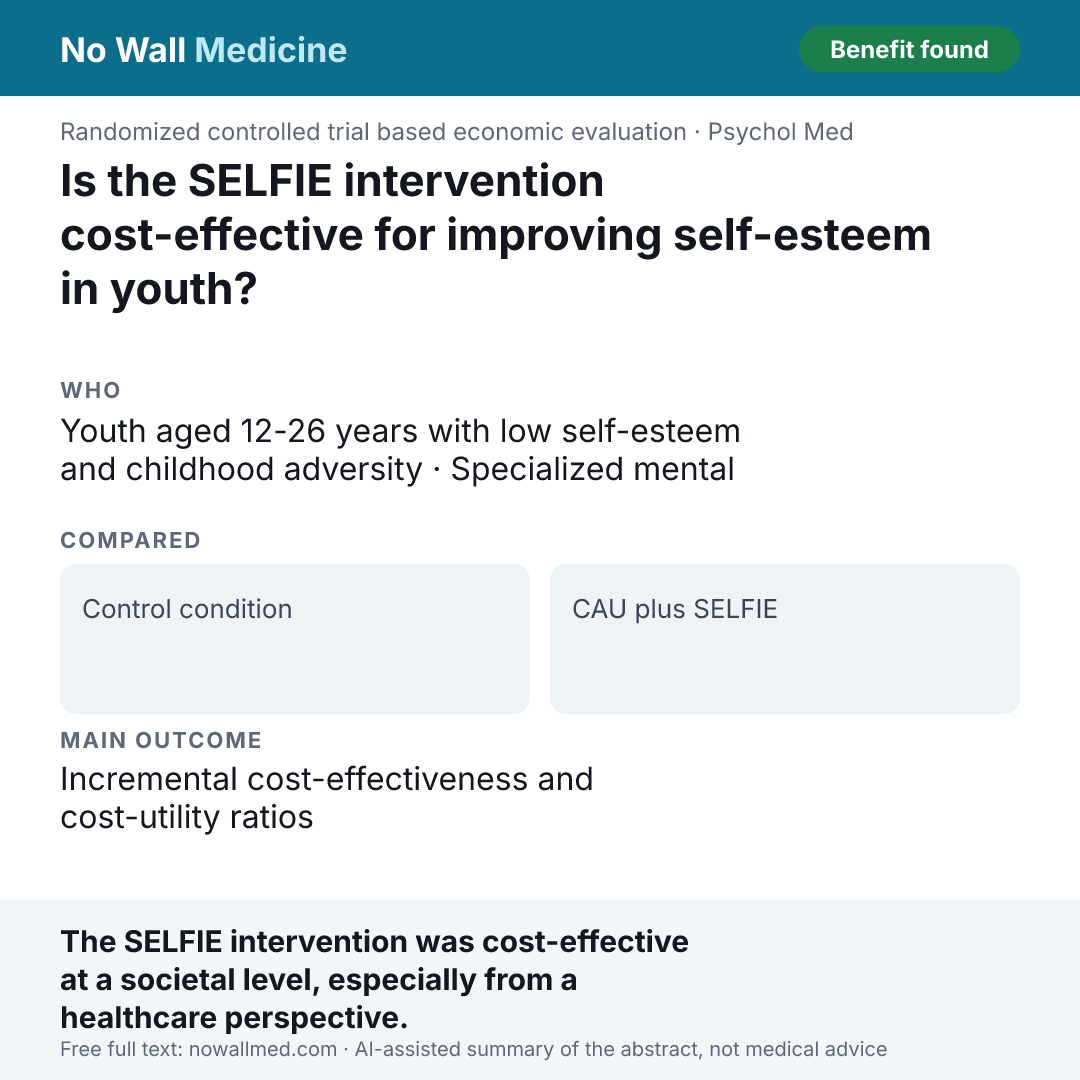
Clinical question: Is the SELFIE intervention cost-effective for improving self-esteem in youth?
Why it matters: Evidence regarding the cost-effectiveness of the SELFIE intervention and ecological momentary interventions, which are real-time digital supports, is currently lacking.
Key points
- Researchers studied youth aged 12-26 with low self-esteem and childhood adversity, comparing standard care to standard care plus the SELFIE digital intervention.
- From a societal perspective, the intervention cost €1,219 per improved self-esteem point and €53,986 per quality-adjusted life year gained.
- The probability of cost-effectiveness was 49% at a €50,000 per quality-adjusted life year threshold and 77% from a healthcare perspective.
Headline and key points written with AI from the paper’s abstract, with every number checked against it. Read the paper before relying on them.
Was this summary helpful?
Subject terms
Headline, design, result, key points, caveat and citation as plain text.
Cite this article
Boonstra A, Daemen M, Osstyn S, et al. Cost-utility and cost-effectiveness of SELFIE, a transdiagnostic ecological momentary intervention for improving self-esteem in youth aged 12-26 years exposed to childhood adversity: Findings from a multicenter randomized controlled trial. Psychol Med. 2026;56:e103. doi:10.1017/S003329172610395X
Spotted a mistake? Suggest a correction