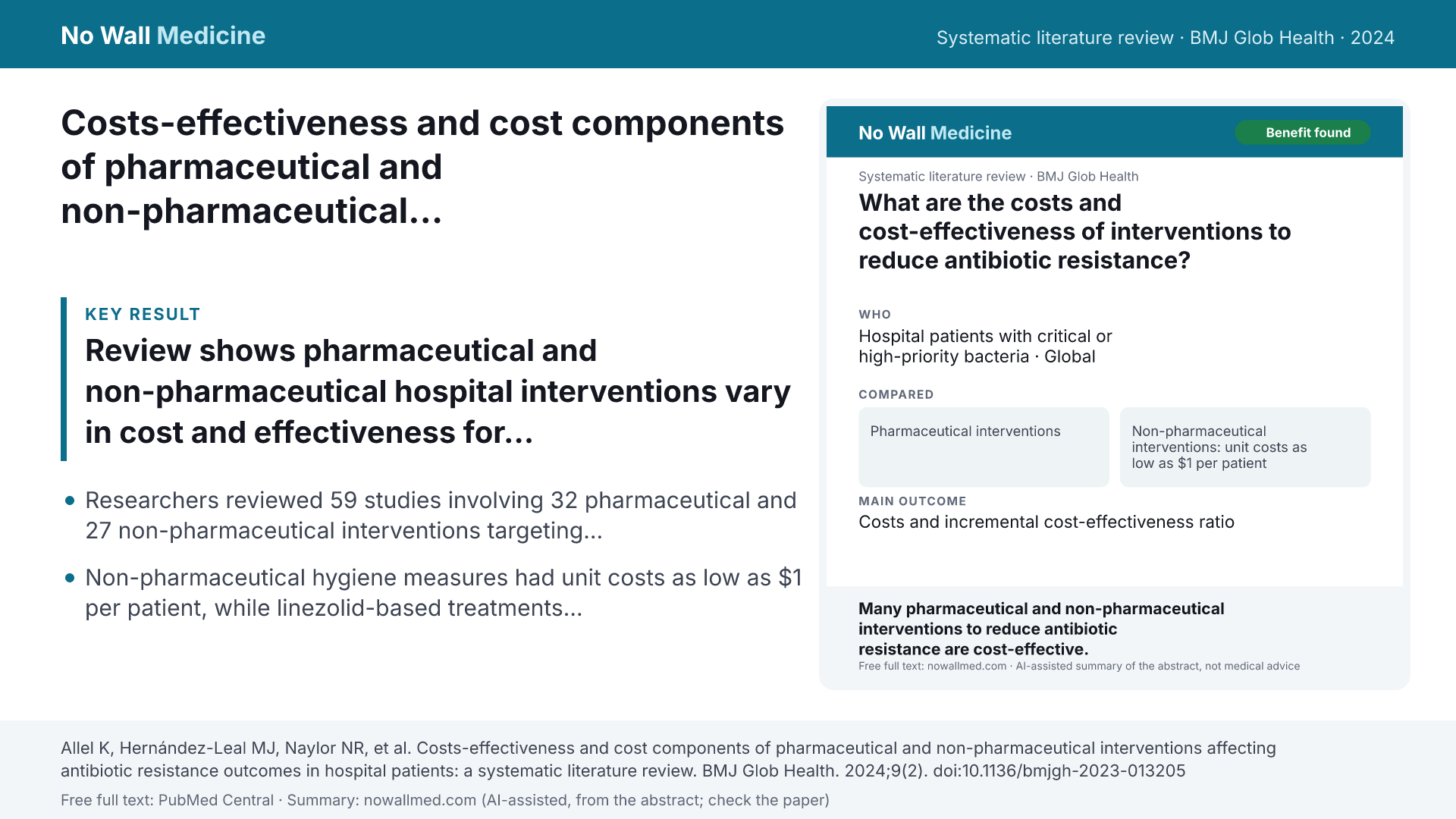
Review shows pharmaceutical and non-pharmaceutical hospital interventions vary in cost and effectiveness for antibiotic resistance
Costs-effectiveness and cost components of pharmaceutical and non-pharmaceutical interventions affecting antibiotic resistance outcomes in hospital patients: a systematic literature review
Systematic literature reviewBenefit found
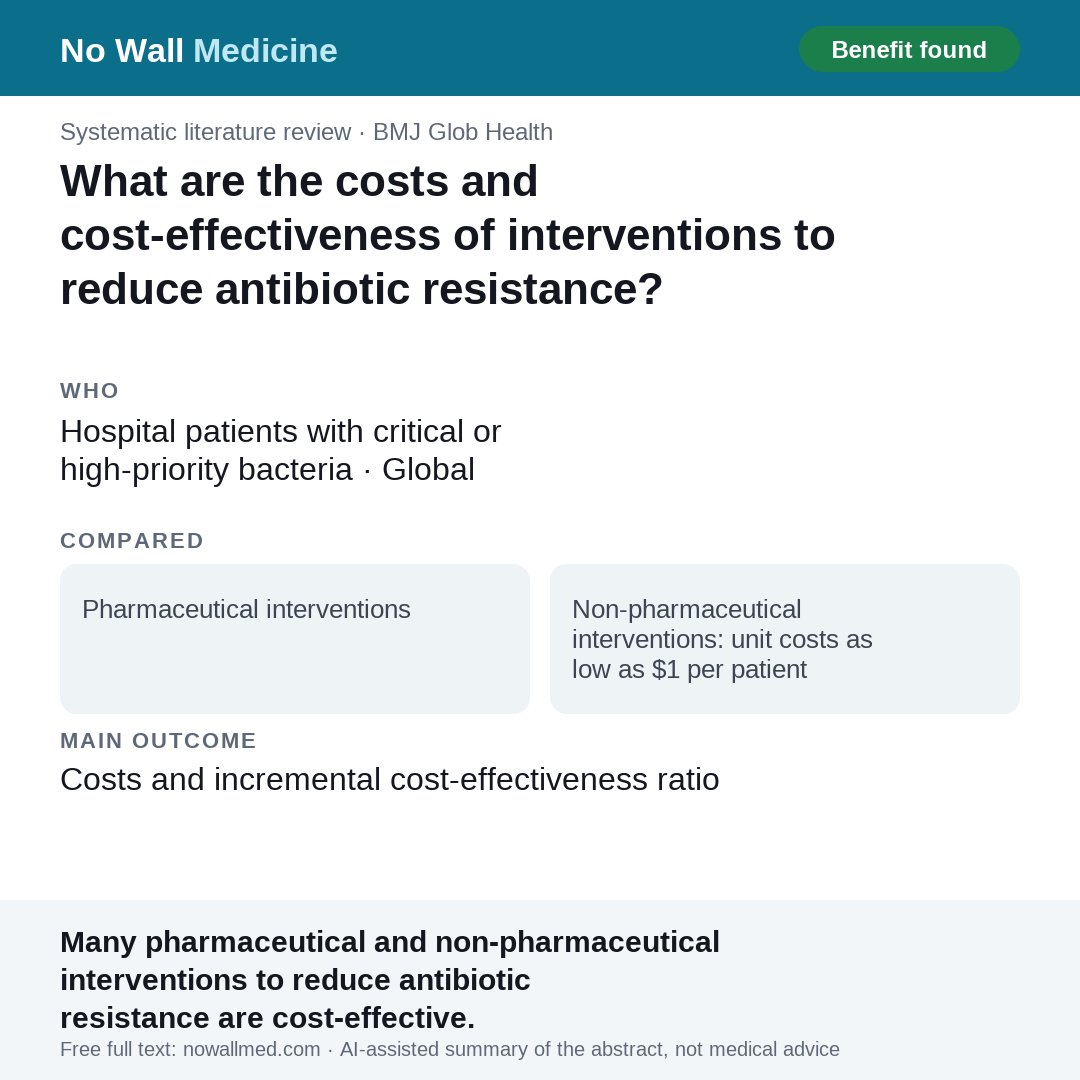
What are the costs and cost-effectiveness of interventions to reduce antibiotic resistance?
Who
Hospital patients with critical or high-priority bacteria · Global
Compared
Pharmaceutical interventions
Non-pharmaceutical interventions: unit costs as low as $1 per patient
Main outcome
Costs and incremental cost-effectiveness ratio
Bottom line: Many pharmaceutical and non-pharmaceutical interventions to reduce antibiotic resistance are cost-effective.
Limitation: Comparisons were hindered by within-study differences and knowledge gaps in low-income and middle-income countries.
BMJ Glob Health · 2024-02-29Download image
Clinical question: What are the costs and cost-effectiveness of interventions to reduce antibiotic resistance?
Why it matters: Limited information on the costs and cost-effectiveness of hospital interventions hinders efficient resource allocation for reducing antibiotic resistance.
Key points
- Researchers reviewed 59 studies involving 32 pharmaceutical and 27 non-pharmaceutical interventions targeting high-priority bacteria in hospital patients.
- Non-pharmaceutical hygiene measures had unit costs as low as $1 per patient, while linezolid-based treatments for methicillin-resistant Staphylococcus aureus showed an incremental cost-effectiveness ratio up to $21,488 per treatment success.
- Infection control measures like hand hygiene and gown usage were found to be highly cost-effective, with an incremental cost-effectiveness ratio of $1160 per quality-adjusted life year.
Limitation the authors note: Comparisons between studies were hindered by within-study differences.
Headline and key points written with AI from the paper’s abstract, with every number checked against it. Read the paper before relying on them.
Was this summary helpful?
Abstract
Introduction
Limited information on costs and the cost-effectiveness of hospital interventions to reduce antibiotic resistance (ABR) hinder efficient resource allocation. Methods
We conducted a systematic literature review for studies evaluating the costs and cost-effectiveness of pharmaceutical and non-pharmaceutical interventions aimed at reducing, monitoring and controlling ABR in patients. Articles published until 12 December 2023 were explored using EconLit, EMBASE and PubMed. We focused on critical or high-priority bacteria, as defined by the WHO, and intervention costs and incremental cost-effectiveness ratio (ICER). Following Preferred Reporting Items for Systematic review and Meta-Analysis guidelines, we extracted unit costs, ICERs and essential study information including country, intervention, bacteria-drug combination, discount rates, type of model and outcomes. Costs were reported in 2022 US dollars ($), adopting the healthcare system perspective. Country willingness-to-pay (WTP) thresholds from Woods et al 2016 guided cost-effectiveness assessments. We assessed the studies reporting checklist using Drummond's method. Results
Among 20 958 articles, 59 (32 pharmaceutical and 27 non-pharmaceutical interventions) met the inclusion criteria. Non-pharmaceutical interventions, such as hygiene measures, had unit costs as low as $1 per patient, contrasting with generally higher pharmaceutical intervention costs. Several studies found that linezolid-based treatments for methicillin-resistant Staphylococcus aureus were cost-effective compared with vancomycin (ICER up to $21 488 per treatment success, all 16 studies' ICERs<WTP). Infection control measures such as hand hygiene and gown usage (ICER=$1160/QALY or $4949 per ABR case averted, all ICERs<WTP) and PCR or chromogenic agar screening for ABR detection were highly cost-effective (eg, ICER=$1206 and $1115 per life-year saved in Europe and the USA). Comparisons were hindered by within-study differences. Conclusion
Robust information on ABR interventions is critical for efficient resource allocation. We highlight cost-effective strategies for mitigating ABR in hospitals, emphasising substantial knowledge gaps, especially in low-income and middle-income countries. Our study serves as a resource for guiding future cost-effectiveness study design and analyses.PROSPERO registration number CRD42020341827 and CRD42022340064.
Abstract reproduced under the article’s CC BY licence.
Subject terms
Cite this article
Allel K, Hernández-Leal MJ, Naylor NR, et al. Costs-effectiveness and cost components of pharmaceutical and non-pharmaceutical interventions affecting antibiotic resistance outcomes in hospital patients: a systematic literature review. BMJ Glob Health. 2024. doi:10.1136/bmjgh-2023-013205
Spotted a mistake? Suggest a correction