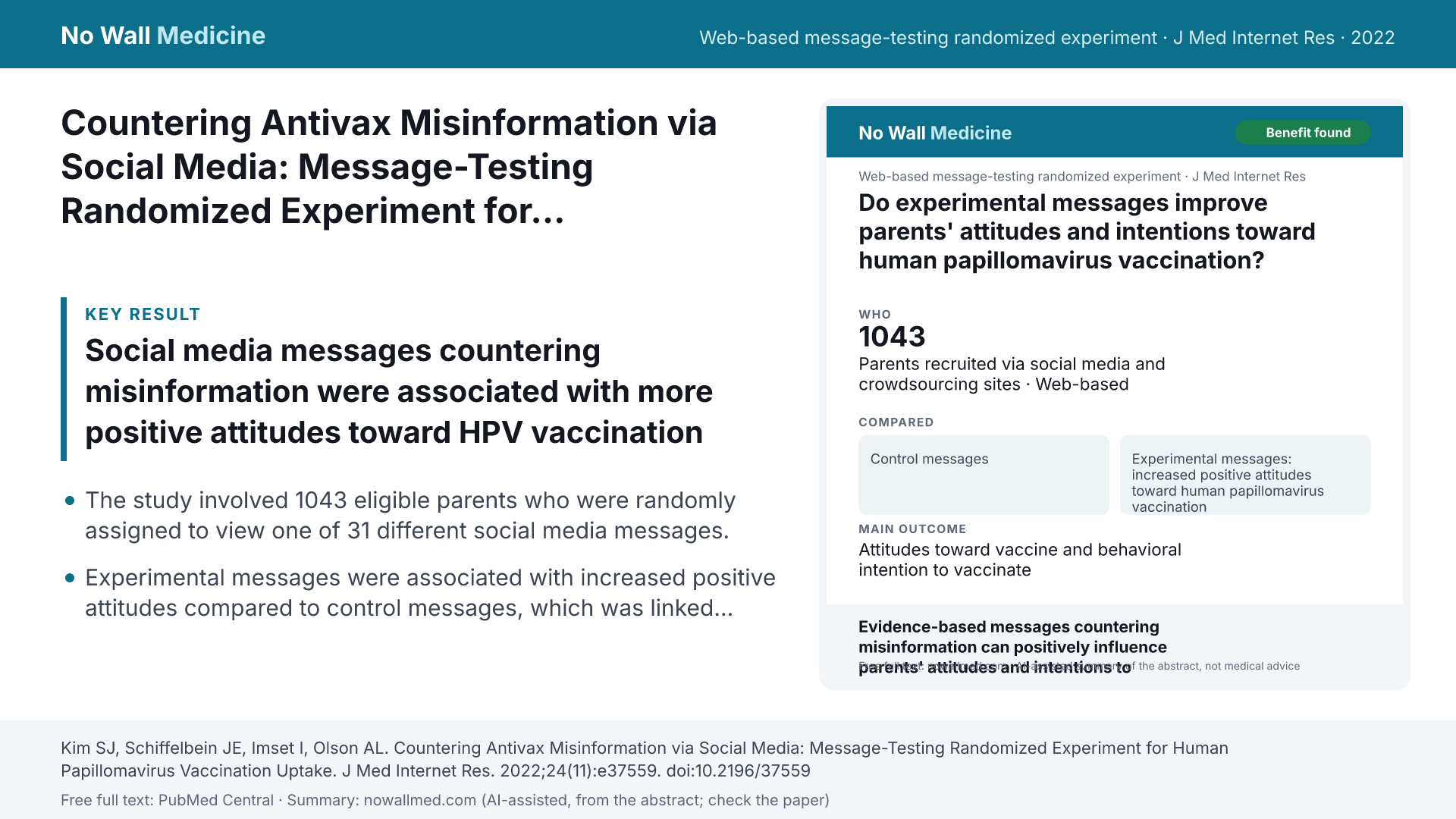
Social media messages countering misinformation were associated with more positive attitudes toward HPV vaccination
Countering Antivax Misinformation via Social Media: Message-Testing Randomized Experiment for Human Papillomavirus Vaccination Uptake
Web-based message-testing randomized experimentBenefit found
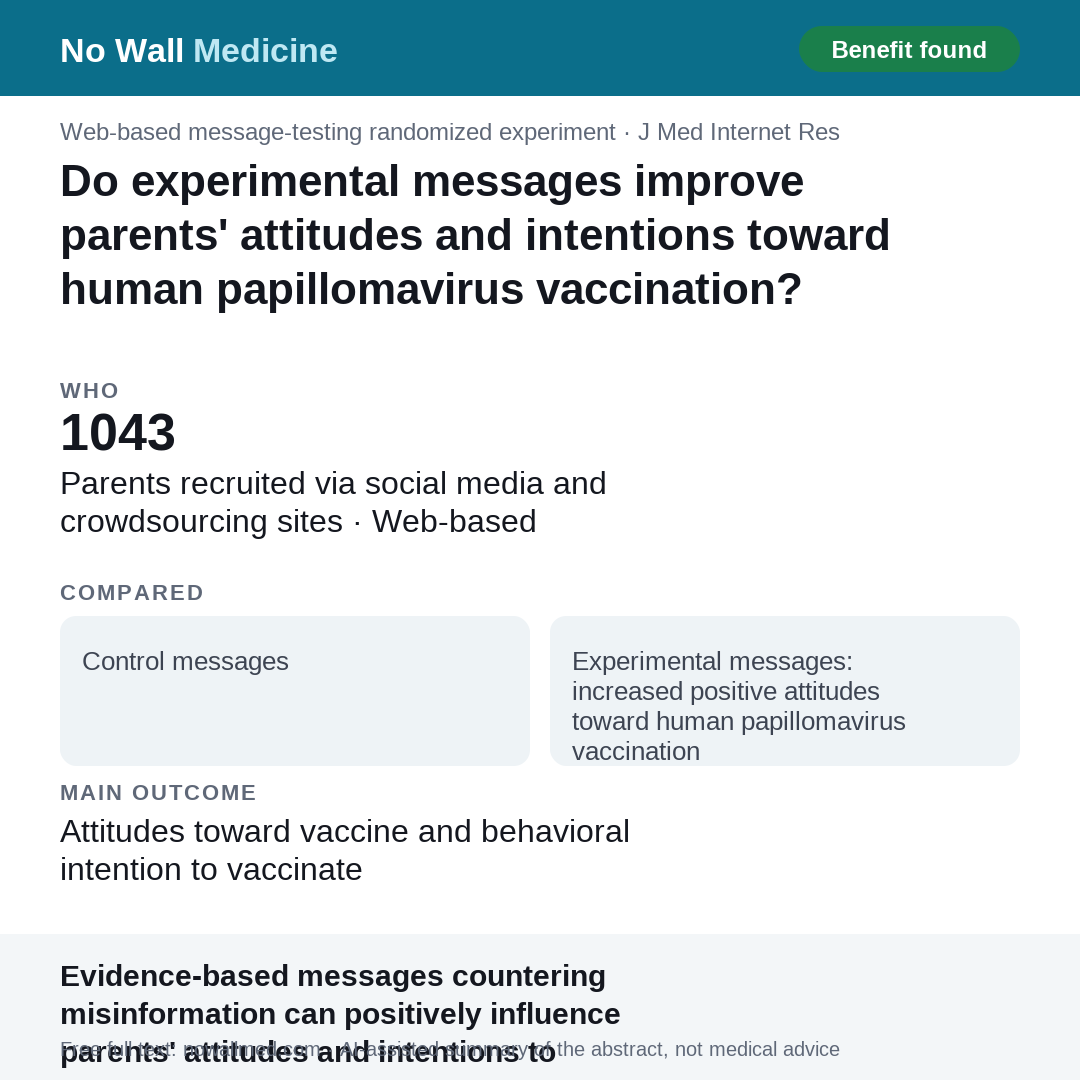
Do experimental messages improve parents' attitudes and intentions toward human papillomavirus vaccination?
Who
1043
Parents recruited via social media and crowdsourcing sites · Web-based
Compared
Control messages
Experimental messages: increased positive attitudes toward human papillomavirus vaccination
Main outcome
Attitudes toward vaccine and behavioral intention to vaccinate
Bottom line: Evidence-based messages countering misinformation can positively influence parents' attitudes and intentions to vaccinate children against human papillomavirus.
J Med Internet Res · 2022-11-24Download image
Clinical question: Do experimental messages improve parents' attitudes and intentions toward human papillomavirus vaccination?
Why it matters: It was unknown which specific types of social media messages could effectively change parental attitudes and intentions regarding human papillomavirus vaccination.
Key points
- The study involved 1043 eligible parents who were randomly assigned to view one of 31 different social media messages.
- Experimental messages were associated with increased positive attitudes compared to control messages, which was linked to increased intention to vaccinate among 189 parents of unvaccinated children.
- Messages providing scientific evidence from government sources and those correcting misinformation were effective in forming positive perceptions.
Headline and key points written with AI from the paper’s abstract, with every number checked against it. Read the paper before relying on them.
Was this summary helpful?
Subject terms
Cite this article
Kim SJ, Schiffelbein JE, Imset I, Olson AL. Countering Antivax Misinformation via Social Media: Message-Testing Randomized Experiment for Human Papillomavirus Vaccination Uptake. J Med Internet Res. 2022. doi:10.2196/37559
Spotted a mistake? Suggest a correction
Top studies every Monday
The week’s key trials and guidelines in your specialties, plus any topics you follow. By email, free.
Get the weekly digest