Countering Antivax Misinformation via Social Media: Message-Testing Randomized Experiment for Human Papillomavirus Vaccination Uptake
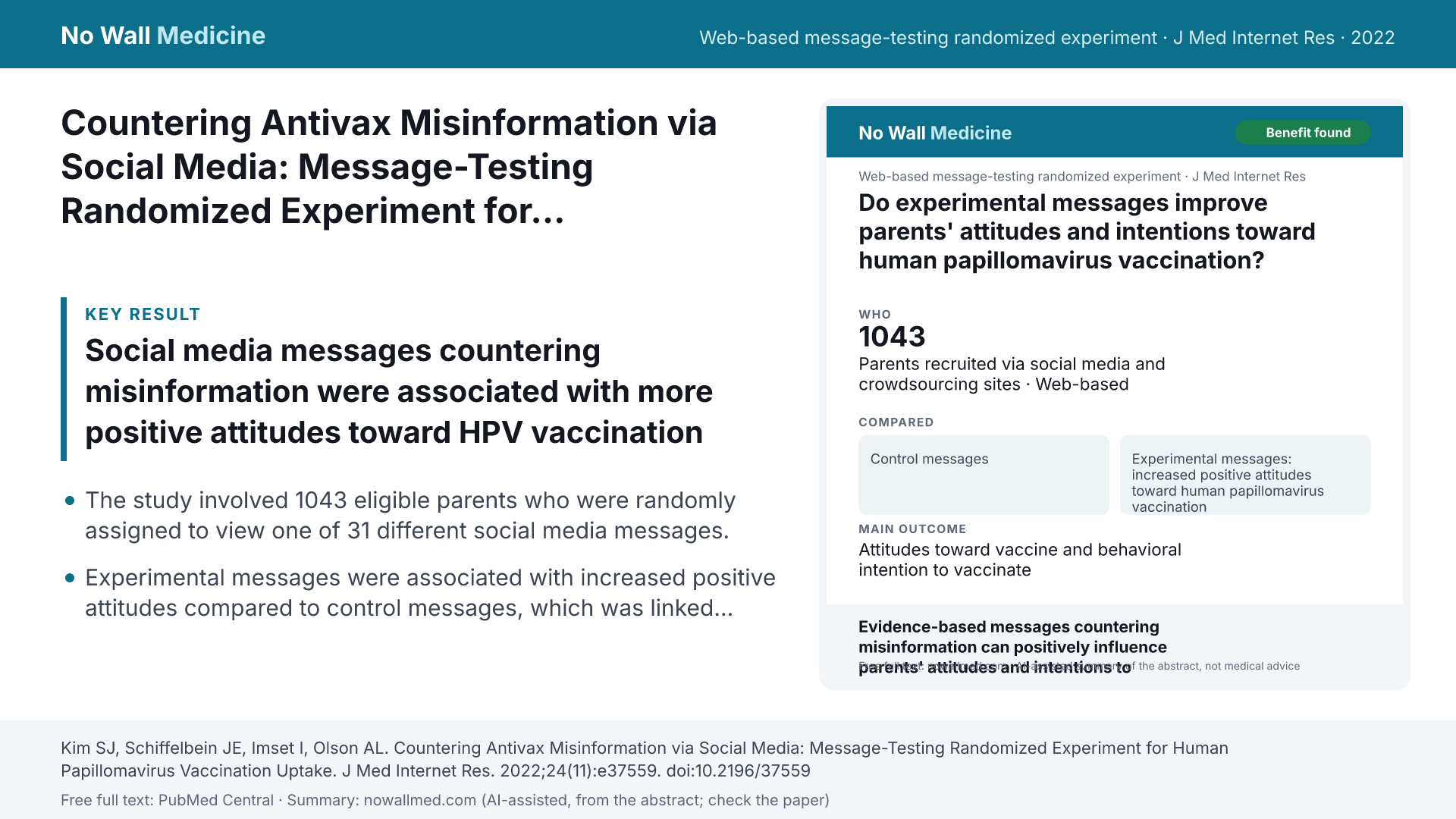
Key result: Social media messages countering misinformation were associated with more positive attitudes toward HPV vaccination
Web-based message-testing randomized experimentBenefit found
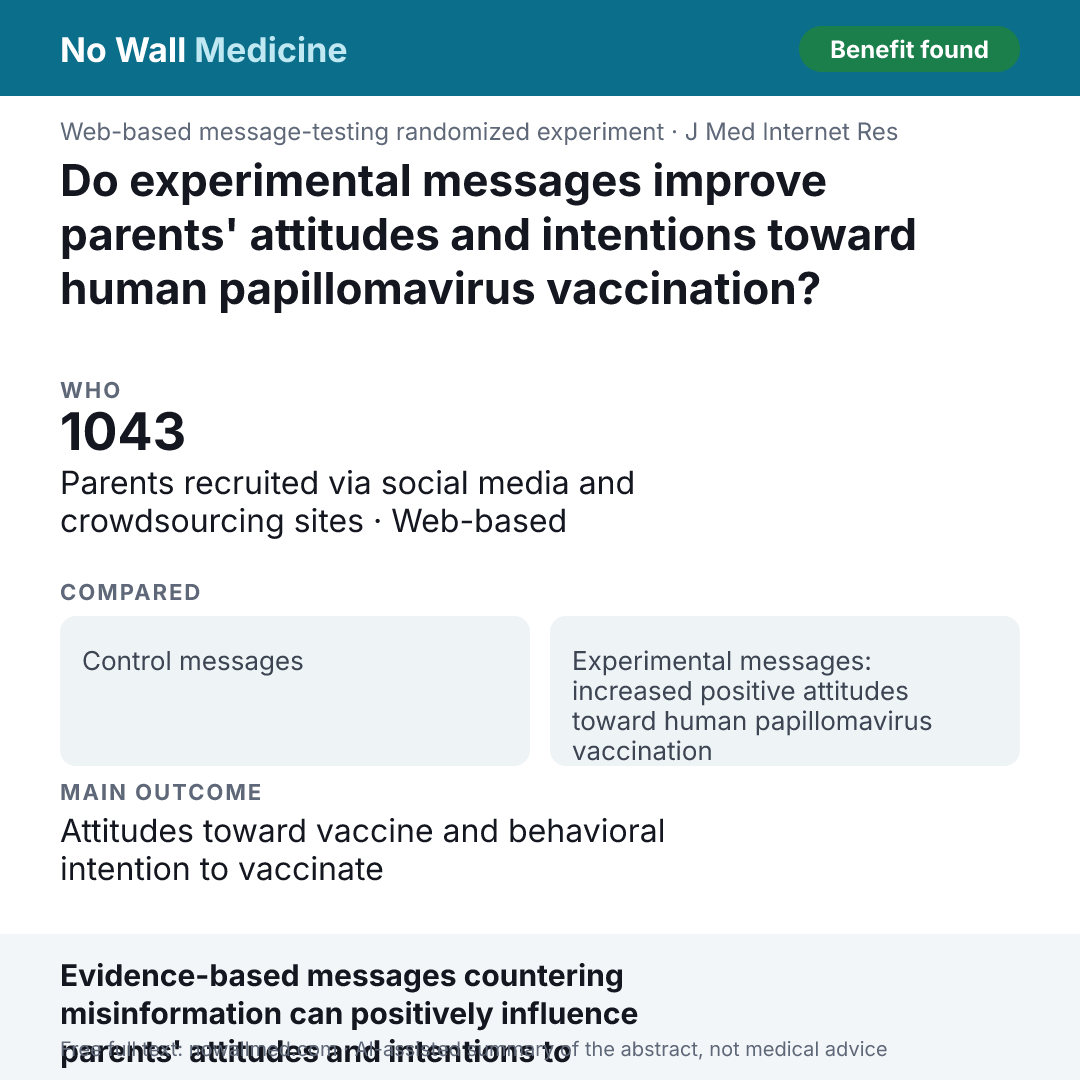
Do experimental messages improve parents' attitudes and intentions toward human papillomavirus vaccination?
Who
1043
Parents recruited via social media and crowdsourcing sites · Web-based
Compared
Control messages
Experimental messages: increased positive attitudes toward human papillomavirus vaccination
Main outcome
Attitudes toward vaccine and behavioral intention to vaccinate
Bottom line: Evidence-based messages countering misinformation can positively influence parents' attitudes and intentions to vaccinate children against human papillomavirus.
J Med Internet Res · 2022-11-24 · Save PNG
Key points
- The study involved 1043 eligible parents who were randomly assigned to view one of 31 different social media messages.
- Experimental messages were associated with increased positive attitudes compared to control messages, which was linked to increased intention to vaccinate among 189 parents of unvaccinated children.
- Messages providing scientific evidence from government sources and those correcting misinformation were effective in forming positive perceptions.
Discussion prompts
- Would these patients look like yours? Who was left out?
- Is the main outcome one that matters to patients?
- Is the difference large enough to change what you do?
Cite: Kim SJ, Schiffelbein JE, Imset I, Olson AL. Countering Antivax Misinformation via Social Media: Message-Testing Randomized Experiment for Human Papillomavirus Vaccination Uptake. J Med Internet Res. 2022;24(11):e37559. doi:10.2196/37559
Free full text: PubMed Central · Summary and visual abstract: nowallmed.com/a/countering-antivax-misinformation-via-social-media-message-testing-1f0oqzg/ (AI-assisted from the abstract; check the paper before relying on it).