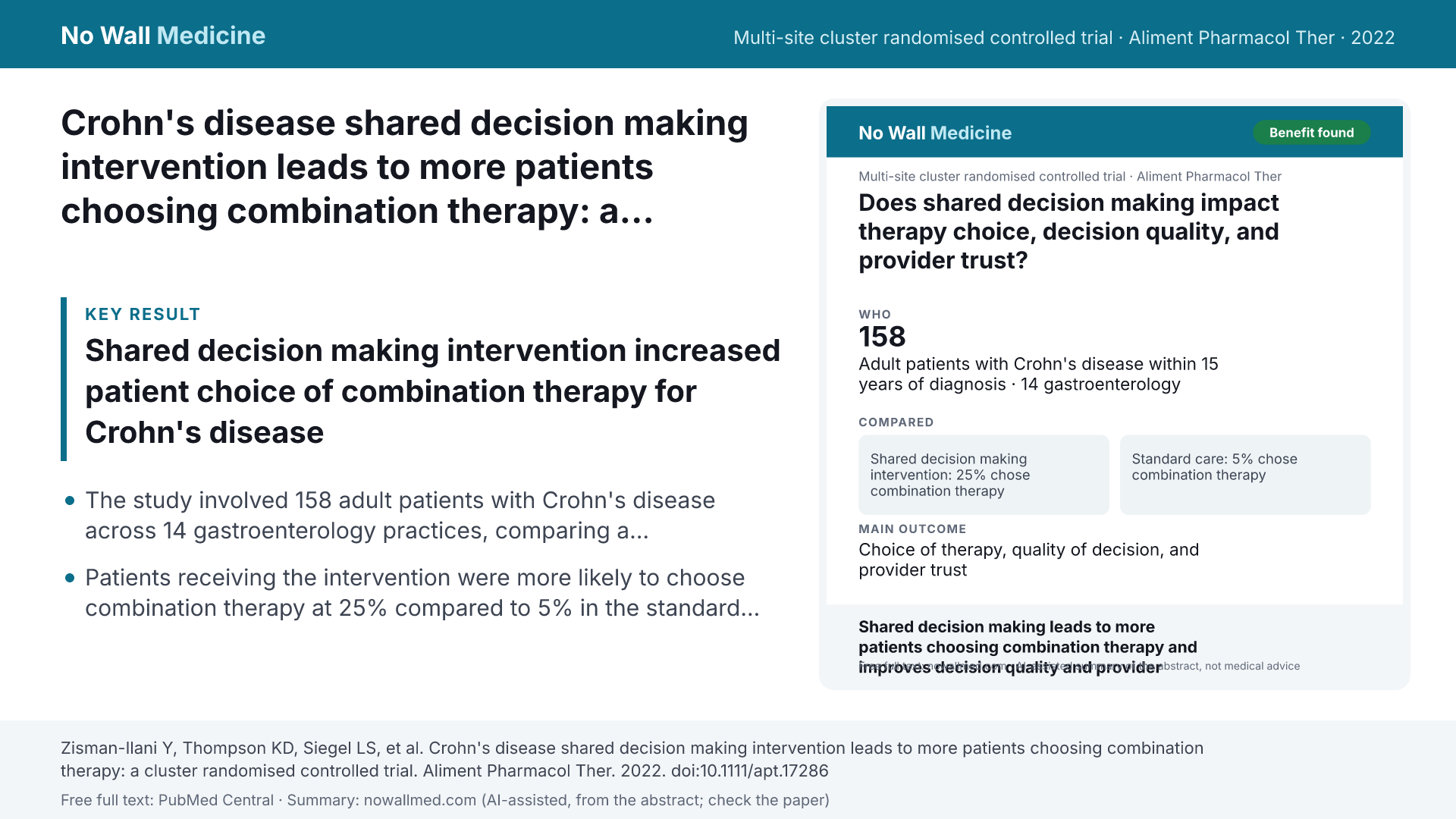
Shared decision making intervention increased patient choice of combination therapy for Crohn's disease
Crohn's disease shared decision making intervention leads to more patients choosing combination therapy: a cluster randomised controlled trial
Multi-site cluster randomised controlled trialBenefit found
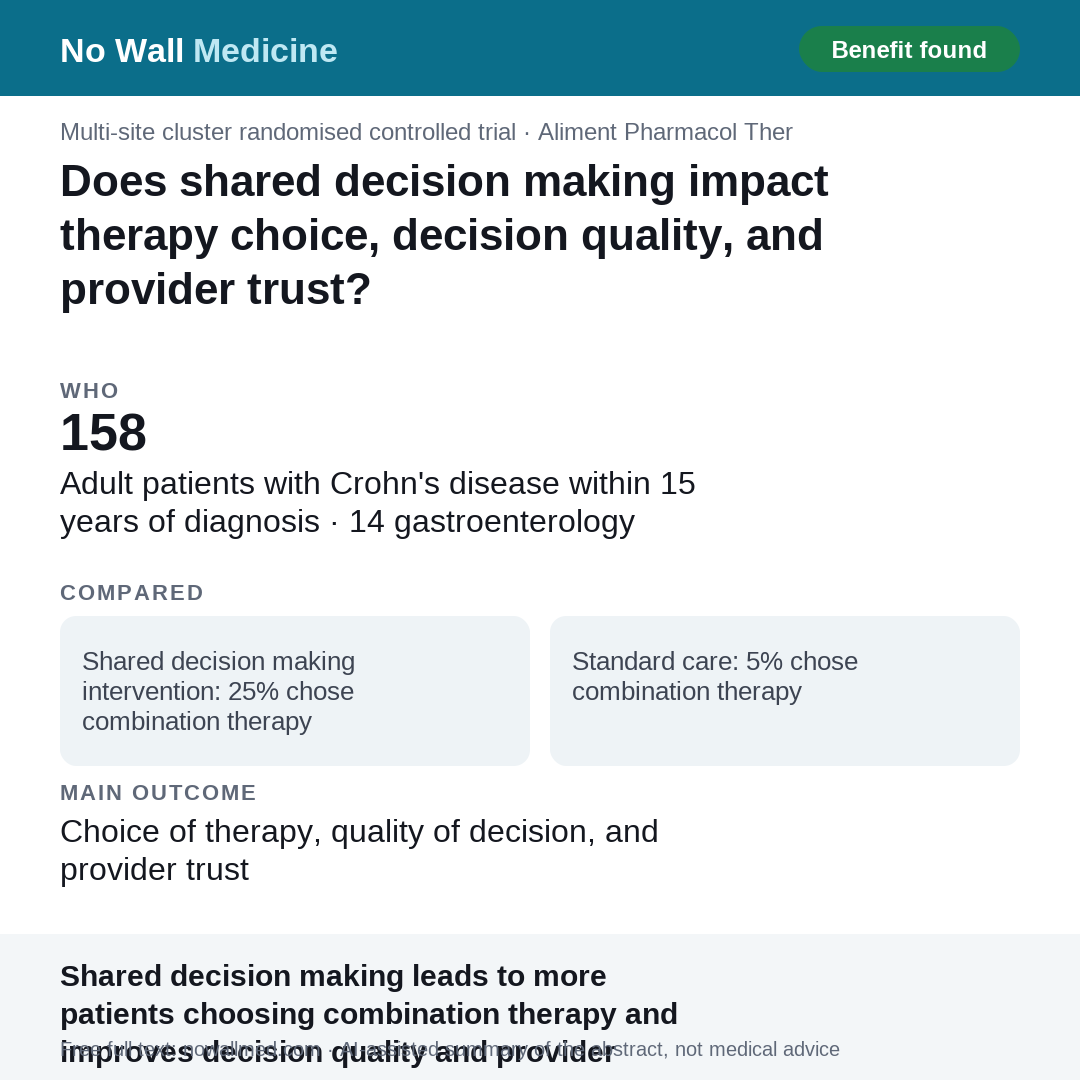
Does shared decision making impact therapy choice, decision quality, and provider trust?
Who
158
Adult patients with Crohn's disease within 15 years of diagnosis · 14 gastroenterology practices in the United States
Compared
Shared decision making intervention: 25% chose combination therapy
Standard care: 5% chose combination therapy
Main outcome
Choice of therapy, quality of decision, and provider trust
Bottom line: Shared decision making leads to more patients choosing combination therapy and improves decision quality and provider trust.
Aliment Pharmacol Ther · 2022-11-14Download image
Clinical question: Does shared decision making impact therapy choice, decision quality, and provider trust?
Why it matters: It is unclear how shared decision making, a process where clinicians and patients collaborate on treatment choices, impacts therapy selection in Crohn's disease.
In absolute numbers
Shared decision making intervention: 25% · Standard care: 5% → a difference of 20 percentage points, so about 5 people would need the treatment for 1 more to benefit (number needed to treat) over the trial’s follow-up.
Worked out by us from the two group results above, not reported by the authors. Check the paper for the exact outcome and timing.
Key points
- The study involved 158 adult patients with Crohn's disease across 14 gastroenterology practices, comparing a shared decision making intervention to standard care.
- Patients receiving the intervention were more likely to choose combination therapy at 25% compared to 5% in the standard care group.
- The intervention group also showed lower decisional conflict, which is uncertainty about a medical choice, and greater trust in their provider.
Headline and key points written with AI from the paper’s abstract, with every number checked against it. Read the paper before relying on them.
Was this summary helpful?
Subject terms
Cite this article
Zisman-Ilani Y, Thompson KD, Siegel LS, Mackenzie T, Crate DJ, Korzenik JR. Crohn's disease shared decision making intervention leads to more patients choosing combination therapy: a cluster randomised controlled trial. Aliment Pharmacol Ther. 2022. doi:10.1111/apt.17286
Spotted a mistake? Suggest a correction
Top studies every Monday
The week’s key trials and guidelines in your specialties, plus any topics you follow. By email, free.
Get the weekly digest