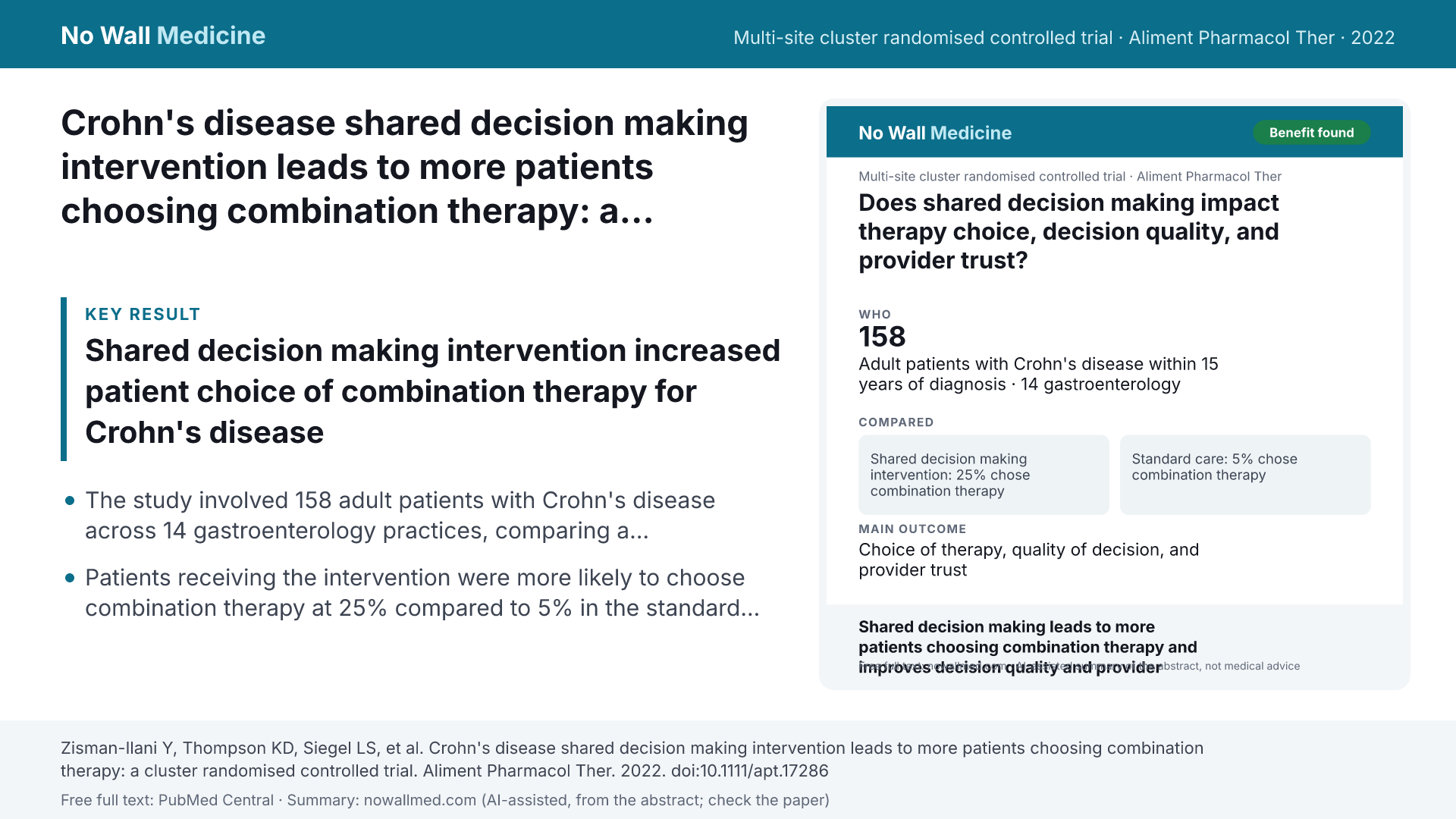
Crohn's disease shared decision making intervention leads to more patients choosing combination therapy: a cluster randomised controlled trial
Key result: Shared decision making intervention increased patient choice of combination therapy for Crohn's disease
Key points
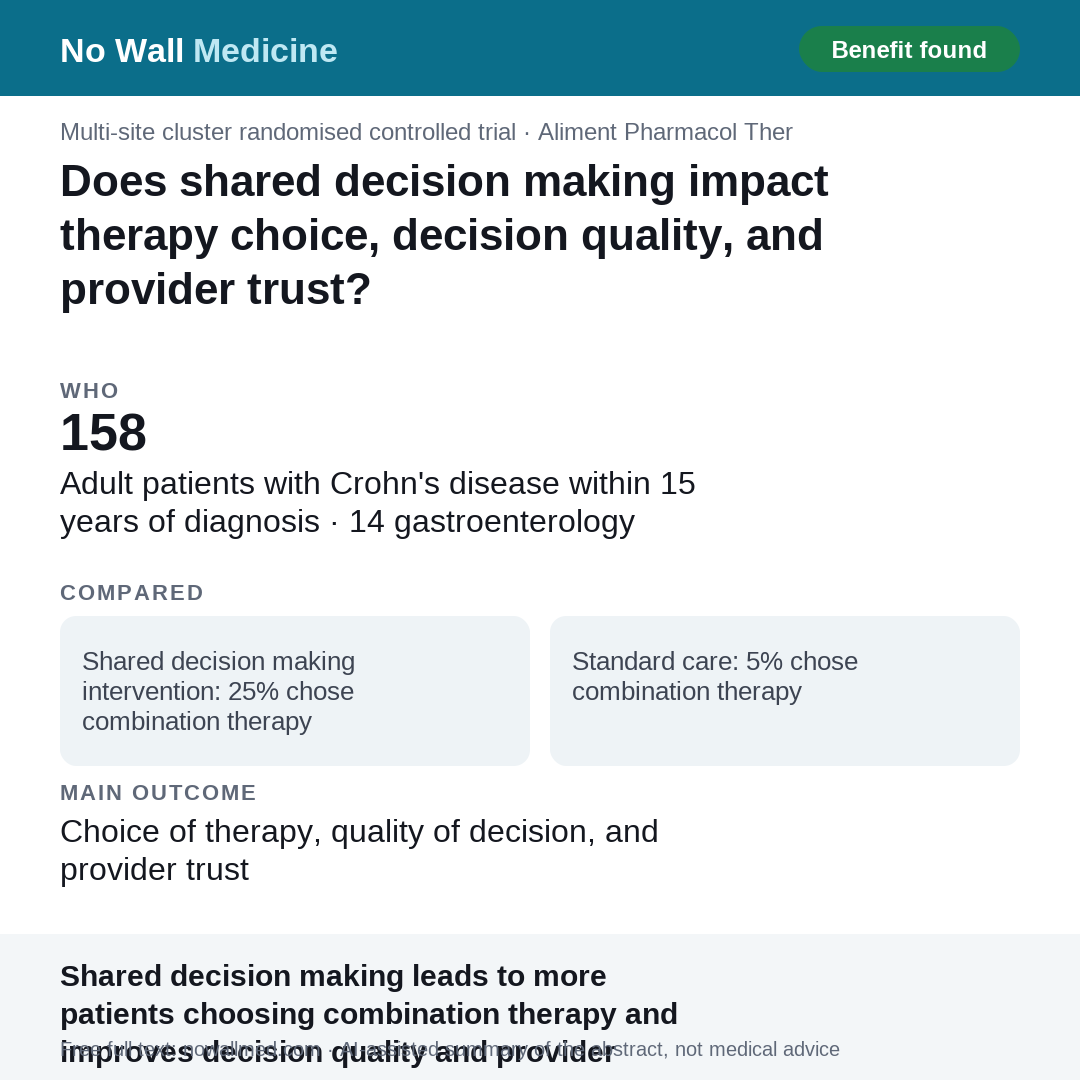
- The study involved 158 adult patients with Crohn's disease across 14 gastroenterology practices, comparing a shared decision making intervention to standard care.
- Patients receiving the intervention were more likely to choose combination therapy at 25% compared to 5% in the standard care group.
- The intervention group also showed lower decisional conflict, which is uncertainty about a medical choice, and greater trust in their provider.
In absolute numbers: Shared decision making intervention 25% vs Standard care 5%, a difference of 20 percentage points (about 5 people treated for one more to benefit).
Why it matters: It is unclear how shared decision making, a process where clinicians and patients collaborate on treatment choices, impacts therapy selection in Crohn's disease.
Discussion prompts
- Would these patients look like yours? Who was left out?
- Is the main outcome one that matters to patients?
- Is the difference large enough to change what you do?
Cite: Zisman-Ilani Y, Thompson KD, Siegel LS, Mackenzie T, Crate DJ, Korzenik JR. Crohn's disease shared decision making intervention leads to more patients choosing combination therapy: a cluster randomised controlled trial. Aliment Pharmacol Ther. 2022. doi:10.1111/apt.17286
Free full text: PubMed Central · Summary and visual abstract: nowallmed.com/a/crohn-s-disease-shared-decision-making-intervention-leads-to-more-1umfx7k/ (AI-assisted from the abstract; check the paper before relying on it).