Computed tomography perfusion and noncontrast computed tomography show similar functional independence rates for late stroke treatment
CT Perfusion vs Noncontrast CT for Late Window Stroke Thrombectomy: A Systematic Review and Meta-analysis
Systematic review and meta-analysisMixed results
Does CT perfusion or noncontrast CT improve outcomes for late window stroke thrombectomy?
Who
3,384
Patients with acute ischemic stroke undergoing endovascular thrombectomy in the late window
Compared
CT perfusion
Noncontrast CT
Main outcome
rate of functional independence
Result: odds ratio 1.03 (95% CI 0.87-1.22)
Bottom line: CT perfusion showed higher successful reperfusion and lower mortality, but no difference in functional independence compared to noncontrast CT.
Neurology · 2023-03-29Download image
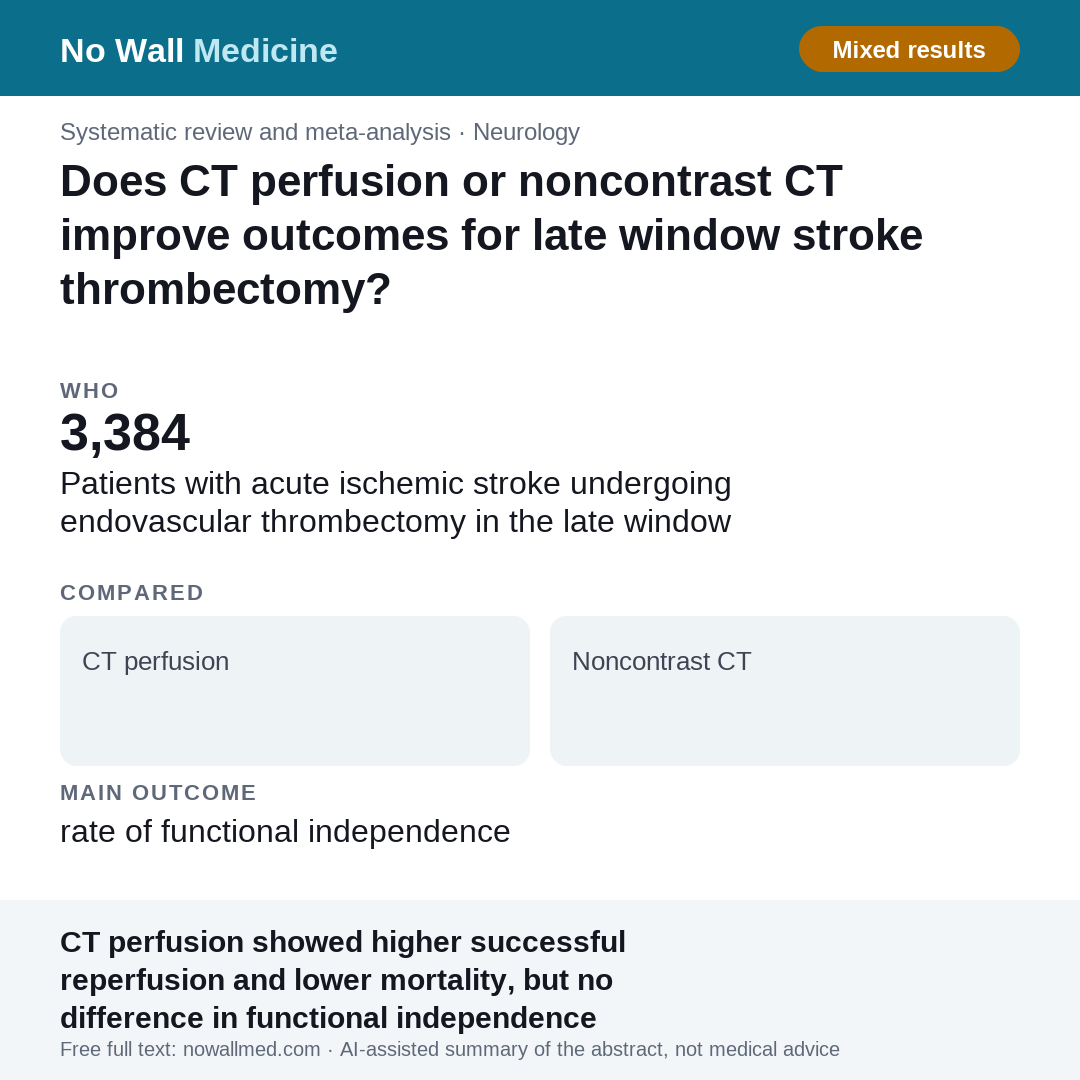
Clinical question: Does CT perfusion or noncontrast CT improve outcomes for late window stroke thrombectomy?
Why it matters: It is unknown whether patient outcomes differ when using computed tomography perfusion versus noncontrast computed tomography to select patients for mechanical clot removal in the late window of stroke.
Key points
- Researchers analyzed five studies involving 3,384 patients to compare computed tomography perfusion (CTP) and noncontrast computed tomography (NCCT) for selecting patients for mechanical clot removal.
- Functional independence rates were comparable between groups (odds ratio 1.03, 95% CI 0.87-1.22; p = 0.71), and symptomatic intracranial hemorrhage rates were also similar (odds ratio 1.09, 95% CI 0.58-2.04; p = 0.80).
- Patients selected via CTP had higher rates of successful reperfusion (odds ratio 1.31, 95% CI 1.05-1.64; p = 0.015) and lower mortality (odds ratio 0.79, 95% CI 0.65-0.96; p = 0.017).
Headline and key points written with AI from the paper’s abstract, with every number checked against it. Read the paper before relying on them.
Was this summary helpful?
Subject terms
Cite this article
Kobeissi H, Ghozy S, Adusumilli G, Bilgin C, Tolba H, Amoukhteh M. CT Perfusion vs Noncontrast CT for Late Window Stroke Thrombectomy: A Systematic Review and Meta-analysis. Neurology. 2023. doi:10.1212/WNL.0000000000207262
Spotted a mistake? Suggest a correction
Top studies every Monday
The week’s key trials and guidelines in your specialties, plus any topics you follow. By email, free.
Get the weekly digest