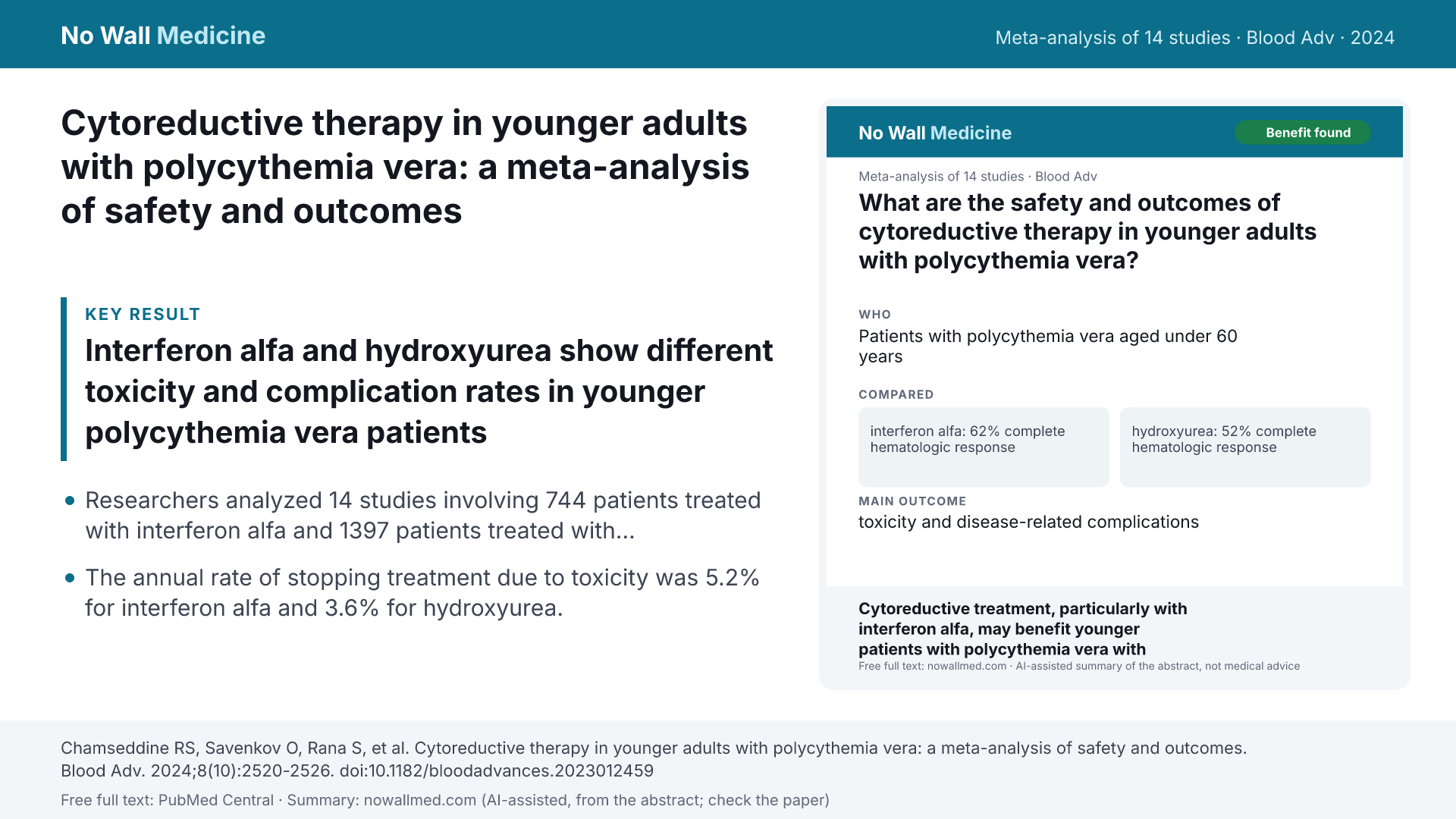
Interferon alfa and hydroxyurea show different toxicity and complication rates in younger polycythemia vera patients
Cytoreductive therapy in younger adults with polycythemia vera: a meta-analysis of safety and outcomes
Meta-analysis of 14 studiesBenefit found
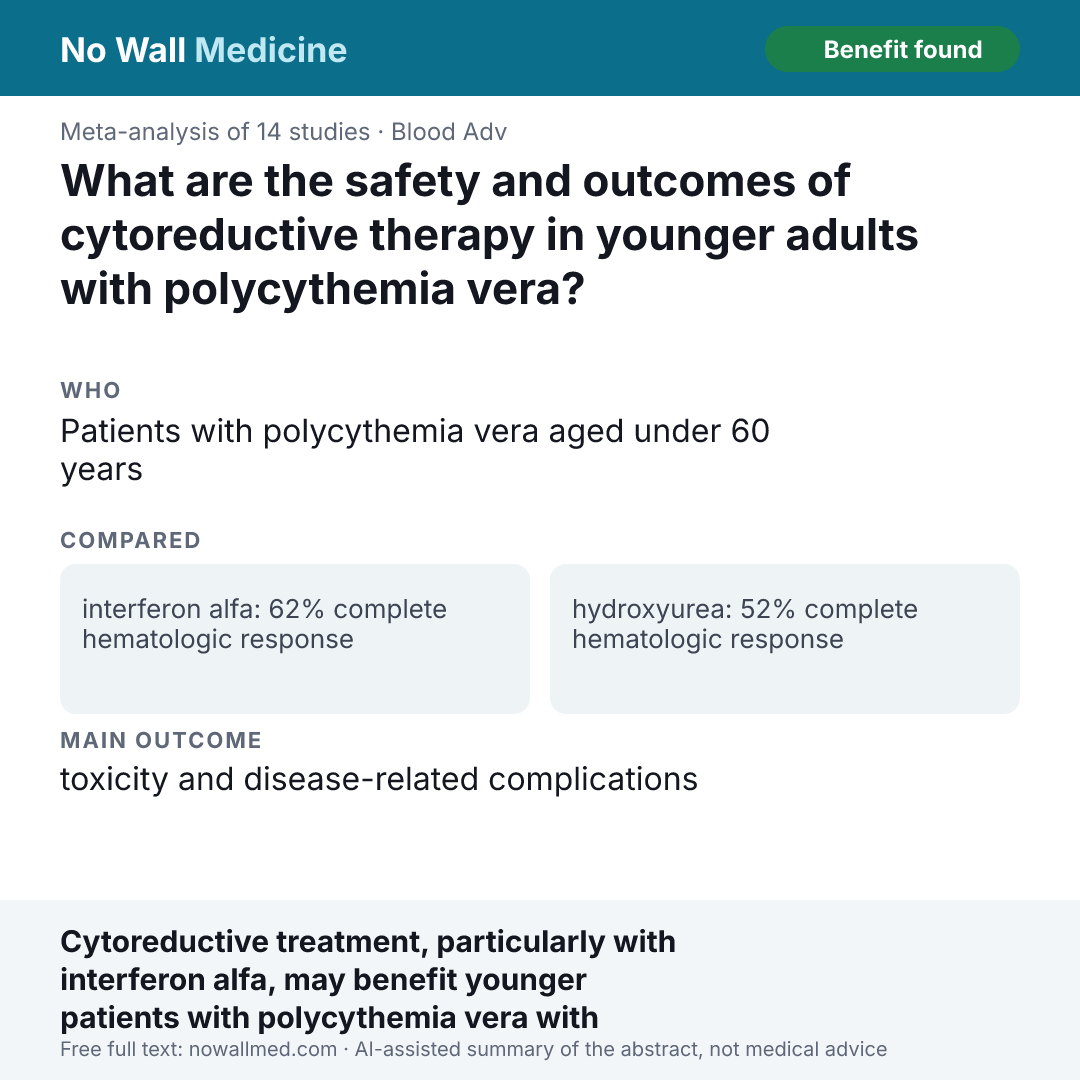
What are the safety and outcomes of cytoreductive therapy in younger adults with polycythemia vera?
Who
Patients with polycythemia vera aged under 60 years
Compared
interferon alfa: 62% complete hematologic response
hydroxyurea: 52% complete hematologic response
Main outcome
toxicity and disease-related complications
Bottom line: Cytoreductive treatment, particularly with interferon alfa, may benefit younger patients with polycythemia vera with acceptable nonfatal toxicity rates.
Limitation: Future randomized trials prioritizing inclusion of patients under 60 are needed.
Blood Adv · 2024-03-20
Headline and visual abstract written with AI from the paper’s abstract, with every number checked against it. Read the paper before relying on them.
Was this summary helpful?
Abstract
Cytoreductive therapy is not routinely recommended for younger patients with polycythemia vera (PV) due to concern that treatment toxicity may outweigh therapeutic benefits. However, no systematic data support this approach. To support objective risk/benefit assessment of cytoreductive drugs in patients with PV aged <60 years (PV<60), this systematic review and meta-analysis was conducted to evaluate toxicity and disease-related complications in PV<60 treated with interferon alfa (rIFN-α) or hydroxyurea (HU). A search of PubMed, Scopus, Web of Science and Embase identified 693 unique studies with relevant keywords, of which 14 met inclusion criteria and were selected for analysis. The weighted average age of patients treated with rIFN-α was 48 years (n = 744 patients; 12 studies) and for HU was 56 years (n = 1397; 8 studies). The weighted average duration of treatment for either drug was 4.5 years. Using a Bayesian hierarchical model, the pooled annual rate of discontinuation due to toxicity was 5.2% for patients receiving rIFN-α (n = 587; 95% confidence interval [CI], 2.2-8.2) and 3.6% for HU (n = 1097; CI, 1-6.2). The average complete hematologic response for rIFN-α and HU was 62% and 52%, respectively. Patients experienced thrombotic events at a pooled annual rate of 0.79% and 1.26%; secondary myelofibrosis at 1.06% and 1.62%; acute myeloid leukemia at 0.14% and 0.26%; and death at 0.87% and 2.65%, respectively. No treatment-related deaths were reported. With acceptable rates of nonfatal toxicity, cytoreductive treatment, particularly with disease-modifying rIFN-α, may benefit PV<60. Future randomized trials prioritizing inclusion of PV<60 are needed to establish a long-term benefit of early cytoreductive treatment in these patients.
Abstract reproduced under the article’s CC BY NC ND licence.
Subject terms
Cite this article
Chamseddine RS, Savenkov O, Rana S, et al. Cytoreductive therapy in younger adults with polycythemia vera: a meta-analysis of safety and outcomes. Blood Adv. 2024;8(10):2520-2526. doi:10.1182/bloodadvances.2023012459
Spotted a mistake? Suggest a correction