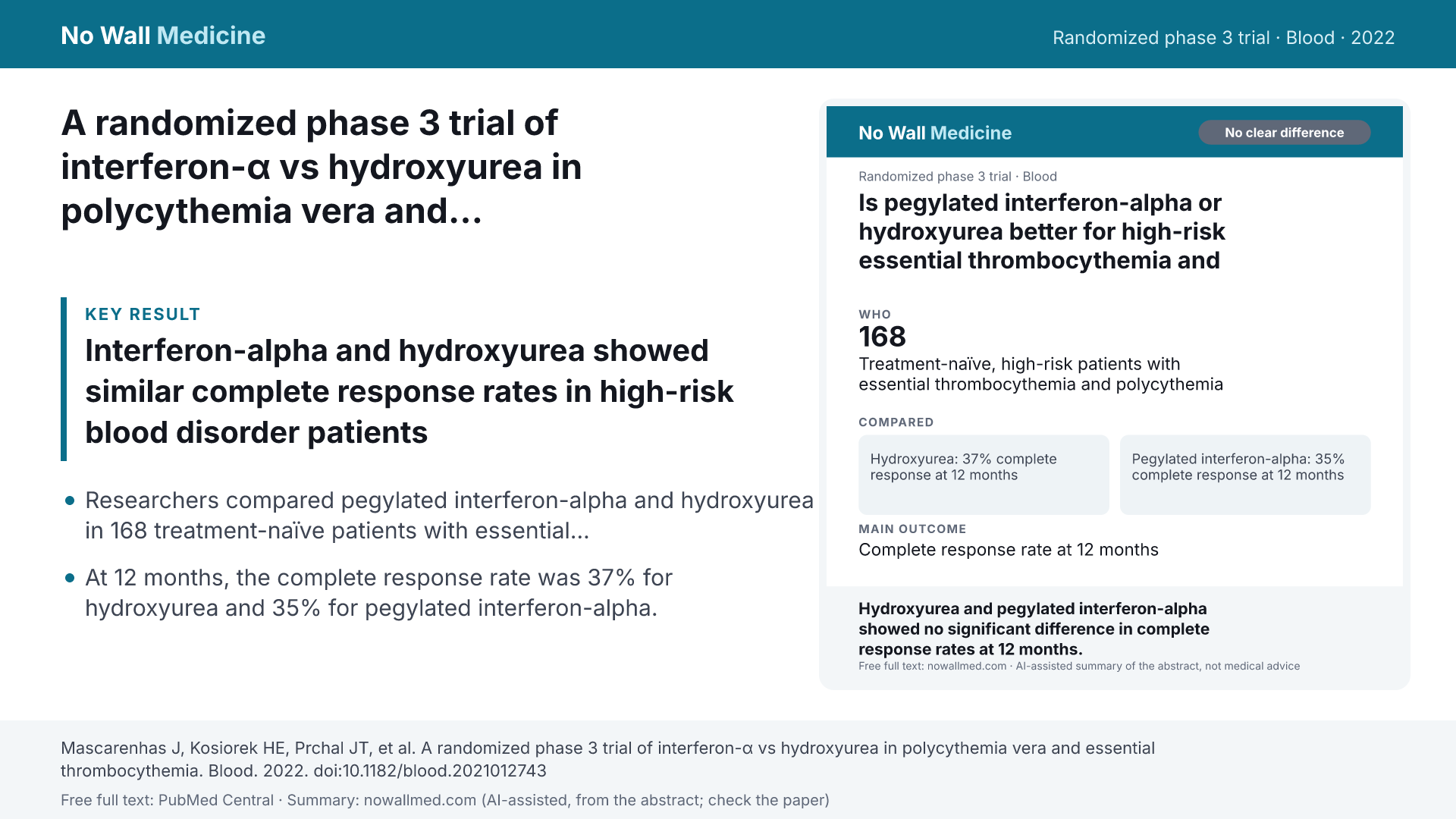
Interferon-alpha and hydroxyurea showed similar complete response rates in high-risk blood disorder patients
A randomized phase 3 trial of interferon-α vs hydroxyurea in polycythemia vera and essential thrombocythemia
Randomized phase 3 trialNo clear difference
Is pegylated interferon-alpha or hydroxyurea better for high-risk essential thrombocythemia and polycythemia vera?
Who
168
Treatment-naïve, high-risk patients with essential thrombocythemia and polycythemia vera
Compared
Hydroxyurea: 37% complete response at 12 months
Pegylated interferon-alpha: 35% complete response at 12 months
Main outcome
Complete response rate at 12 months
Bottom line: Hydroxyurea and pegylated interferon-alpha showed no significant difference in complete response rates at 12 months.
Blood · 2022-01-11Download image
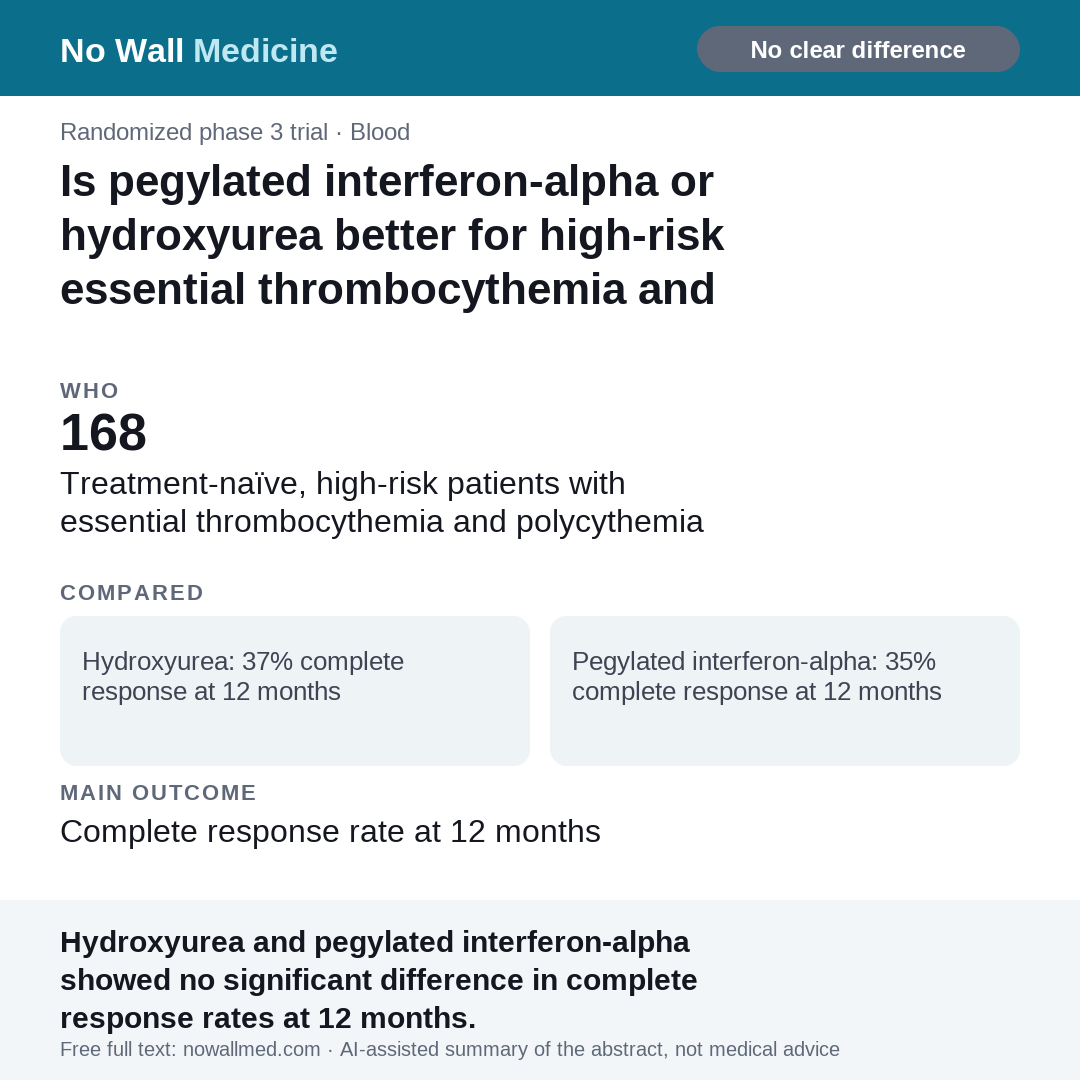
Clinical question: Is pegylated interferon-alpha or hydroxyurea better for high-risk essential thrombocythemia and polycythemia vera?
Why it matters: It was unknown whether pegylated interferon-alpha or hydroxyurea is more effective at achieving complete response in high-risk patients with essential thrombocythemia or polycythemia vera.
Key points
- Researchers compared pegylated interferon-alpha and hydroxyurea in 168 treatment-naïve patients with essential thrombocythemia or polycythemia vera.
- At 12 months, the complete response rate was 37% for hydroxyurea and 35% for pegylated interferon-alpha.
- Pegylated interferon-alpha was associated with more frequent grade 3/4 adverse events at 46% compared to 28% for hydroxyurea.
Headline and key points written with AI from the paper’s abstract, with every number checked against it. Read the paper before relying on them.
Was this summary helpful?
Subject terms
Cite this article
Mascarenhas J, Kosiorek HE, Prchal JT, et al. A randomized phase 3 trial of interferon-α vs hydroxyurea in polycythemia vera and essential thrombocythemia. Blood. 2022. doi:10.1182/blood.2021012743
Spotted a mistake? Suggest a correction