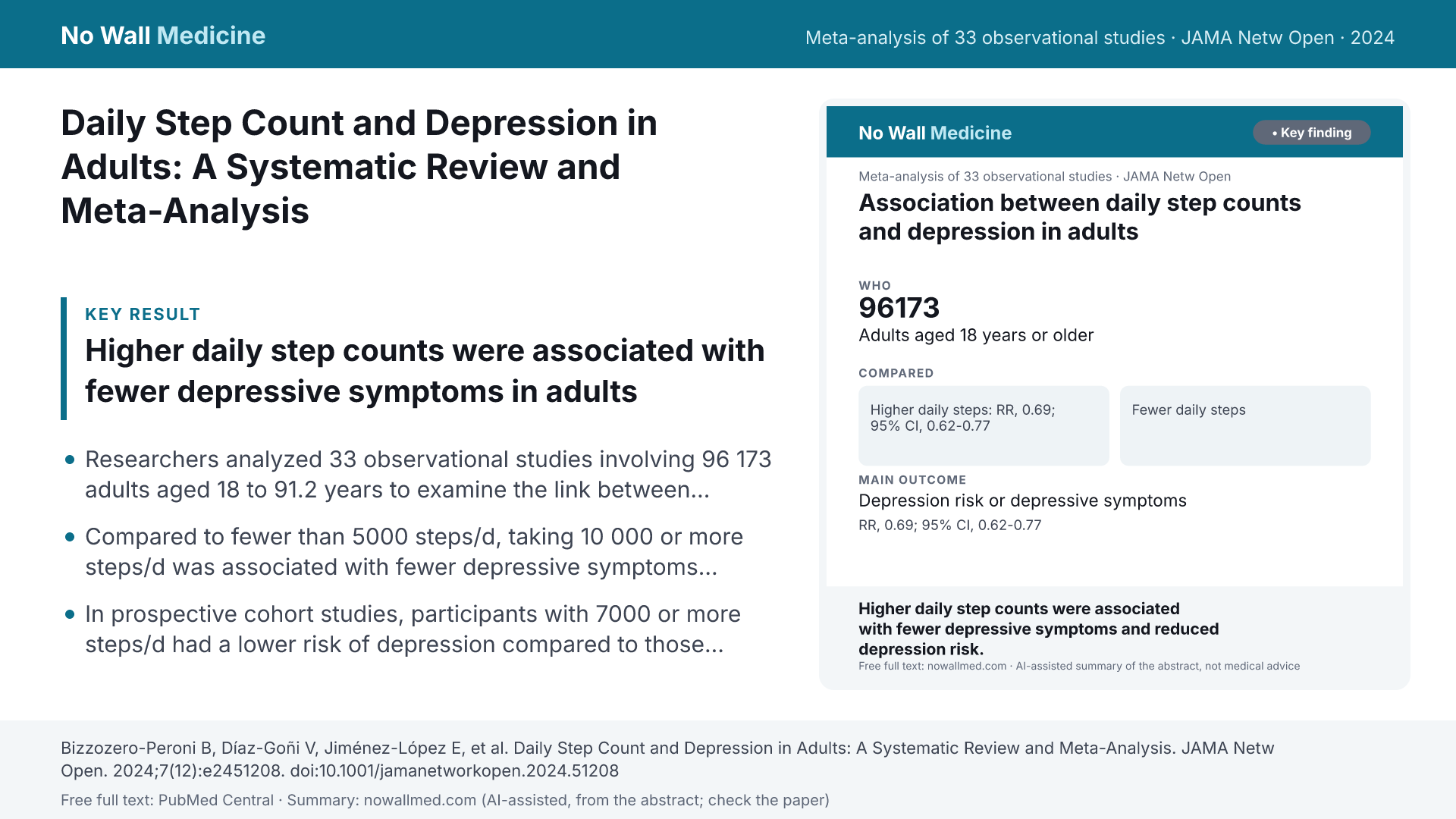
Higher daily step counts were associated with fewer depressive symptoms in adults
Daily Step Count and Depression in Adults: A Systematic Review and Meta-Analysis
Systematic review and meta-analysisBenefit found
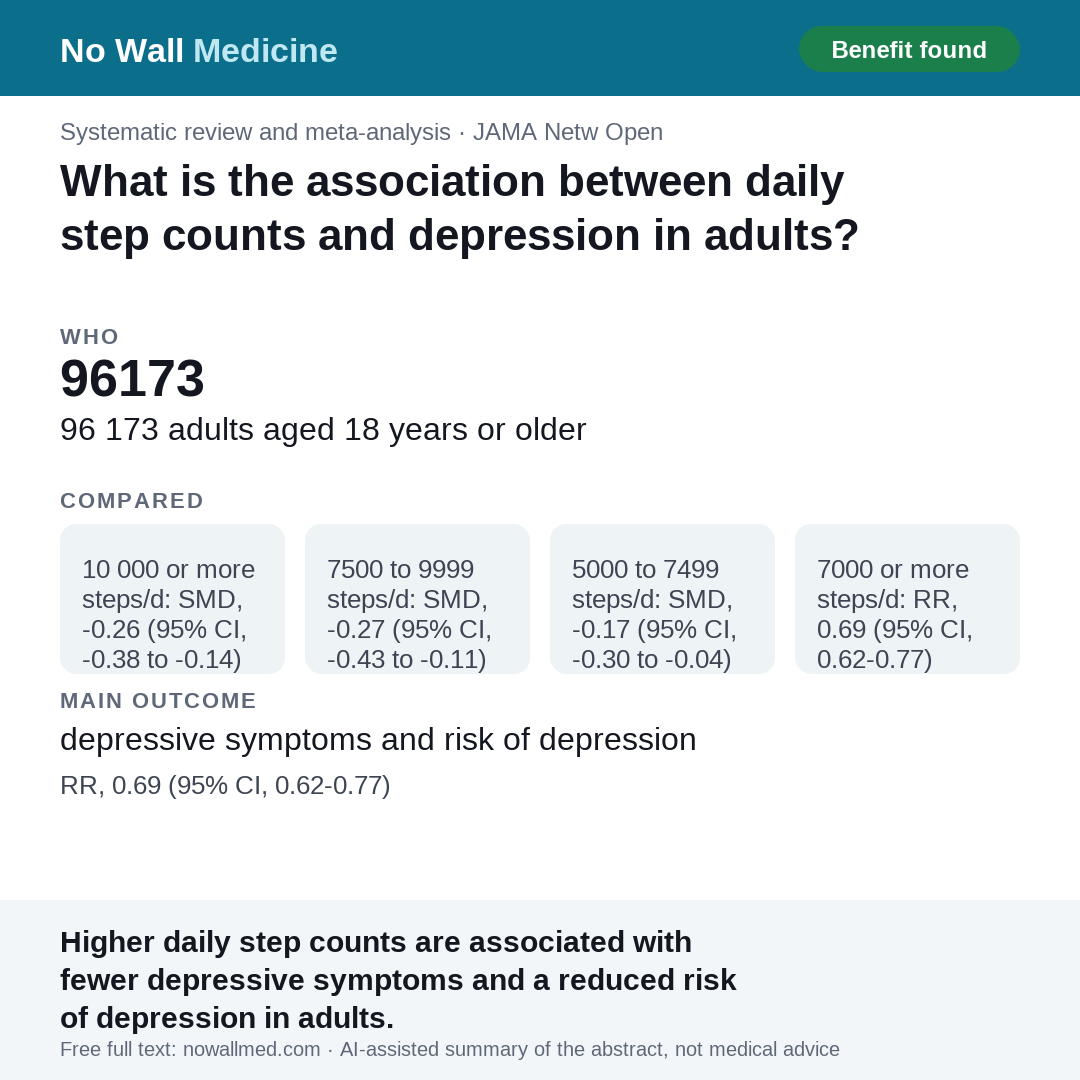
What is the association between daily step counts and depression in adults?
Who
96173
96 173 adults aged 18 years or older
Compared
10 000 or more steps/d: SMD, -0.26 (95% CI, -0.38 to -0.14)
7500 to 9999 steps/d: SMD, -0.27 (95% CI, -0.43 to -0.11)
5000 to 7499 steps/d: SMD, -0.17 (95% CI, -0.30 to -0.04)
7000 or more steps/d: RR, 0.69 (95% CI, 0.62-0.77)
Main outcome
depressive symptoms and risk of depression
Result: RR, 0.69 (95% CI, 0.62-0.77)
Bottom line: Higher daily step counts are associated with fewer depressive symptoms and a reduced risk of depression in adults.
Limitation: Further prospective cohort studies are needed to clarify the potential protective role.
JAMA Netw Open · 2024-12-02Download image
Clinical question: What is the association between daily step counts and depression in adults?
Why it matters: It was unknown if step count-based recommendations for cardiovascular health and mortality also apply to mental health outcomes like depression.
Key points
- Researchers analyzed 33 observational studies involving 96 173 adults aged 18 to 91.2 years to examine the link between daily steps and depression.
- Compared to fewer than 5000 steps/d, taking 10 000 or more steps/d was associated with fewer depressive symptoms (SMD, -0.26; 95% CI, -0.38 to -0.14).
- In prospective cohort studies, participants with 7000 or more steps/d had a lower risk of depression compared to those with fewer than 7000 steps/d (RR, 0.69; 95% CI, 0.62-0.77).
Limitation the authors note: The authors state that further prospective cohort studies are needed to clarify the potential protective role of daily steps in mitigating the risk of depression.
Headline and key points written with AI from the paper’s abstract, with every number checked against it. Read the paper before relying on them.
Was this summary helpful?
Subject terms
Cite this article
Bizzozero-Peroni B, Díaz-Goñi V, Jiménez-López E, Rodríguez-Gutiérrez E, Sequí-Domínguez I, Núñez de Arenas-Arroyo S. Daily Step Count and Depression in Adults: A Systematic Review and Meta-Analysis. JAMA Netw Open. 2024. doi:10.1001/jamanetworkopen.2024.51208
Spotted a mistake? Suggest a correction
Top studies every Monday
The week’s key trials and guidelines in your specialties, plus any topics you follow. By email, free.
Get the weekly digest