Adding daratumumab to standard therapy showed improved response rates in transplant-ineligible myeloma patients
Daratumumab, cyclophosphamide, bortezomib, and dexamethasone for transplant-ineligible myeloma: AMaRC 03-16
Randomized trialBenefit found
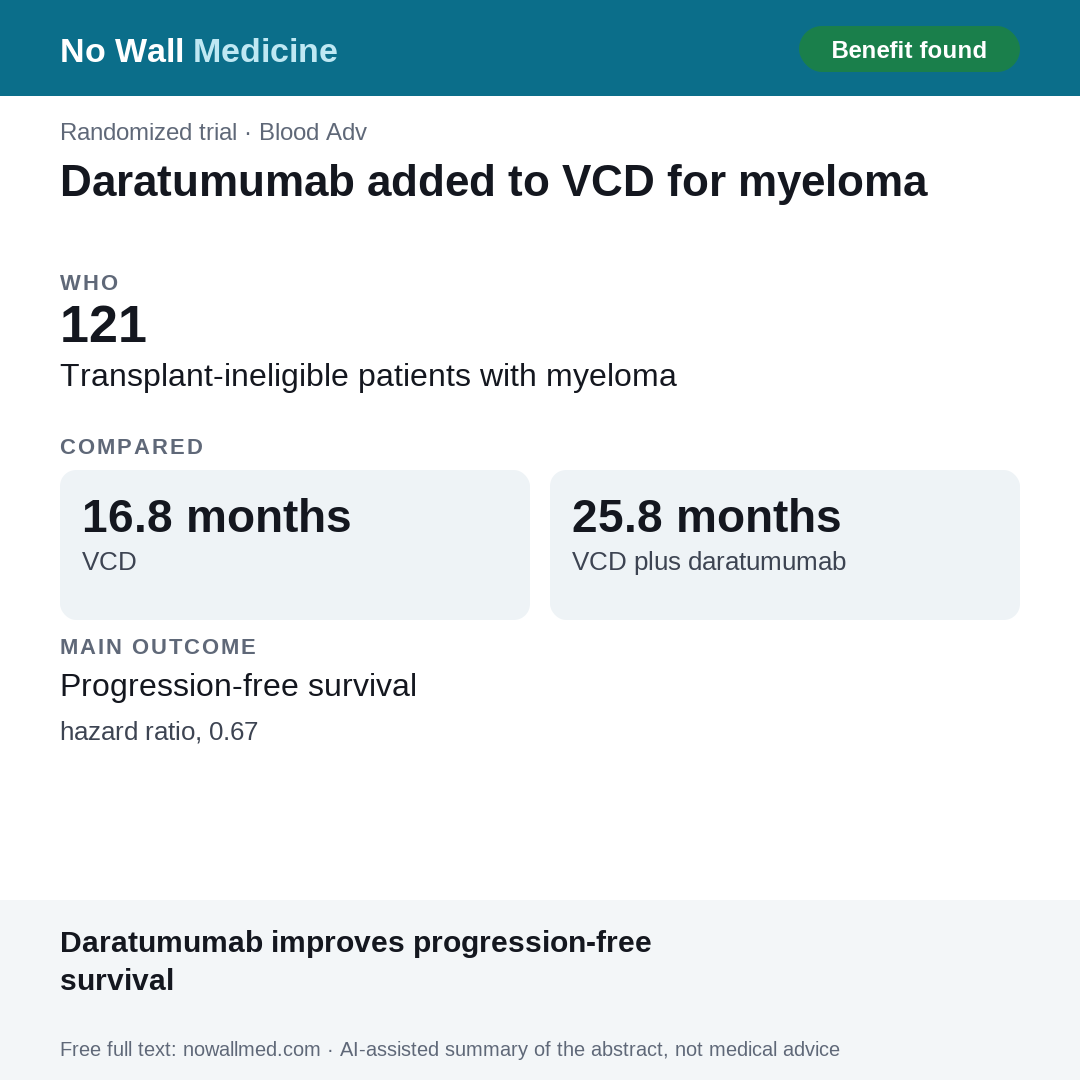
Daratumumab added to VCD for myeloma
Who
121
Transplant-ineligible patients with myeloma
Compared
16.8 monthsVCD
25.8 monthsVCD plus daratumumab
Main outcome
Progression-free survival
Result: hazard ratio, 0.67
Bottom line: Daratumumab improves progression-free survival
Blood Adv · 2024-05-13Download image
Why it matters: It was unknown if adding daratumumab to the bortezomib, cyclophosphamide, and dexamethasone regimen would improve outcomes for patients with myeloma who cannot undergo a stem cell transplant.
Key points
- Researchers randomized 121 patients with untreated myeloma to receive either bortezomib, cyclophosphamide, and dexamethasone or that same regimen plus daratumumab.
- The daratumumab group had higher best overall response rates of 86% compared to 65% in the standard group.
- Median progression-free survival, the time until the disease worsens, was 16.8 months for the standard group and 25.8 months for the daratumumab group.
Headline and key points written with AI from the paper’s abstract, with every number checked against it. Read the paper before relying on them.
Was this summary helpful?
Abstract
In newly diagnosed transplant-ineligible patients with myeloma, daratumumab has improved outcomes when added to the standard-of-care regimens. In a randomized trial, we tested whether similar improvements would be observed when daratumumab was added to the bortezomib, cyclophosphamide, and dexamethasone (VCD) regimen. Transplant-ineligible patients with untreated myeloma were randomized to receive VCD or VCD plus daratumumab (VCDD). A total of 121 patients were randomized: 57 in the VCD arm and 64 in the VCDD arm. Baseline characteristics were balanced between the 2 arms. The median progression-free survival (PFS) was 16.8 months (95% confidence interval [CI], 15.3-21.7) and 25.8 months (95% CI, 19.9-33.5) in the VCD and VCDD arms, respectively (hazard ratio, 0.67; log-rank test P = .066). In a preplanned analysis, it was demonstrated that the daratumumab-containing arm showed a significant improvement in PFS from 18 months onward, based on estimates at fixed time points after randomization. The proportions of patients who were progression-free at the following time points were: 18 months, 48% vs 68% (P = .0002); 24 months, 36% vs 52% (P = .0001); and 30 months, 27% vs 41% (P < .0001) in the VCD and VCDD arms, respectively. The best overall response and very good partial response rate were significantly higher in the daratumumab arm compared with the VCD and VCDD arms, respectively (65% vs 86%, P = .007; and 28% vs 52%, P = .009). Seventy-two percent of the VCDD patients completed the 9 cycles of induction therapy with no grade 3 or 4 peripheral neuropathy adverse events. This study supports VCDD as an option for the initial treatment of transplant-ineligible patients with myeloma. This trial was registered at the Australian New Zealand Clinical Trials Registry (ACTRN12617000202369).
Abstract reproduced under the article’s CC BY NC ND licence.
Subject terms
Cite this article
Mollee P, Reynolds J, Janowski W, Quach H, Campbell P, Gibbs S. Daratumumab, cyclophosphamide, bortezomib, and dexamethasone for transplant-ineligible myeloma: AMaRC 03-16. Blood Adv. 2024. doi:10.1182/bloodadvances.2023012539
Spotted a mistake? Suggest a correction
Top studies every Monday
The week’s key trials and guidelines in your specialties, plus any topics you follow. By email, free.
Get the weekly digest