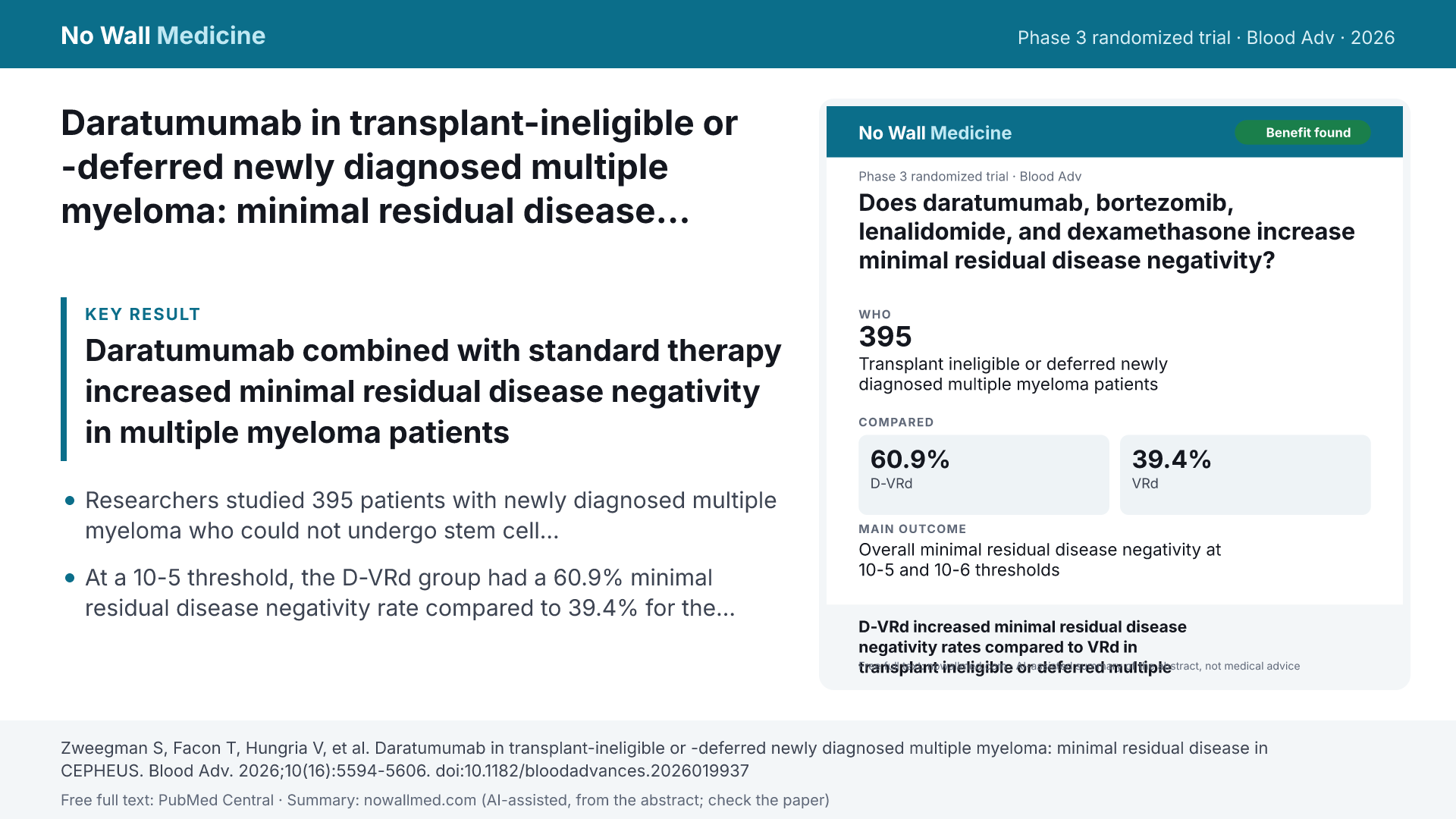
Daratumumab combined with standard therapy increased minimal residual disease negativity in multiple myeloma patients
Daratumumab in transplant-ineligible or -deferred newly diagnosed multiple myeloma: minimal residual disease in CEPHEUS
Phase 3 randomized trialBenefit found
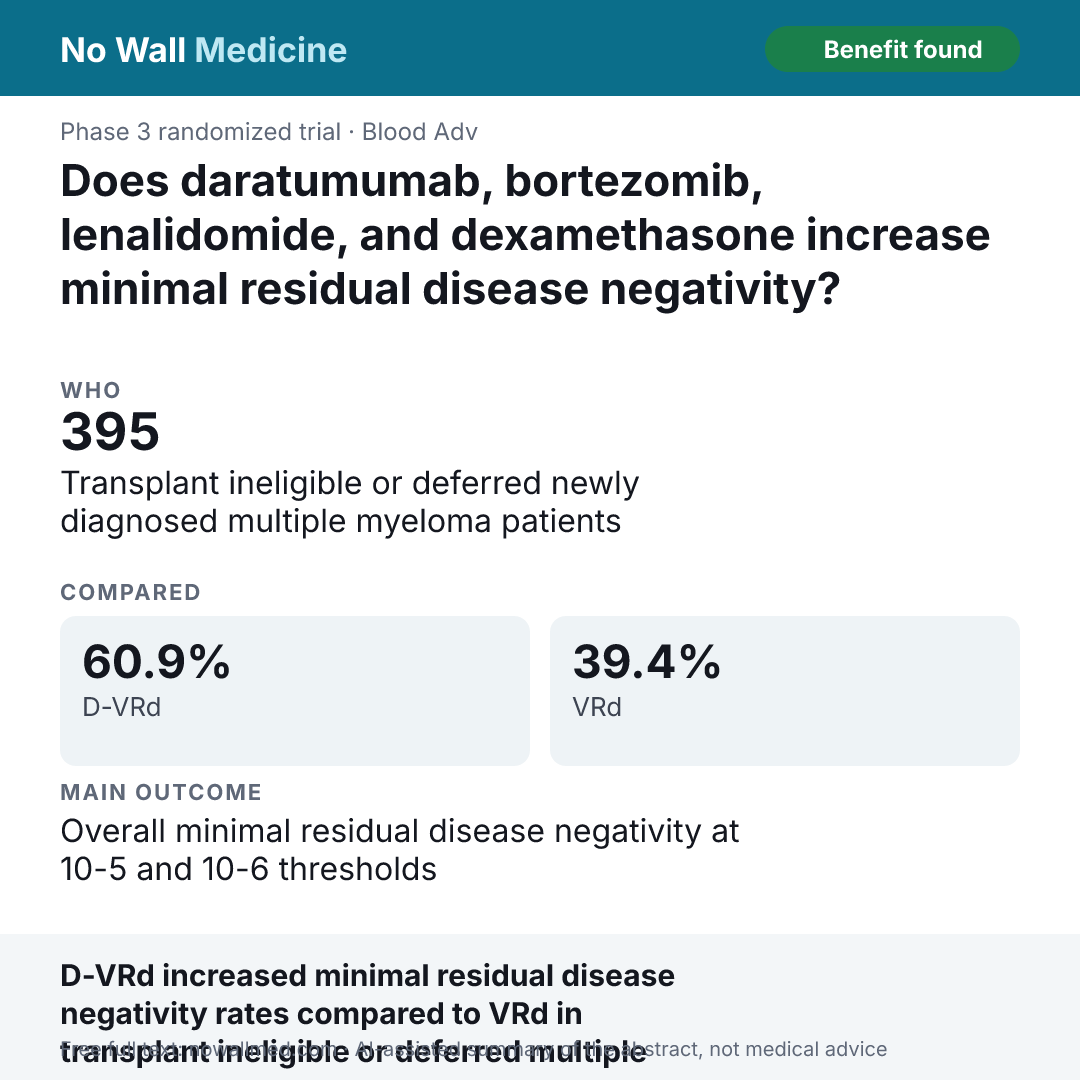
Does daratumumab, bortezomib, lenalidomide, and dexamethasone increase minimal residual disease negativity?
Who
395
Transplant ineligible or deferred newly diagnosed multiple myeloma patients
Compared
60.9%D-VRd (10-5 threshold)
39.4%VRd (10-5 threshold)
Main outcome
Overall minimal residual disease negativity at 10-5 and 10-6 thresholds
Result: odds ratio 2.37 (95% CI 1.58 to 3.55)
Bottom line: D-VRd increased minimal residual disease negativity rates compared to VRd in transplant ineligible or deferred multiple myeloma patients.
Blood Adv · 2026-06-03 · Save PNG
Same trial (NCT03652064)
Papers we list that report this registered trial, oldest first. Read a secondary analysis alongside the main results.
- Main results Benefit found
Adding daratumumab to VRd improved deep remission rates in transplant-ineligible myeloma patients Nat Med 2025-02 - Related analysis Benefit found
This paper Blood Adv 2026-06
Clinical question: Does daratumumab, bortezomib, lenalidomide, and dexamethasone increase minimal residual disease negativity?
Why it matters: Doctors need to determine if adding daratumumab to standard therapy improves the depth and durability of response in patients ineligible for transplant.
Key points
- Researchers studied 395 patients with newly diagnosed multiple myeloma who could not undergo stem cell transplantation, comparing D-VRd to VRd therapy.
- At a 10-5 threshold, the D-VRd group had a 60.9% minimal residual disease negativity rate compared to 39.4% for the VRd group.
- The D-VRd group also showed higher rates of sustained minimal residual disease negativity at 12, 24, and 36 months.
Headline and key points written with AI from the paper’s abstract, with every number checked against it. Read the paper before relying on them.
Was this summary helpful?
Abstract
In the phase 3 CEPHEUS study, D-VRd (daratumumab/bortezomib/lenalidomide/dexamethasone) increased overall minimal residual disease (MRD)-negativity rates vs VRd in patients who were transplant ineligible/deferred with newly diagnosed multiple myeloma (NDMM). We present an expanded MRD analysis of CEPHEUS. Patients who were transplant-ineligible or deferred transplant as initial therapy were randomized to D-VRd or VRd. Overall MRD negativity (next-generation sequencing) was defined as the proportion of patients achieving complete response or better and MRD-negative status assessed at 10-5 (primary end point) and 10-6 thresholds. In total, 395 patients were randomized (D-VRd, n = 197; VRd, n = 198). With 58.7-months median follow-up, overall MRD-negativity rates were significantly higher with D-VRd vs VRd (10-5: 60.9% vs 39.4%; odds ratio [OR], 2.37; 95% confidence interval [CI], 1.58-3.55; P< .0001; 10-6: 46.2% vs 27.3%; OR, 2.24; 95% CI, 1.48-3.40; P = .0001). Sustained MRD negativity (≥12 months) was significantly higher with D-VRd vs VRd (10-5: 49.2% vs 27.3%; 10-6: 34.0% vs 16.2%; each P< .0001), with similar benefits at ≥24 and ≥36 months. MRD-negativity rates were higher at all prespecified time points and cumulatively with D-VRd. Among patients who achieved MRD negativity, progression-free survival (PFS) trended in favor of D-VRd vs VRd (10-5: hazard ratio, 0.61; 95% CI, 0.35-1.06; P = .0755; 10-6: 0.66; 95% CI, 0.31-1.41; P = .2811). Responses with D-VRd were deeper and more durable vs VRd, with increased overall, sustained, and landmark MRD-negativity rates, translating into improved overall PFS with D-VRd vs VRd (intent-to-treat), with potential to improve PFS even among patients with MRD negativity. D-VRd is therefore a new standard-of-care treatment for transplant-ineligible/transplant-deferred NDMM. This trial was registered at www.clinicaltrials.gov as NCT03652064.
Abstract reproduced under the article’s CC BY NC ND licence.
Subject terms
Headline, design, result, key points, caveat and citation as plain text.
Cite this article
Zweegman S, Facon T, Hungria V, et al. Daratumumab in transplant-ineligible or -deferred newly diagnosed multiple myeloma: minimal residual disease in CEPHEUS. Blood Adv. 2026;10(16):5594-5606. doi:10.1182/bloodadvances.2026019937
Spotted a mistake? Suggest a correction