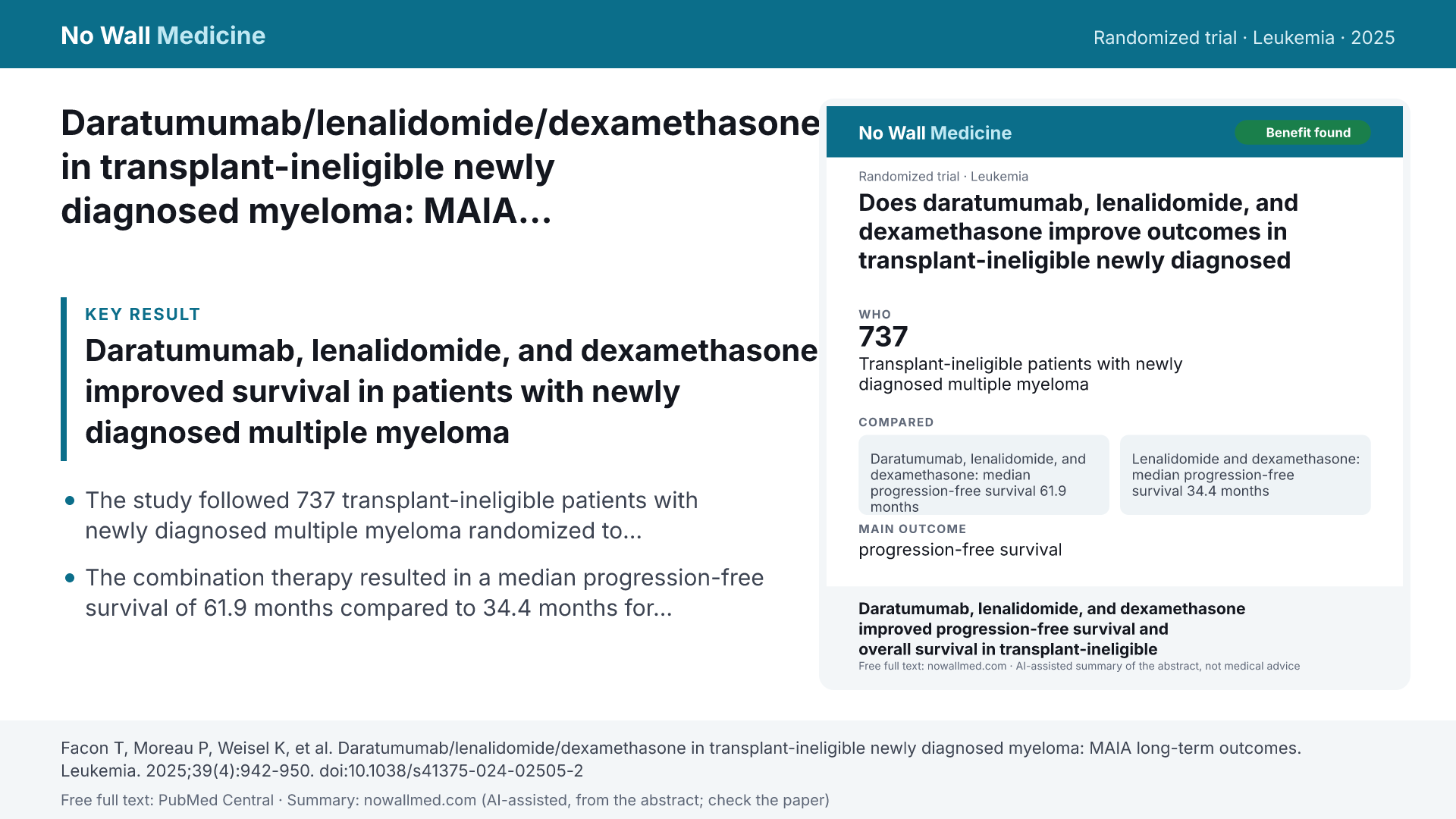
Daratumumab, lenalidomide, and dexamethasone improved survival in patients with newly diagnosed multiple myeloma
Daratumumab/lenalidomide/dexamethasone in transplant-ineligible newly diagnosed myeloma: MAIA long-term outcomes
Randomized trialBenefit found
Does daratumumab, lenalidomide, and dexamethasone improve outcomes in transplant-ineligible newly diagnosed multiple myeloma?
Who
737
Transplant-ineligible patients with newly diagnosed multiple myeloma
Compared
Daratumumab, lenalidomide, and dexamethasone: median progression-free survival 61.9 months
Lenalidomide and dexamethasone: median progression-free survival 34.4 months
Main outcome
progression-free survival
Result: hazard ratio 0.55 (95% CI 0.45-0.67)
Bottom line: Daratumumab, lenalidomide, and dexamethasone improved progression-free survival and overall survival in transplant-ineligible patients.
Leukemia · 2025-02-27Download image
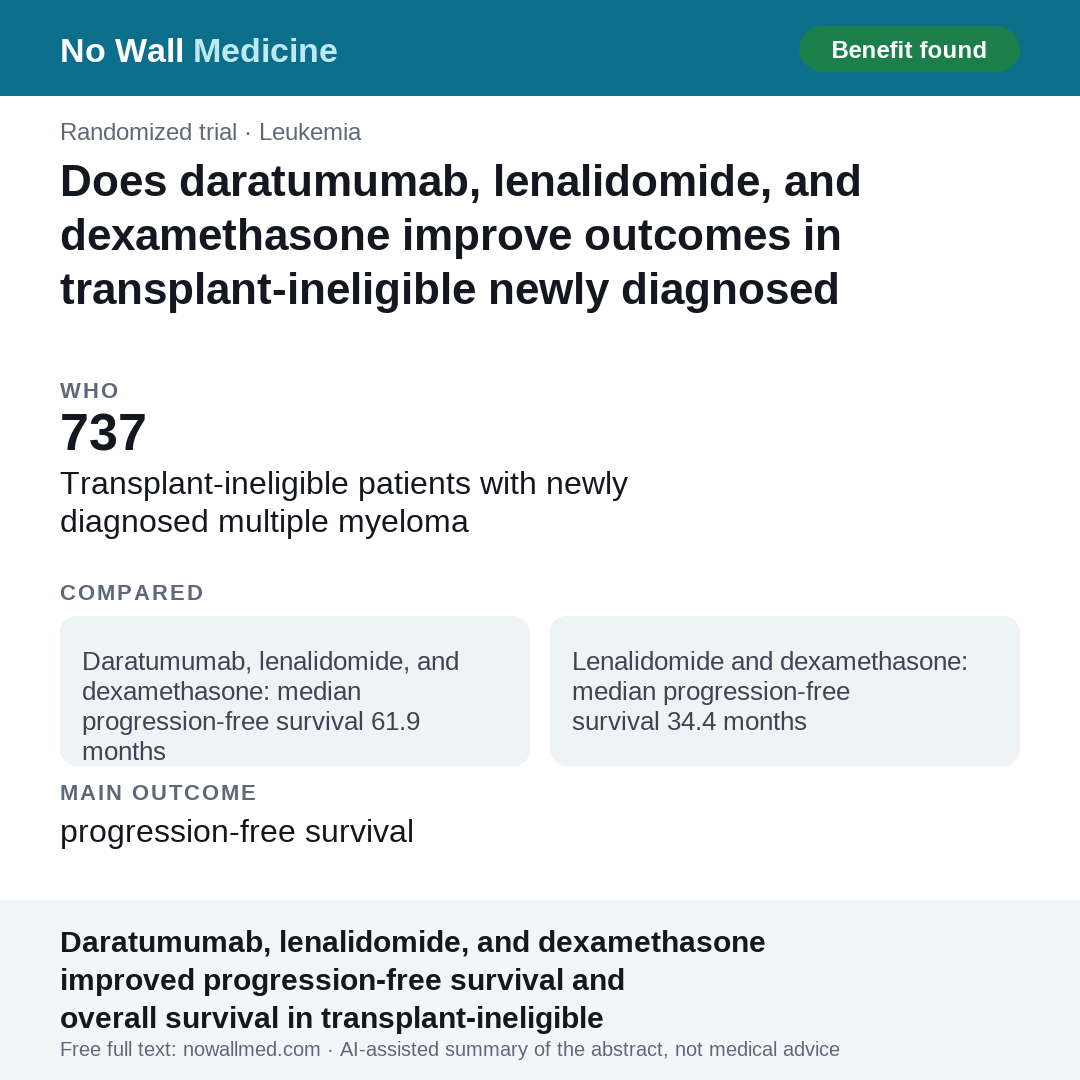
Clinical question: Does daratumumab, lenalidomide, and dexamethasone improve outcomes in transplant-ineligible newly diagnosed multiple myeloma?
Why it matters: It was unknown if the long-term efficacy and safety benefits of adding daratumumab to lenalidomide and dexamethasone would persist beyond five years.
Key points
- The study followed 737 transplant-ineligible patients with newly diagnosed multiple myeloma randomized to receive daratumumab, lenalidomide, and dexamethasone or lenalidomide and dexamethasone alone.
- The combination therapy resulted in a median progression-free survival of 61.9 months compared to 34.4 months for the two-drug regimen.
- The 60-month overall survival rate was 66.6% for the three-drug group versus 53.6% for the two-drug group.
Headline and key points written with AI from the paper’s abstract, with every number checked against it. Read the paper before relying on them.
Was this summary helpful?
Subject terms
Cite this article
Facon T, Moreau P, Weisel K, et al. Daratumumab/lenalidomide/dexamethasone in transplant-ineligible newly diagnosed myeloma: MAIA long-term outcomes. Leukemia. 2025. doi:10.1038/s41375-024-02505-2
Spotted a mistake? Suggest a correction