Text message intervention showed no significant difference in reducing burnout among trainee anaesthetists
'Dear Doctor': a randomised controlled trial of a text message intervention to reduce burnout in trainee anaesthetists
Two-group non-blinded randomised controlled trialNo clear difference
Can a text message intervention reduce burnout and increase well-being in trainee anaesthetists?
Who
279
United Kingdom trainee anaesthetists · United Kingdom
Compared
Intervention group
Control group
Main outcome
Burnout and well-being
Bottom line: A text message intervention had no significant impact on burnout or well-being in trainee anaesthetists.
Limitation: The first United Kingdom wave of COVID-19 coincided with the second half of the trial.
Anaesthesia · 2022-01-13Download image
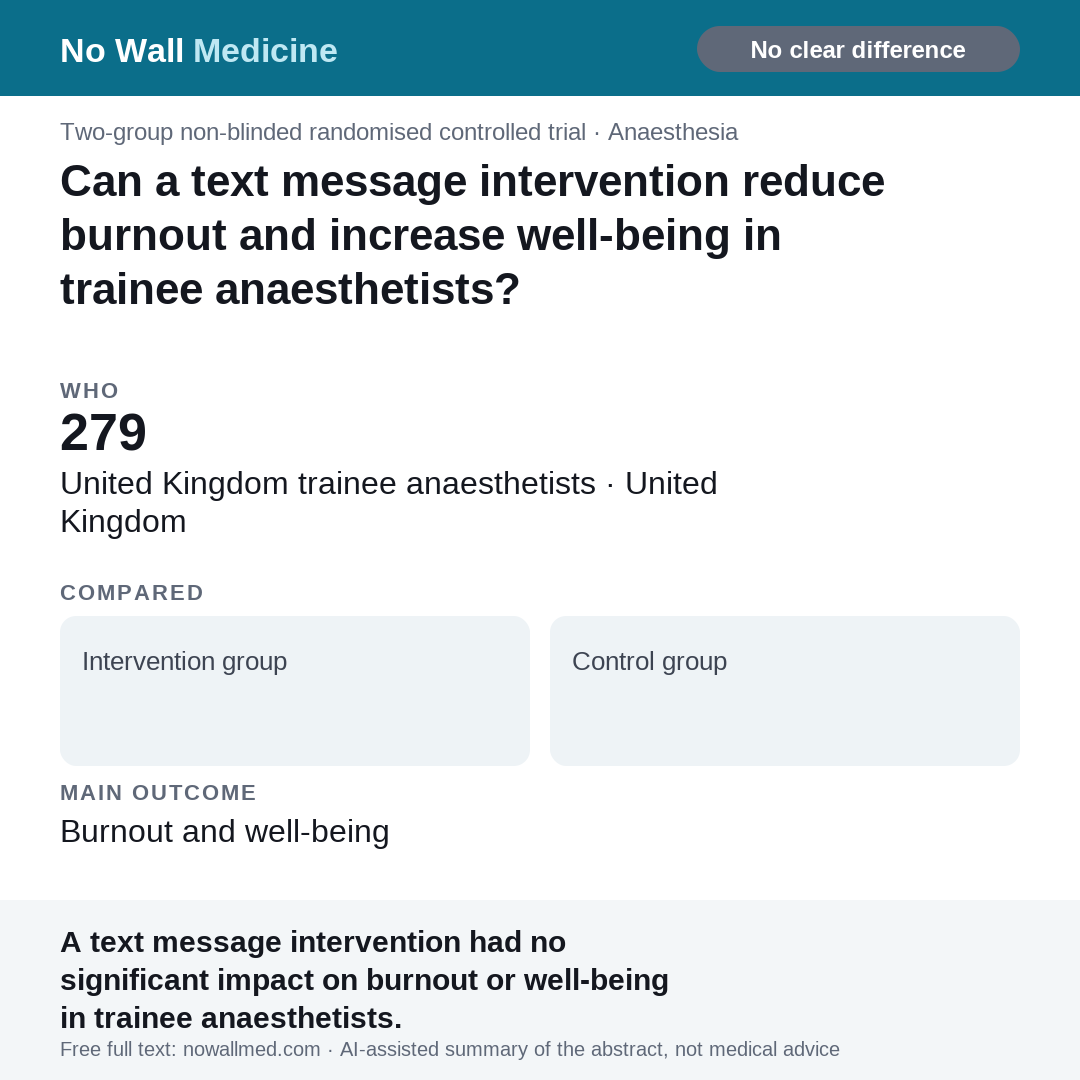
Clinical question: Can a text message intervention reduce burnout and increase well-being in trainee anaesthetists?
Why it matters: It is unknown if a low-cost text message intervention using evidence-based themes can reduce burnout and increase well-being in trainee anaesthetists.
Key points
- Researchers conducted a randomized controlled trial with 279 trainee anaesthetists to compare a text message intervention against a control group.
- The intervention group received 22 fortnightly messages, but there were no significant differences in burnout (p = 0.45), well-being (p = 0.40), or sick days (p = 0.56).
- Post-hoc analysis found the intervention was associated with reduced burnout in participants reporting personal or work-related difficulties (p = 0.02) or significant negative pandemic impact (p = 0.05).
Limitation the authors note: The final survey was completed by only 153 trainees out of the original 279 participants.
Headline and key points written with AI from the paper’s abstract, with every number checked against it. Read the paper before relying on them.
Was this summary helpful?
Subject terms
Cite this article
Brazier A, Larson E, Xu Y, Judah G, Egan M, Burd H. 'Dear Doctor': a randomised controlled trial of a text message intervention to reduce burnout in trainee anaesthetists. Anaesthesia. 2022. doi:10.1111/anae.15643
Spotted a mistake? Suggest a correction
Top studies every Monday
The week’s key trials and guidelines in your specialties, plus any topics you follow. By email, free.
Get the weekly digest