Decision support intervention did not significantly increase anticoagulation initiation for emergency department patients
Decision Support Intervention and Anticoagulation for Emergency Department Atrial Fibrillation: The O'CAFÉ Stepped-Wedge Cluster Randomized Clinical Trial
Stepped-wedge cluster randomized clinical trialNo clear difference
Does a multipronged intervention increase anticoagulation initiation for eligible emergency department atrial fibrillation patients?
Who
1203
Adult emergency department patients with primary atrial fibrillation eligible for anticoagulation · 13 community medical centers in Northern California
Compared
63.0%Control (usual care)
68.4%Intervention
Main outcome
Anticoagulation on discharge or within 30 days
Result: adjusted odds ratio, 1.33 (95% CI, 0.75-2.35)
Bottom line: A multipronged intervention did not significantly increase anticoagulation initiation among eligible emergency department patients with atrial fibrillation.
JAMA Netw Open · 2024-11-04Download image
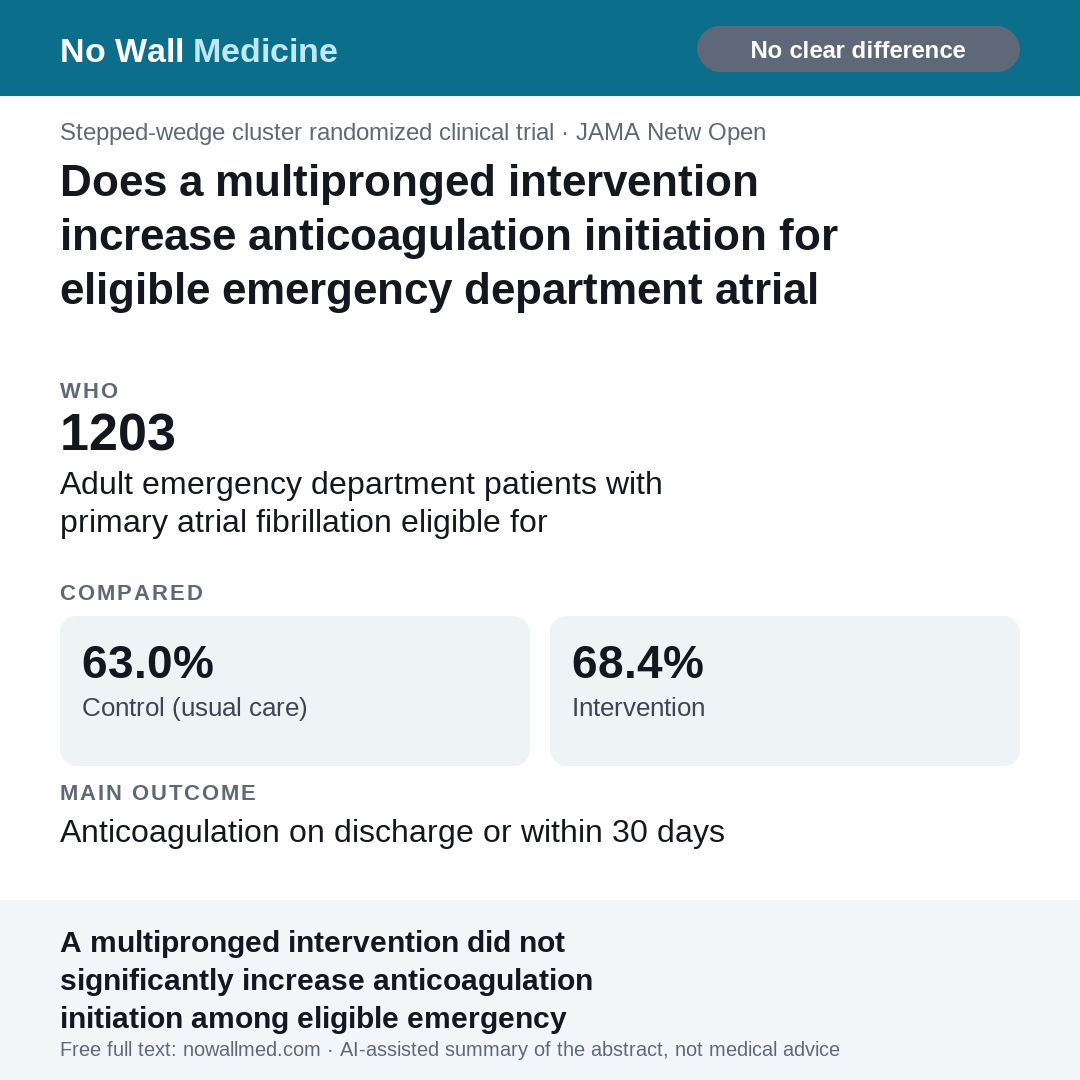
Clinical question: Does a multipronged intervention increase anticoagulation initiation for eligible emergency department atrial fibrillation patients?
Why it matters: Efforts to increase the use of blood thinners for stroke prevention in emergency department patients have yielded conflicting results.
Key points
- Researchers studied 1203 adult emergency department patients with atrial fibrillation or atrial flutter who were eligible for blood thinner initiation.
- The multipronged intervention was not associated with a statistically significant change in anticoagulation initiation compared to usual care (adjusted odds ratio, 1.33 [95% CI, 0.75-2.35]; P = .13).
- Among patients who used the decision support, 75.6% received anticoagulation compared to 65.8% for those who did not use it.
Headline and key points written with AI from the paper’s abstract, with every number checked against it. Read the paper before relying on them.
Topics
Cite this article
Vinson DR, Warton EM, Durant EJ, Mark DG, Ballard DW, Hofmann ER. Decision Support Intervention and Anticoagulation for Emergency Department Atrial Fibrillation: The O'CAFÉ Stepped-Wedge Cluster Randomized Clinical Trial. JAMA Netw Open. 2024. doi:10.1001/jamanetworkopen.2024.43097
Spotted a mistake? Suggest a correction
Top studies every Monday
The week’s key trials and guidelines in your specialties, plus any topics you follow. By email, free.
Get the weekly digest