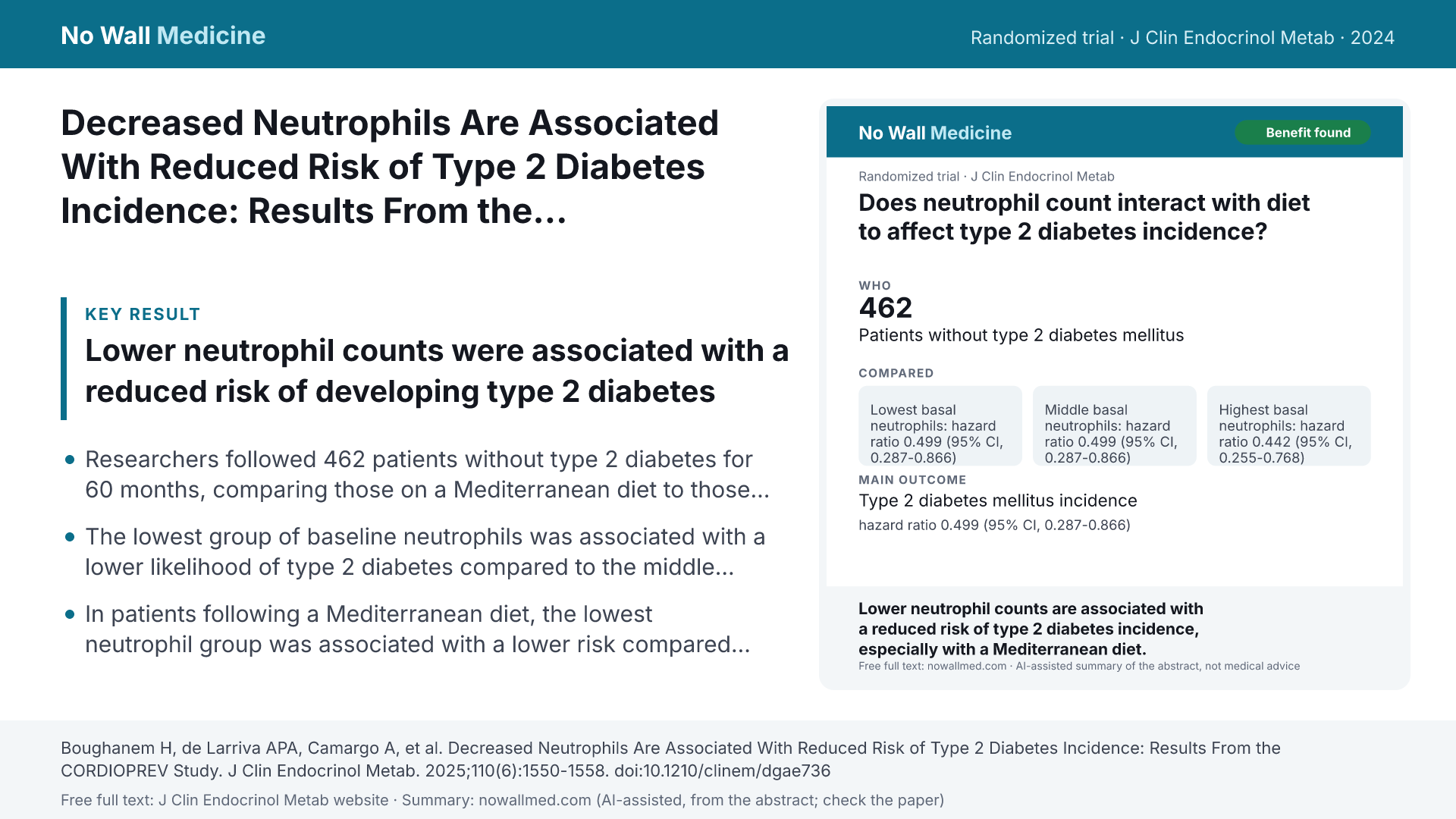
Lower neutrophil counts were associated with a reduced risk of developing type 2 diabetes
Decreased Neutrophils Are Associated With Reduced Risk of Type 2 Diabetes Incidence: Results From the CORDIOPREV Study
Randomized trialBenefit found
Does neutrophil count interact with diet to affect type 2 diabetes incidence?
Who
462
Patients without type 2 diabetes mellitus
Compared
Lowest basal neutrophils: hazard ratio 0.499 (95% CI, 0.287-0.866)
Middle basal neutrophils: hazard ratio 0.499 (95% CI, 0.287-0.866)
Highest basal neutrophils: hazard ratio 0.442 (95% CI, 0.255-0.768)
Main outcome
Type 2 diabetes mellitus incidence
Result: hazard ratio 0.499 (95% CI, 0.287-0.866)
Bottom line: Lower neutrophil counts are associated with a reduced risk of type 2 diabetes incidence, especially with a Mediterranean diet.
J Clin Endocrinol Metab · 2024-10-29 · Save PNG

Clinical question: Does neutrophil count interact with diet to affect type 2 diabetes incidence?
Key points
- Researchers followed 462 patients without type 2 diabetes for 60 months, comparing those on a Mediterranean diet to those on a low-fat diet.
- The lowest group of baseline neutrophils was associated with a lower likelihood of type 2 diabetes compared to the middle (HR = 0.499) and highest (HR = 0.442) groups.
- In patients following a Mediterranean diet, the lowest neutrophil group was associated with a lower risk compared to the middle (HR = 0.423) and highest (HR = 0.371) groups.
Headline and key points written with AI from the paper’s abstract, with every number checked against it. Read the paper before relying on them.
Was this summary helpful?
Subject terms
Headline, design, result, key points, caveat and citation as plain text.
Cite this article
Boughanem H, de Larriva APA, Camargo A, et al. Decreased Neutrophils Are Associated With Reduced Risk of Type 2 Diabetes Incidence: Results From the CORDIOPREV Study. J Clin Endocrinol Metab. 2025;110(6):1550-1558. doi:10.1210/clinem/dgae736
Spotted a mistake? Suggest a correction