Deep brain stimulation was associated with increased serious adverse events in Parkinson's disease patients
Deep brain stimulation for Parkinson's disease: systematic review with meta-analysis and trial sequential analysis
Systematic review with meta-analysisHarm found
What are the benefits and harms of deep brain stimulation for Parkinson's disease?
Who
1125
Patients with Parkinson's disease
Compared
Deep brain stimulation with antiparkinsonian drugs
Antiparkinsonian drugs only
Main outcome
All cause mortality, serious adverse events, and disease specific symptoms
Result: risk ratio 2.36 (95% CI 1.37 to 4.09) for serious adverse events
Bottom line: Deep brain stimulation with antiparkinsonian drugs increased the risk of serious adverse events compared to drugs only.
Limitation: High risk of bias and very low certainty of evidence for all primary outcomes.
BMJ Med · 2024-08-16Download image
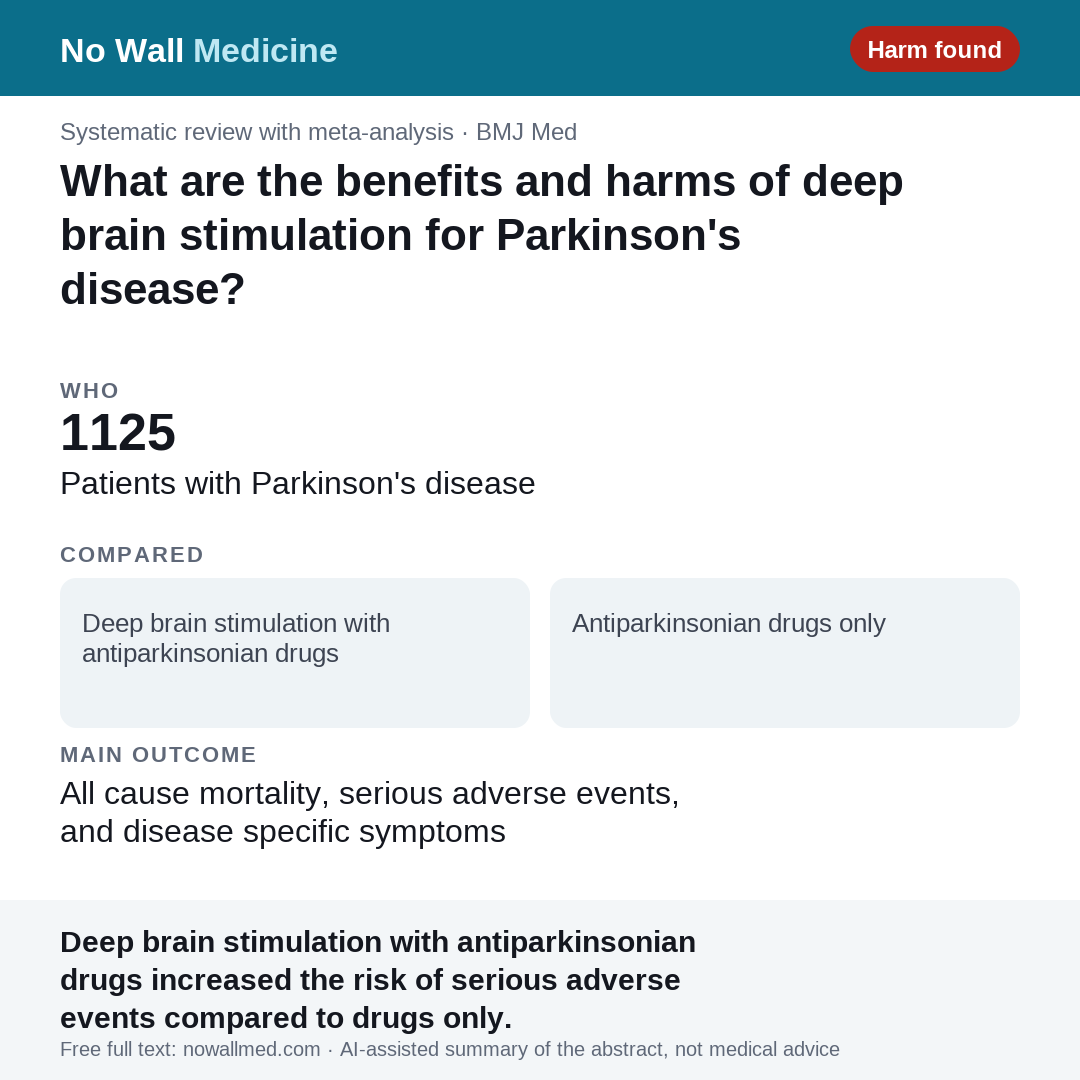
Clinical question: What are the benefits and harms of deep brain stimulation for Parkinson's disease?
Why it matters: The benefits and harms of deep brain stimulation compared to medication alone for Parkinson's disease remain uncertain due to low certainty of evidence.
Key points
- Researchers analyzed seven randomized clinical trials involving 1125 participants comparing deep brain stimulation plus medication to medication alone.
- Deep brain stimulation was associated with an increased risk of serious adverse events, with a risk ratio of 2.36 (95% CI 1.37 to 4.09).
- Adverse events included perioperative complications like brain bleeds and confusion, as well as hardware issues like device dislocation or infection.
Limitation the authors note: All included trials had a high risk of bias and the certainty of evidence was very low for all primary outcomes.
Headline and key points written with AI from the paper’s abstract, with every number checked against it. Read the paper before relying on them.
Was this summary helpful?
Abstract
Objective
To assess the benefits and harms of deep brain stimulation for Parkinson's disease. Design
Systematic review with meta-analysis and trial sequential analysis. Data sources
Cochrane Central Register of Controlled Trials (CENTRAL), Medline, Embase, Latin American and Caribbean Health Sciences Literature (LILACS), and other sources, from inception to 9 May 2023. Eligibility criteria for selecting studies
Randomised clinical trials of deep brain stimulation with antiparkinsonian drug treatment use versus antiparkinsonian drugs only (primary comparison, seven trials) for Parkinson's disease. Other comparisons were deep brain stimulation versus surgery with sham stimulation (three trials) and versus resective surgery (two trials). Results
Primary outcomes were all cause mortality, serious adverse events, and disease specific symptoms. In seven trials, 1125 participants were randomised to receive deep brain stimulation with antiparkinsonian drugs versus antiparkinsonian drugs only. All results had a high risk of bias and the certainty of the evidence was very low for all primary outcomes. Information size was insufficient for assessing all cause mortality (risk ratio 2.69, 95% confidence interval (CI) 0.79 to 9.24; I2=0.0%; τ2=0.00; P=0.12; four trials). Meta-analysis showed that deep brain stimulation increased the risk of serious adverse events (risk ratio 2.36, 95% CI 1.37 to 4.09; I2=73.7%; τ2=0.24; P<0.01; six trials) mainly because of an increased risk of perioperative complications, such as cerebral haemorrhages and postoperative confusion, and hardware related events, such as infection at the stimulator site, dislocation of the device, or reoperations. Meta-analyses indicated that deep brain stimulation might reduce some symptoms specific to Parkinson's disease, but assessment of disease specific symptoms in these trials had methodological limitations, including not reporting overall symptom scores. Conclusions
The certainty of evidence was very low for all primary outcomes, and based on the included evidence, the beneficial effects were questionable because of methodological limitations. Compared with only antiparkinsonian drug treatment, deep brain stimulation with antiparkinsonian drugs seemed to increase the risk of serious adverse events, mainly because of perioperative complications and hardware related events. Conducting randomised clinical trials of adequate methodological quality to effectively evaluate the effects of deep brain stimulation is crucial. Systematic review registration
PROSPERO CRD42022306556.
Abstract reproduced under the article’s CC BY NC licence.
Cite this article
Petersen JJ, Kamp CB, Faltermeier P, Juul S, Løkkegaard A, Gluud C. Deep brain stimulation for Parkinson's disease: systematic review with meta-analysis and trial sequential analysis. BMJ Med. 2024. doi:10.1136/bmjmed-2023-000705
Spotted a mistake? Suggest a correction
Top studies every Monday
The week’s key trials and guidelines in your specialties, plus any topics you follow. By email, free.
Get the weekly digest