Postdiagnostic support programme increased physical activity and medication adherence in people with early-stage dementia
Postdiagnostic support programme for people newly diagnosed with early-stage dementia: a randomised controlled trial
Multisite, waitlist randomised clinical trialBenefit found
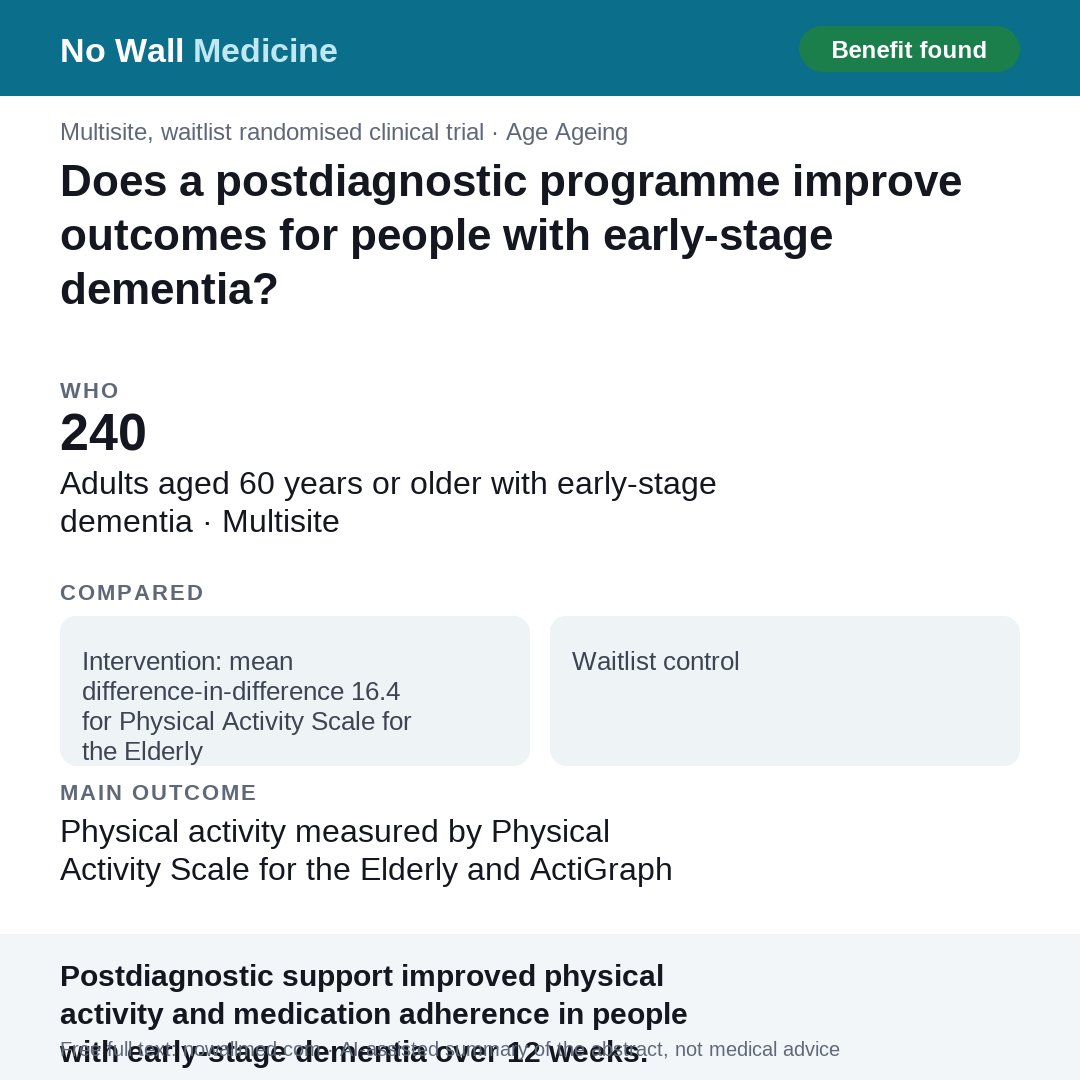
Does a postdiagnostic programme improve outcomes for people with early-stage dementia?
Who
240
Adults aged 60 years or older with early-stage dementia · Multisite
Compared
Intervention: mean difference-in-difference 16.4 for Physical Activity Scale for the Elderly
Waitlist control
Main outcome
Physical activity measured by Physical Activity Scale for the Elderly and ActiGraph
Result: mean difference-in-difference 16.4 (95% CI 0.84 to 31.87)
Bottom line: Postdiagnostic support improved physical activity and medication adherence in people with early-stage dementia over 12 weeks.
Age Ageing · 2026-11-22Download image
Clinical question: Does a postdiagnostic programme improve outcomes for people with early-stage dementia?
Why it matters: It is unknown if a structured multicomponent postdiagnostic programme can enhance self-care management for people newly diagnosed with early-stage dementia.
Key points
- The trial studied 240 adults aged 60 years or older with a recent dementia diagnosis, comparing a structured group intervention to a waitlist control group.
- Participants in the intervention group showed significantly greater improvements in physical activity scores, daily sedentary breaks, and medication adherence at 12 weeks.
- No significant differences were found between the groups regarding malnutritional risks, health-related quality of life, or healthcare utilisation.
Headline and key points written with AI from the paper’s abstract, with every number checked against it. Read the paper before relying on them.
Was this summary helpful?
Subject terms
Cite this article
Chan HY, Tao A, Chui KC, Ho FK, Wong BP, Lam SK. Postdiagnostic support programme for people newly diagnosed with early-stage dementia: a randomised controlled trial. Age Ageing. 2026. doi:10.1093/ageing/afag334
Spotted a mistake? Suggest a correction
Top studies every Monday
The week’s key trials and guidelines in your specialties, plus any topics you follow. By email, free.
Get the weekly digest