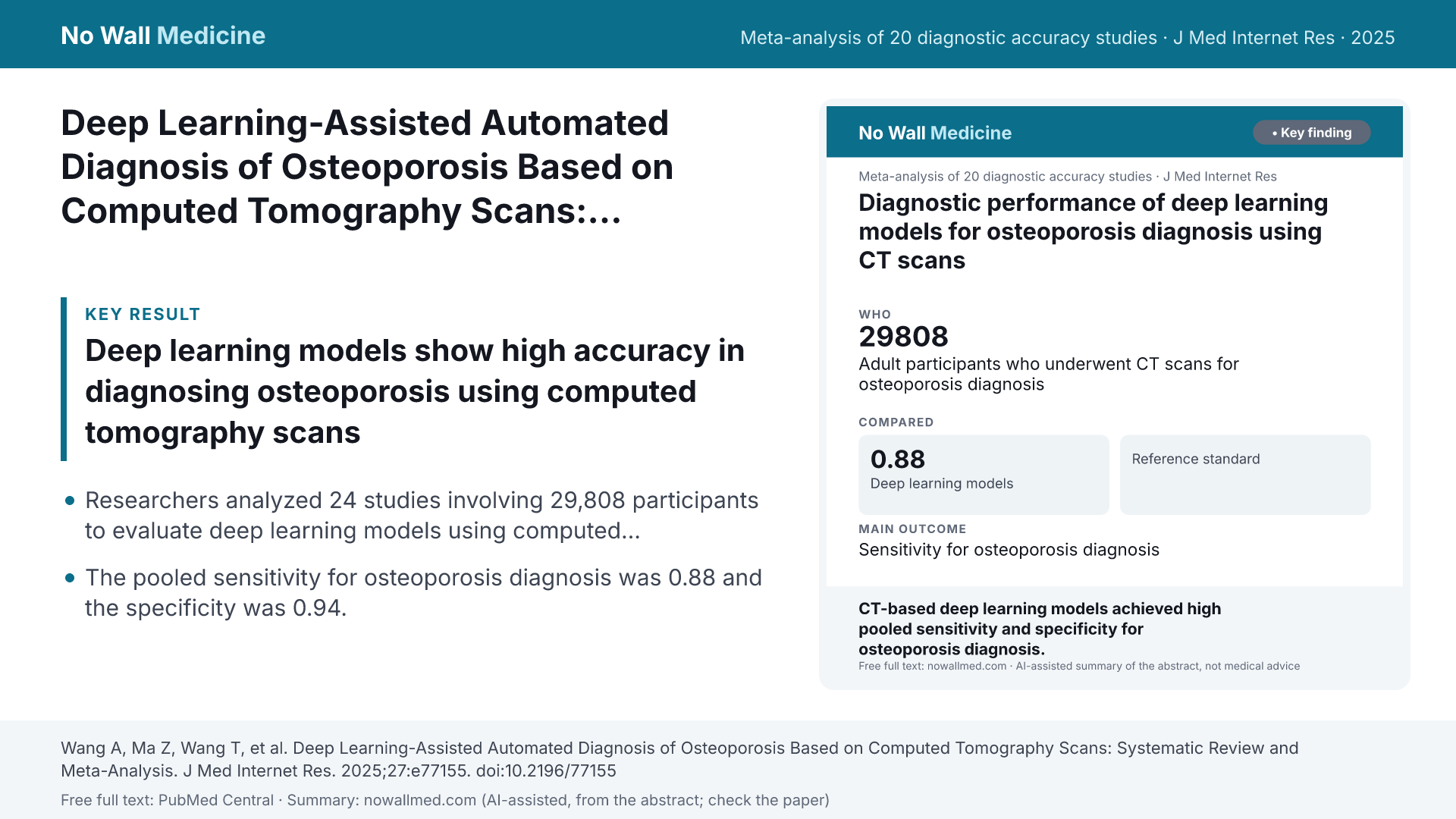
Deep Learning-Assisted Automated Diagnosis of Osteoporosis Based on Computed Tomography Scans: Systematic Review and Meta-Analysis
Key result: Deep learning models show high accuracy in diagnosing osteoporosis using computed tomography scans
Key points
- Researchers analyzed 24 studies involving 29,808 participants to evaluate deep learning models using computed tomography scans.
- The pooled sensitivity for osteoporosis diagnosis was 0.88 and the specificity was 0.94.
- The area under the curve for identifying osteoporosis, osteopenia, and normal cases was 0.96, 0.94, and 0.98, respectively.
Why it matters: Osteoporosis is frequently underdiagnosed because it often has no symptoms and healthcare resources for screening are limited.
Limitation the authors note: Substantial heterogeneity among studies, limited external validation, and incomplete end-to-end pipelines constrain the generalizability of the models.
Discussion prompts
- Would these patients look like yours? Who was left out?
- Is the main outcome one that matters to patients?
- Is the difference large enough to change what you do?
Cite: Wang A, Ma Z, Wang T, et al. Deep Learning-Assisted Automated Diagnosis of Osteoporosis Based on Computed Tomography Scans: Systematic Review and Meta-Analysis. J Med Internet Res. 2025;27:e77155. doi:10.2196/77155
Free full text: PubMed Central · Summary and visual abstract: nowallmed.com/a/deep-learning-assisted-automated-diagnosis-of-osteoporosis-based-on-1p917io/ (AI-assisted from the abstract; check the paper before relying on it).