Deep learning shows high accuracy in detecting and measuring brain bleeding on CT scans
Deep learning-assisted detection and segmentation of intracranial hemorrhage in noncontrast computed tomography scans of acute stroke patients: a systematic review and meta-analysis
Systematic review and meta-analysisBenefit found
How accurate is deep learning for detecting and segmenting intracranial hemorrhage in noncontrast computed tomography scans?
Who
36
Acute stroke patients with noncontrast computed tomography scans
Compared
Deep learning technologies: sensitivity 0.89 (95% CI: 0.88-0.90)
Manual labeling
Main outcome
Detection and segmentation of intracranial hemorrhage
Result: AUROC 0.94 (95% CI: 0.93-0.95)
Bottom line: Deep learning shows comparable performance to clinicians in hemorrhage identification and segmentation with greater efficiency and reduced cost.
Int J Surg · 2024-06-01Download image
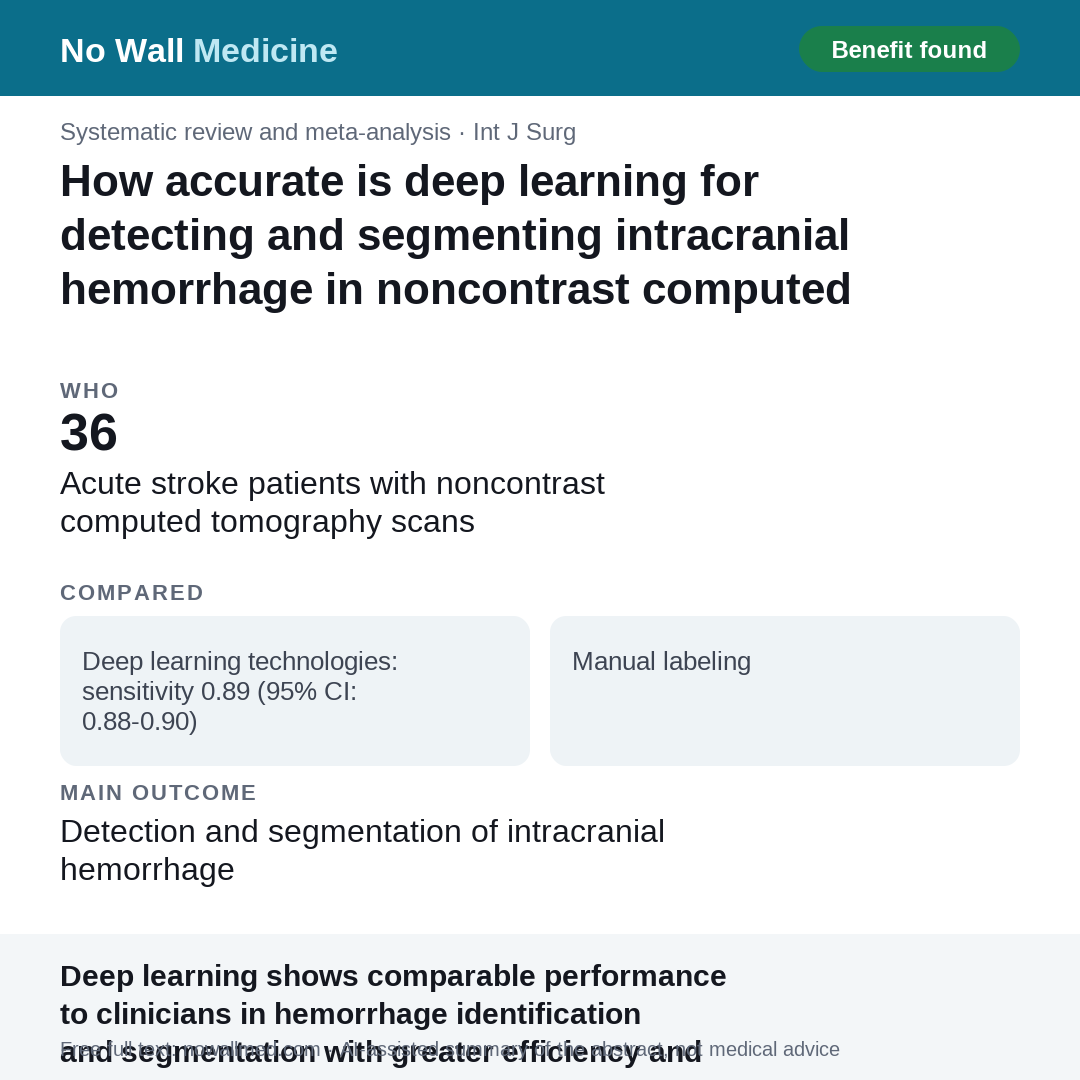
Clinical question: How accurate is deep learning for detecting and segmenting intracranial hemorrhage in noncontrast computed tomography scans?
Why it matters: The performance of deep learning for detecting and segmenting intracranial hemorrhage in noncontrast computed tomography scans lacked sufficient evidence.
Key points
- Researchers analyzed 36 studies to evaluate deep learning technologies for detecting and segmenting intracranial hemorrhage, which is bleeding inside the skull, on noncontrast computed tomography scans.
- The pooled results showed a sensitivity of 0.89, a specificity of 0.91, and an area under the receiver operating characteristic curve of 0.94.
- Deep learning technologies were associated with less processing time than manual labeling, though there was no significant difference in hemorrhage quantification.
Headline and key points written with AI from the paper’s abstract, with every number checked against it. Read the paper before relying on them.
Was this summary helpful?
Subject terms
Cite this article
Hu P, Yan T, Xiao B, Shu H, Sheng Y, Wu Y. Deep learning-assisted detection and segmentation of intracranial hemorrhage in noncontrast computed tomography scans of acute stroke patients: a systematic review and meta-analysis. Int J Surg. 2024. doi:10.1097/JS9.0000000000001266
Spotted a mistake? Suggest a correction
Top studies every Monday
The week’s key trials and guidelines in your specialties, plus any topics you follow. By email, free.
Get the weekly digest