High oxygen during delayed cord clamping was associated with higher oxygen levels in preterm infants
Deferred Cord Clamping With High Oxygen in Extremely Preterm Infants: A Randomized Clinical Trial
Double-blinded randomized clinical trialBenefit found
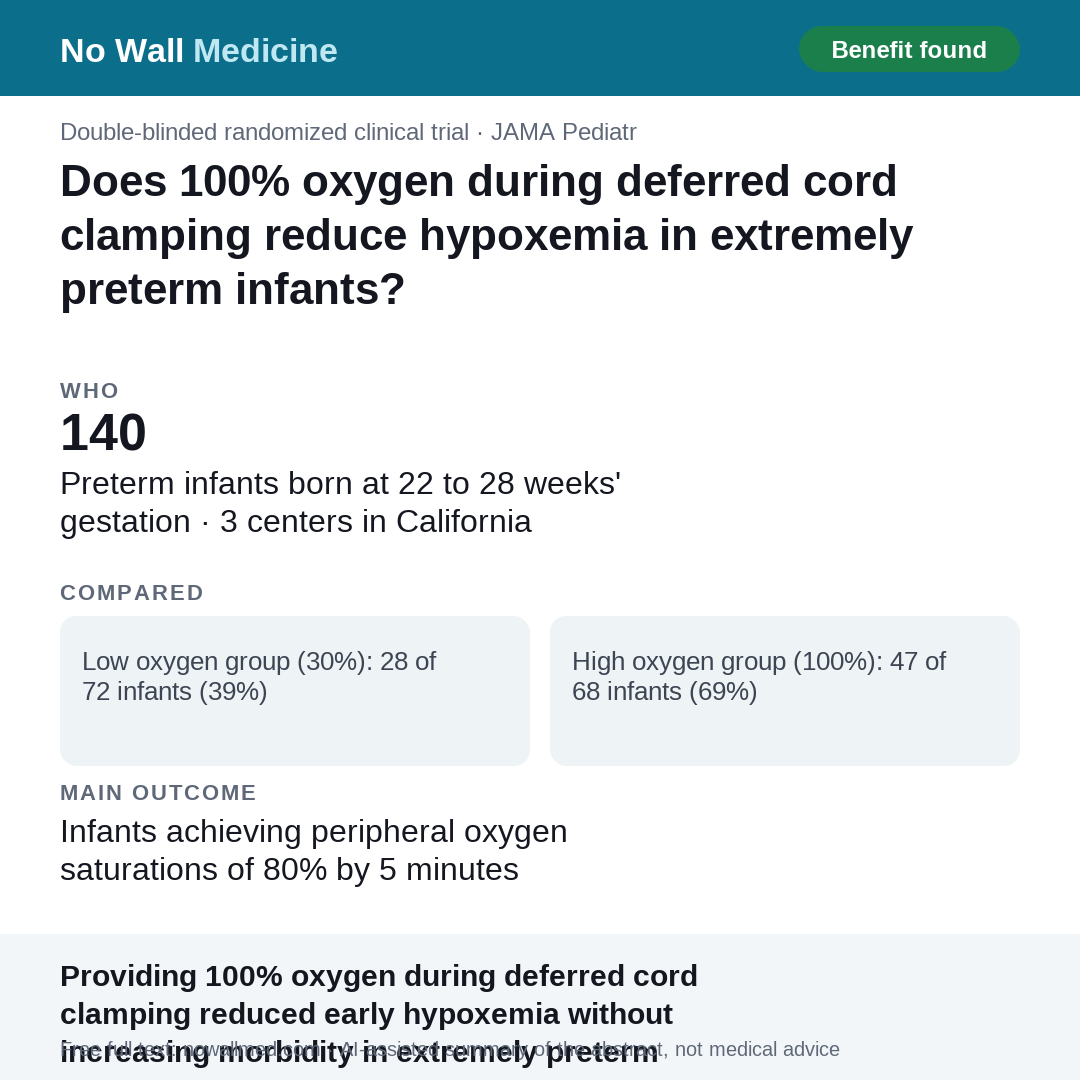
Does 100% oxygen during deferred cord clamping reduce hypoxemia in extremely preterm infants?
Who
140
Preterm infants born at 22 to 28 weeks' gestation · 3 centers in California
Compared
Low oxygen group (30%): 28 of 72 infants (39%)
High oxygen group (100%): 47 of 68 infants (69%)
Main outcome
Infants achieving peripheral oxygen saturations of 80% by 5 minutes
Result: adjusted odds ratio 3.74 (95% CI 1.80-7.79)
Bottom line: Providing 100% oxygen during deferred cord clamping reduced early hypoxemia without increasing morbidity in extremely preterm infants.
Limitation: A large randomized clinical trial is needed to determine long-term survival and morbidities.
JAMA Pediatr · 2025-07-21Download image
Clinical question: Does 100% oxygen during deferred cord clamping reduce hypoxemia in extremely preterm infants?
Why it matters: It is unknown if providing 100% oxygen via face mask during the window of delayed cord clamping reduces hypoxemia, which is low blood oxygen, in preterm newborns.
Key points
- Researchers studied 140 preterm infants born between 22 to 28 weeks' gestation who were randomized to receive either 30% or 100% oxygen during delayed cord clamping.
- In the high oxygen group, 47 of 68 infants (69%) achieved a peripheral oxygen saturation of 80% by 5 minutes of life compared to 28 of 72 infants (39%) in the low oxygen group.
- There were no differences between the groups regarding maximum oxygen levels during resuscitation, arterial blood oxygen levels, severe brain bleeding, or death before 40 weeks' postmenstrual age.
Headline and key points written with AI from the paper’s abstract, with every number checked against it. Read the paper before relying on them.
Topics
Cite this article
Katheria AC, Ines F, Lee HC, Sollinger C, Vali P, Morales A. Deferred Cord Clamping With High Oxygen in Extremely Preterm Infants: A Randomized Clinical Trial. JAMA Pediatr. 2025. doi:10.1001/jamapediatrics.2025.2128
Spotted a mistake? Suggest a correction
Top studies every Monday
The week’s key trials and guidelines in your specialties, plus any topics you follow. By email, free.
Get the weekly digest