Assisted ventilation before umbilical cord clamping did not reduce brain hemorrhage or early death
Ventilatory Assistance Before Umbilical Cord Clamping in Extremely Preterm Infants: A Randomized Clinical Trial
Phase 3, 1:1, parallel-stratified randomized clinical trialNo clear difference
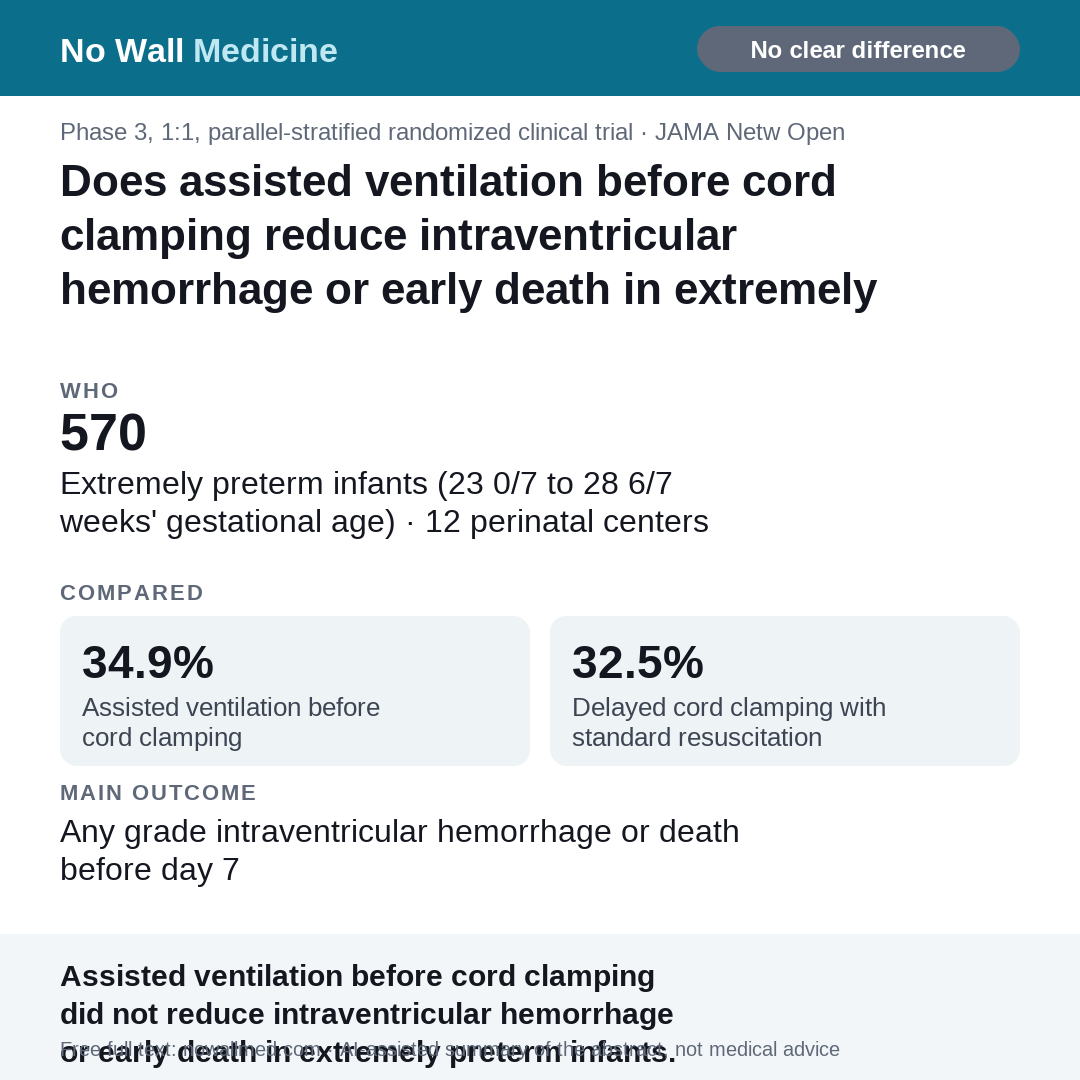
Does assisted ventilation before cord clamping reduce intraventricular hemorrhage or early death in extremely preterm infants?
Who
570
Extremely preterm infants (23 0/7 to 28 6/7 weeks' gestational age) · 12 perinatal centers across the US and Canada
Compared
34.9%Assisted ventilation before cord clamping (97 of 278)
32.5%Delayed cord clamping with standard resuscitation (95 of 292)
Main outcome
Any grade intraventricular hemorrhage or death before day 7
Result: adjusted relative risk 1.02 (95% CI 0.81-1.27)
Bottom line: Assisted ventilation before cord clamping did not reduce intraventricular hemorrhage or early death in extremely preterm infants.
JAMA Netw Open · 2024-05-01Download image
Clinical question: Does assisted ventilation before cord clamping reduce intraventricular hemorrhage or early death in extremely preterm infants?
Why it matters: It was unknown if providing assisted ventilation during delayed umbilical cord clamping improves outcomes for infants born between 23 0/7 and 28 6/7 weeks' gestational age.
Key points
- Researchers randomized 570 extremely preterm infants to receive 120 seconds of assisted ventilation before cord clamping or 30 to 60 seconds of delayed cord clamping followed by standard resuscitation.
- The combined outcome of intraventricular hemorrhage, which is bleeding in the brain, or death before day 7 occurred in 34.9% of the intervention group and 32.5% of the control group.
- In the cohort of infants not breathing well after birth, the outcome occurred in 38.7% of the intervention group and 43.0% of the control group.
Headline and key points written with AI from the paper’s abstract, with every number checked against it. Read the paper before relying on them.
Topics
Cite this article
Fairchild KD, Petroni GR, Varhegyi NE, Strand ML, Josephsen JB, Niermeyer S. Ventilatory Assistance Before Umbilical Cord Clamping in Extremely Preterm Infants: A Randomized Clinical Trial. JAMA Netw Open. 2024. doi:10.1001/jamanetworkopen.2024.11140
Spotted a mistake? Suggest a correction
Top studies every Monday
The week’s key trials and guidelines in your specialties, plus any topics you follow. By email, free.
Get the weekly digest