Inconsistent methods for defining infant race and ethnicity lead to frequent data misclassification
Defining an Infant's Race and Ethnicity: A Systematic Review
Systematic reviewHarm found
How consistent are different methods of collecting infant race and ethnicity data?
Who
United States infant population · United States
Compared
Infants of color: most likely to be misclassified
Infants with racially discordant parents: most likely to be misclassified
Main outcome
Concordance among differing race and ethnicity data collection techniques
Bottom line: Discordance in data collection methods leads to inaccurate reporting of infant morbidity and mortality.
Limitation: Studies were heterogeneous in methodology and populations and data could not be compiled for analysis.
Pediatrics · 2022-12-29Download image
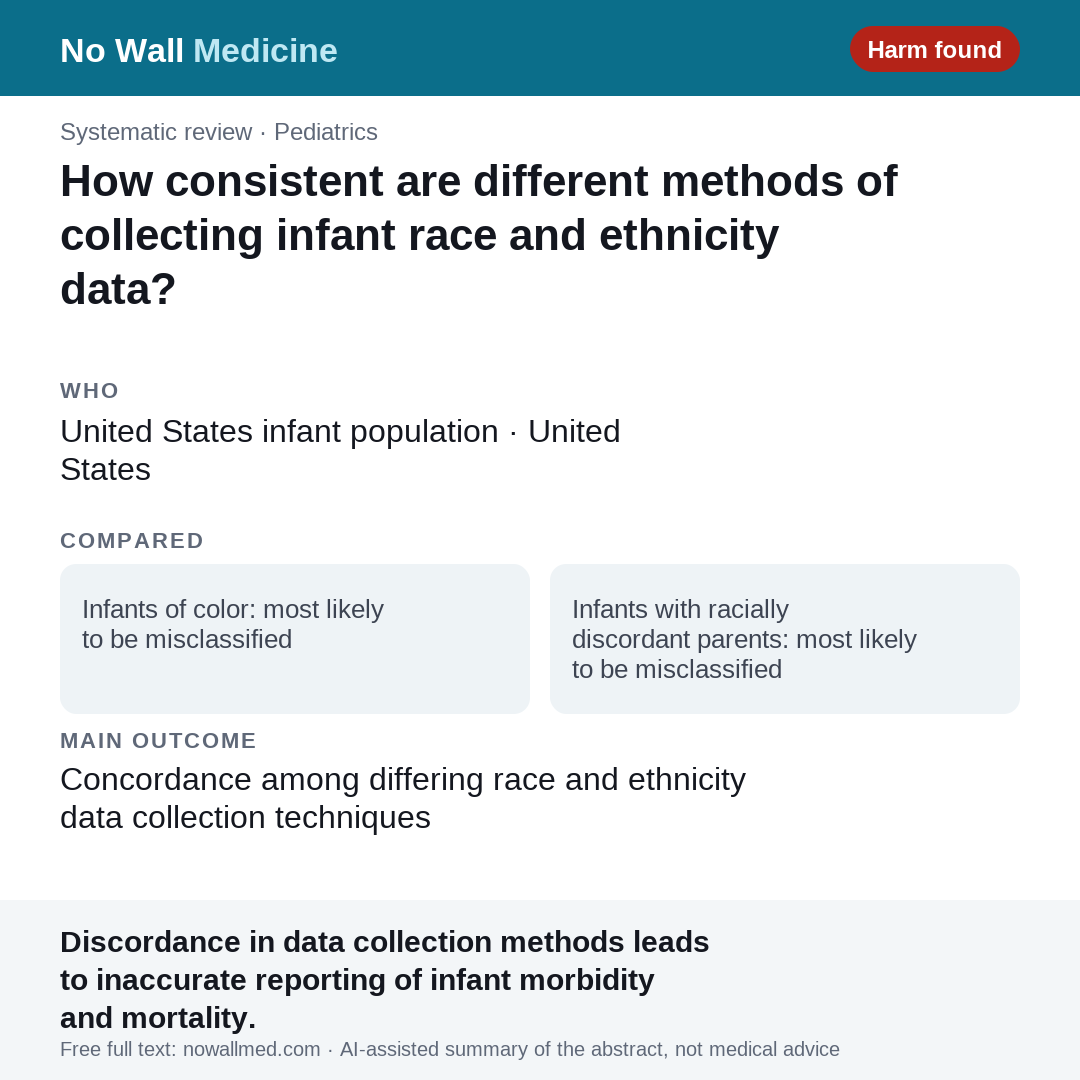
Clinical question: How consistent are different methods of collecting infant race and ethnicity data?
Why it matters: Inconsistent approaches to data collection and definitions for infant race and ethnicity yield variable results in perinatal health care research.
Key points
- Researchers reviewed 12 studies published between 1980 and 2021 that compared different methods of capturing race and ethnicity in the United States infant population.
- Discordance in race and ethnicity data was common across multiple collection methods, particularly for infants of color and those with racially or ethnically discordant parents.
- Misclassification was associated with inaccurate reporting of infant illness and death, often underestimating the burden in minoritized groups and overestimating it in the non-Hispanic/Latinx white population.
Limitation the authors note: Studies were heterogeneous in methodology and populations of study and data could not be compiled for analysis.
Headline and key points written with AI from the paper’s abstract, with every number checked against it. Read the paper before relying on them.
Was this summary helpful?
Subject terms
Cite this article
Weikel BW, Klawetter S, Bourque SL, Hannan KE, Roybal K, Soondarotok M. Defining an Infant's Race and Ethnicity: A Systematic Review. Pediatrics. 2022. doi:10.1542/peds.2022-058756
Spotted a mistake? Suggest a correction
Top studies every Monday
The week’s key trials and guidelines in your specialties, plus any topics you follow. By email, free.
Get the weekly digest