Defining COVID-19-associated pulmonary aspergillosis: systematic review and meta-analysis
Systematic review and meta-analysisMixed results
What are the prevalence, diagnosis, treatment, and outcomes of COVID-19-associated pulmonary aspergillosis?
Who
3297
Adult patients in intensive care units with COVID-19
Compared
COVID-19 patients in ICU cohort studies: prevalence 10% (95% CI 8%-13%)
59.2%Mortality rate
Main outcome
Prevalence, diagnosis, treatment, and outcomes of COVID-19-associated pulmonary aspergillosis
Bottom line: COVID-19-associated pulmonary aspergillosis prevalence is significant but may be exaggerated by nonstandard definitions.
Limitation: Definitions had limited correlation with one another.
Clin Microbiol Infect · 2022-02-10Download image
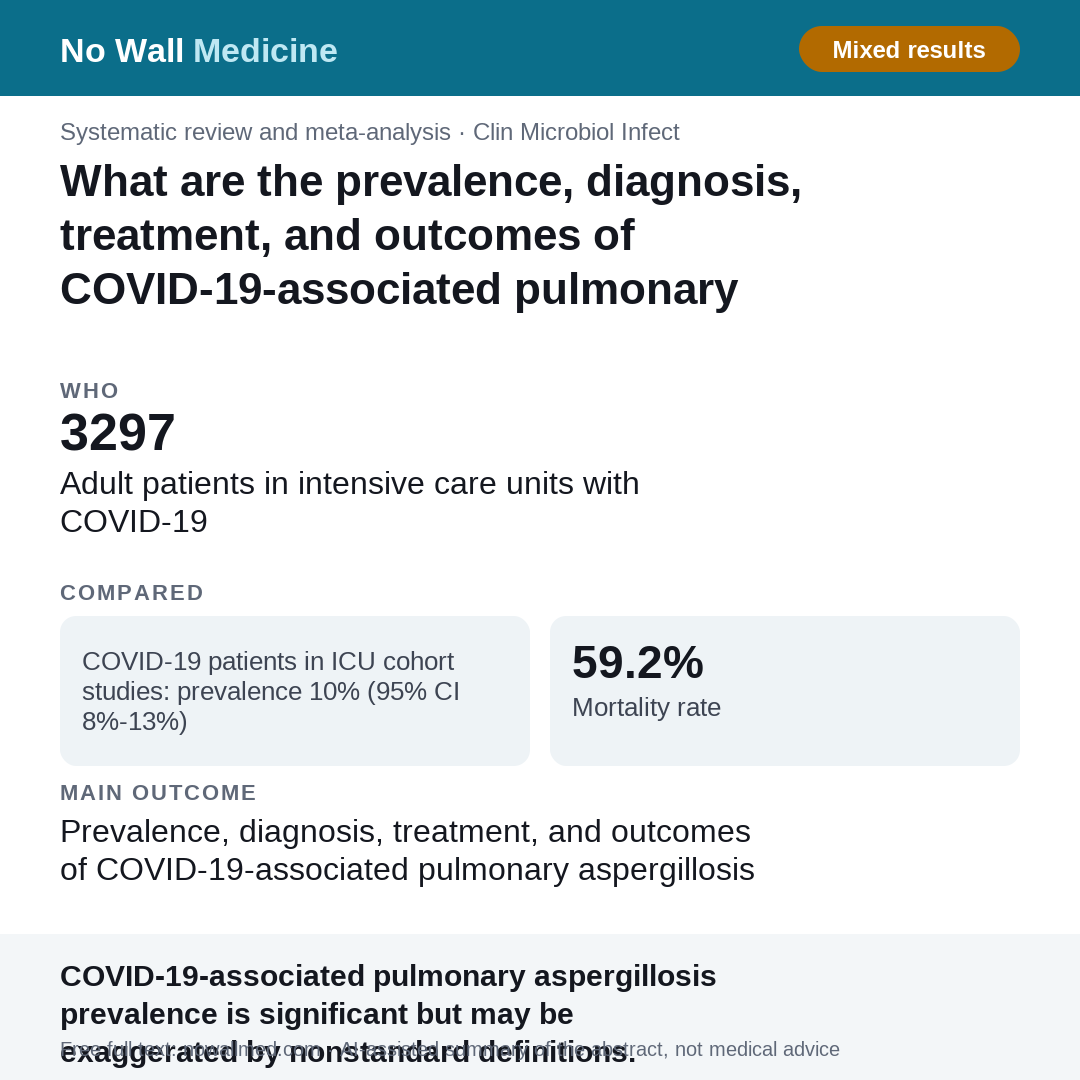
Clinical question: What are the prevalence, diagnosis, treatment, and outcomes of COVID-19-associated pulmonary aspergillosis?
Abstract
Background
Pulmonary aspergillosis may complicate coronavirus disease 2019 (COVID-19) and contribute to excess mortality in intensive care unit (ICU) patients. The disease is poorly understood, in part due to discordant definitions across studies. Objectives
We sought to review the prevalence, diagnosis, treatment, and outcomes of COVID-19-associated pulmonary aspergillosis (CAPA) and compare research definitions. Data sources
PubMed, Embase, Web of Science, and MedRxiv were searched from inception to October 12, 2021. Study eligibility criteria
ICU cohort studies and CAPA case series including ≥3 patients were included. Participants
Adult patients in ICUs with COVID-19. Interventions
Patients were reclassified according to four research definitions. We assessed risk of bias with an adaptation of the Joanna Briggs Institute cohort checklist tool for systematic reviews. Methods
We calculated CAPA prevalence using the Freeman-Tukey random effects method. Correlations between definitions were assessed with Spearman's rank test. Associations between antifungals and outcome were assessed with random effects meta-analysis. Results
Fifty-one studies were included. Among 3297 COVID-19 patients in ICU cohort studies, 313 were diagnosed with CAPA (prevalence 10%; 95% CI 8%-13%). Two hundred seventy-seven patients had patient-level data allowing reclassification. Definitions had limited correlation with one another (ρ = 0.268-0.447; p < 0.001), with the exception of Koehler and Verweij (ρ = 0.893; p < 0.001); 33.9% of patients reported to have CAPA did not fulfill any research definitions. Patients were diagnosed after a median of 8 days (interquartile range 5-14) in ICUs. Tracheobronchitis occurred in 3% of patients examined with bronchoscopy. The mortality rate was high (59.2%). Applying CAPA research definitions did not strengthen the association between mould-active antifungals and survival. Conclusions
The reported prevalence of CAPA is significant but may be exaggerated by nonstandard definitions.
Subject terms
Cite this article
Kariyawasam RM, Dingle TC, Kula BE, Vandermeer B, Sligl WI, Schwartz IS. Defining COVID-19-associated pulmonary aspergillosis: systematic review and meta-analysis. Clin Microbiol Infect. 2022. doi:10.1016/j.cmi.2022.01.027
Spotted a mistake? Suggest a correction
Top studies every Monday
The week’s key trials and guidelines in your specialties, plus any topics you follow. By email, free.
Get the weekly digest