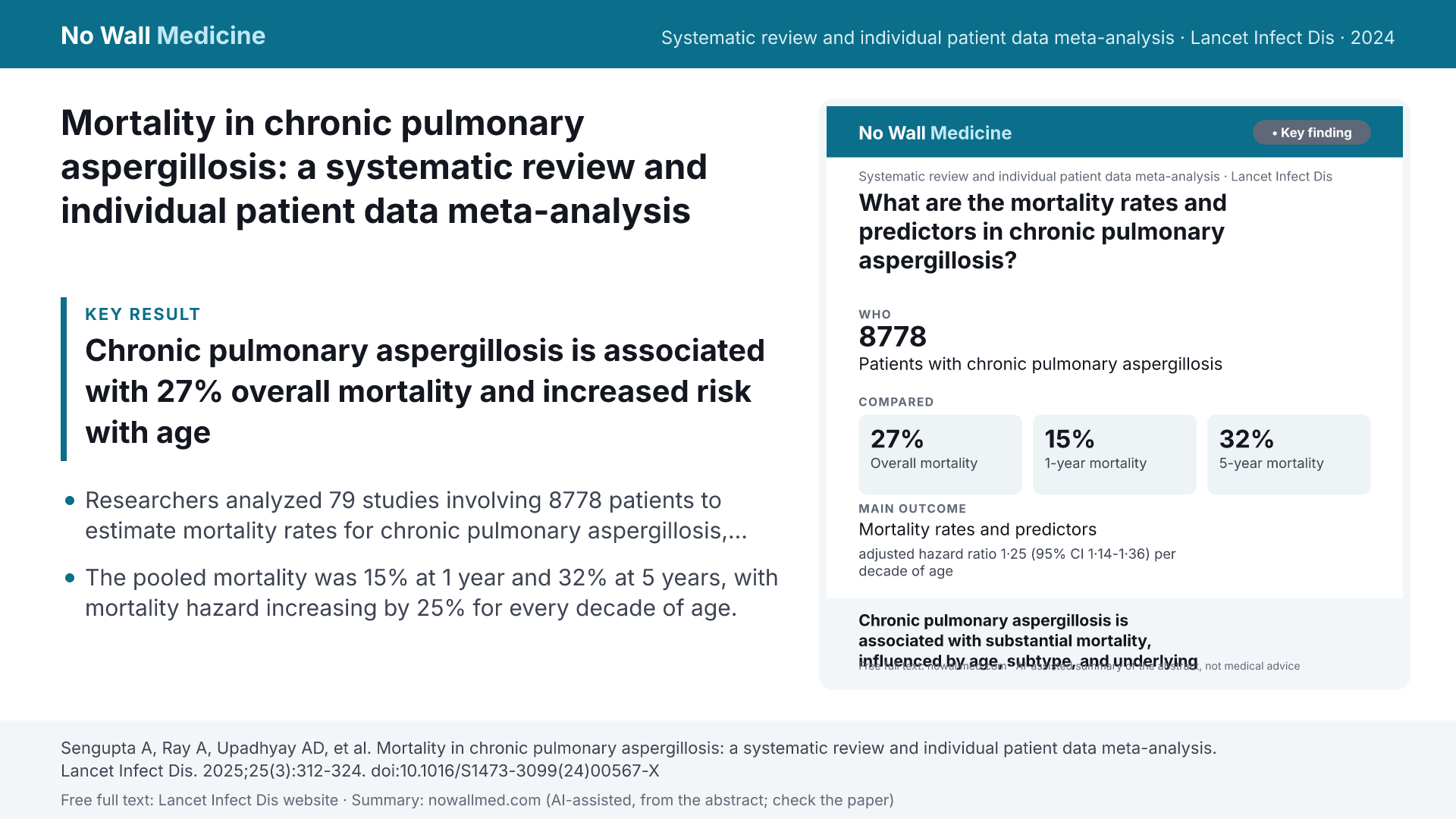
Chronic pulmonary aspergillosis is associated with 27% overall mortality and increased risk with age
Mortality in chronic pulmonary aspergillosis: a systematic review and individual patient data meta-analysis
Systematic review and individual patient data meta-analysisKey finding
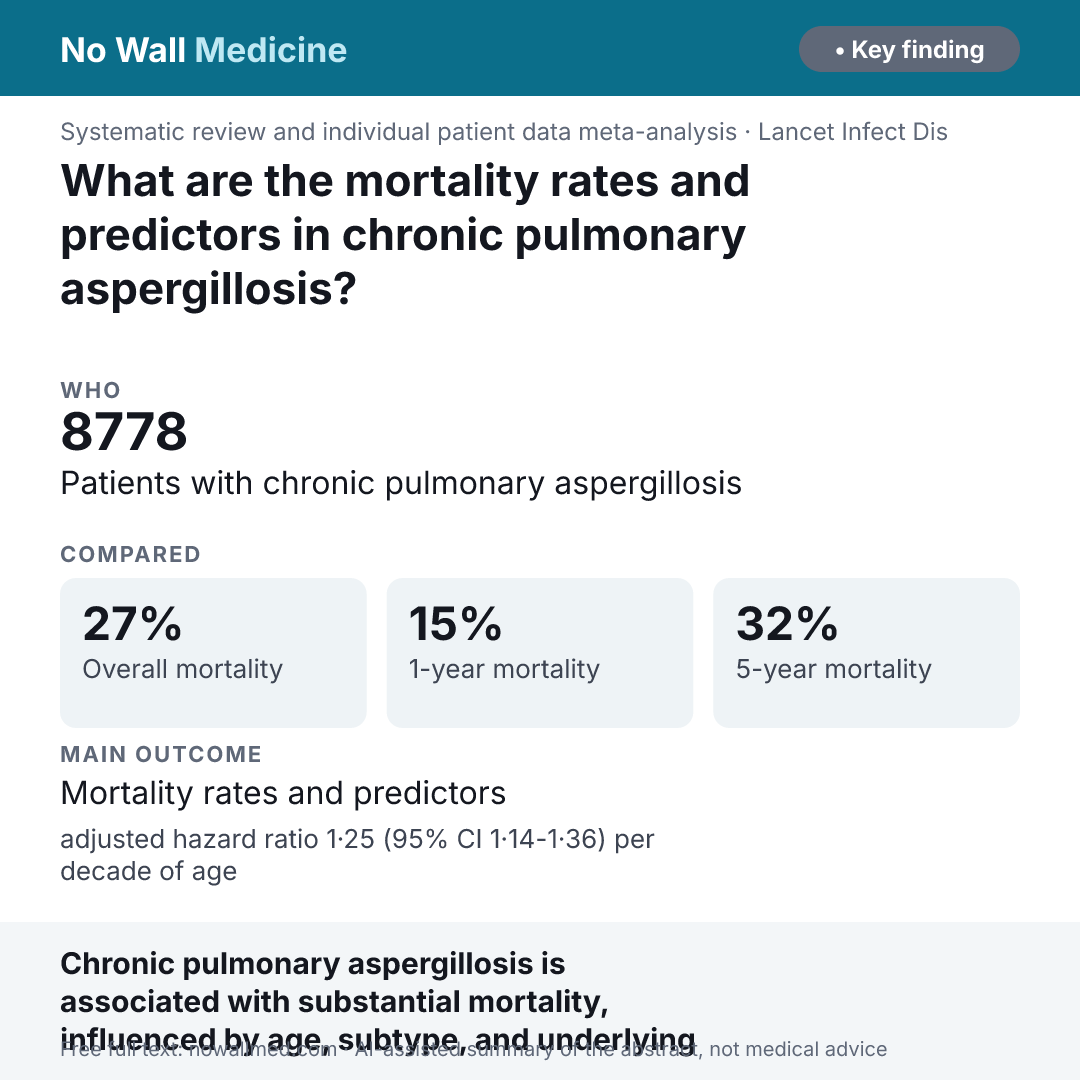
What are the mortality rates and predictors in chronic pulmonary aspergillosis?
Who
8778
Patients with chronic pulmonary aspergillosis
Compared
27%Overall mortality (95% CI 22-32)
15%1-year mortality (11-19)
32%5-year mortality (25-39)
Main outcome
Mortality rates and predictors
Result: adjusted hazard ratio 1·25 (95% CI 1·14-1·36) per decade of age
Bottom line: Chronic pulmonary aspergillosis is associated with substantial mortality, influenced by age, subtype, and underlying comorbidities.
Lancet Infect Dis · 2024-11-29 · Save PNG
Clinical question: What are the mortality rates and predictors in chronic pulmonary aspergillosis?
Why it matters: The rates of death and the specific factors that predict mortality in patients with chronic pulmonary aspergillosis were not clearly established.
Key points
- Researchers analyzed 79 studies involving 8778 patients to estimate mortality rates for chronic pulmonary aspergillosis, a fungal lung infection.
- The pooled mortality was 15% at 1 year and 32% at 5 years, with mortality hazard increasing by 25% for every decade of age.
- Underlying malignancy and specific subtypes like subacute invasive pulmonary aspergillosis were associated with increased mortality compared to simple aspergilloma.
Headline and key points written with AI from the paper’s abstract, with every number checked against it. Read the paper before relying on them.
Was this summary helpful?
Abstract
Background
Despite antifungal treatment, chronic pulmonary aspergillosis (CPA) is associated with substantial morbidity and mortality. We conducted a systematic review and meta-analysis to evaluate rates of mortality and its predictors in CPA. Methods
A systematic literature search was conducted across MEDLINE (PubMed), Scopus, Embase, and Web of Science to identify studies in English, reporting mortality in CPA, from database inception to Aug 15, 2023. We included clinical studies, observational studies, controlled trials, and abstracts. Case reports, animal studies, letters, news, and literature reviews were excluded. Authors of studies published since 2016 were also contacted to obtain anonymised individual patient data (IPD); for other studies, summary estimates were extracted. Subgroup analysis was done for differences in overall 1-year and 5-year mortality, data source, study design, risk of bias, country, Human Development Index, age groups, and the underlying lung disease. We used random-effects meta-analyses to estimate pooled mortality rates. Subgroup analyses and meta-regression were done to explore sources of heterogeneity. One-stage meta-analysis with a stratified Cox proportional hazards model was used to estimate the univariable and hazards for mortality, adjusting for age, sex, type of CPA, treatment, and underlying pulmonary comorbidities. This study was registered with PROSPERO (CRD42023453447). Findings
We included 79 studies involving 8778 patients in the overall pooled analysis and 15 studies involving 1859 patients in the IPD meta-analysis. Pooled mortality (from 70 studies) was estimated at 27% overall (95% CI 22-32; I2 =95·4%), 15% at 1 year (11-19; I2 =91·6%), and 32% at 5 years (25-39; I2 =94·3%). Overall mortality in patients with CPA with pulmonary tuberculosis as the predominant predisposing condition was 25% (16-35; I2 =87·5%; 20 studies) and with chronic obstructive pulmonary disease was 35% (22-49; I2 =89·7%; 14 studies). Mortality in cohorts of patients who underwent surgical resection was low at 3% (2-4). In the multivariable analysis, among predisposing respiratory conditions, pulmonary tuberculosis history had the lowest mortality hazard (relative to an absence of the disease at baseline), whereas worse outcomes were seen with underlying malignancy; subacute invasive pulmonary aspergillosis and chronic cavitary pulmonary aspergillosis subtypes of CPA were also significantly associated with increased mortality relative to simple aspergilloma on multivariable analysis. Mortality hazard increased by 25% with each decade of age (adjusted hazard ratio 1·25 [95% CI 1·14-1·36], p<0·0001). Interpretation
CPA is associated with substantial mortality. Advancing age, CPA subtype, and underlying comorbidities are important predictors of mortality. Future studies should focus on identifying appropriate treatment strategies tailored to different risk groups. Funding
None.
Abstract reproduced under the article’s CC BY licence.
Subject terms
Headline, design, result, key points, caveat and citation as plain text.
Cite this article
Sengupta A, Ray A, Upadhyay AD, et al. Mortality in chronic pulmonary aspergillosis: a systematic review and individual patient data meta-analysis. Lancet Infect Dis. 2025;25(3):312-324. doi:10.1016/S1473-3099(24)00567-X
Spotted a mistake? Suggest a correction