Defining end of life in dementia: A systematic review
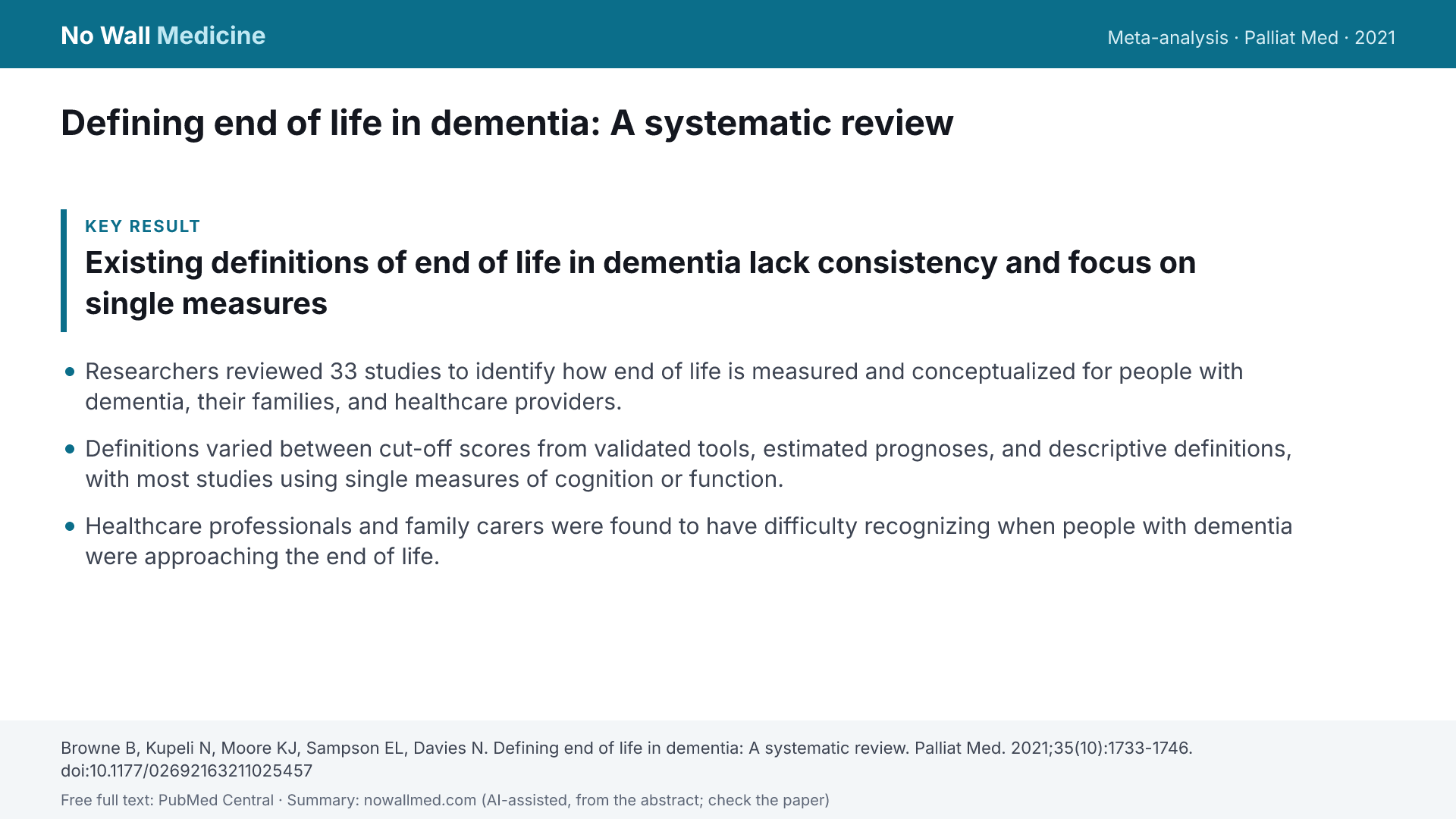
Key result: Existing definitions of end of life in dementia lack consistency and focus on single measures
Key points
- Researchers reviewed 33 studies to identify how end of life is measured and conceptualized for people with dementia, their families, and healthcare providers.
- Definitions varied between cut-off scores from validated tools, estimated prognoses, and descriptive definitions, with most studies using single measures of cognition or function.
- Healthcare professionals and family carers were found to have difficulty recognizing when people with dementia were approaching the end of life.
Why it matters: Existing definitions of end of life do not account for the uncertain trajectory of dementia, where patients may live in advanced stages for years or die earlier.
Discussion prompts
- Would these patients look like yours? Who was left out?
- Is the main outcome one that matters to patients?
- Is the difference large enough to change what you do?
Cite: Browne B, Kupeli N, Moore KJ, Sampson EL, Davies N. Defining end of life in dementia: A systematic review. Palliat Med. 2021;35(10):1733-1746. doi:10.1177/02692163211025457
Free full text: PubMed Central · Summary and visual abstract: nowallmed.com/a/defining-end-of-life-in-dementia-a-systematic-172rexp/ (AI-assisted from the abstract; check the paper before relying on it).