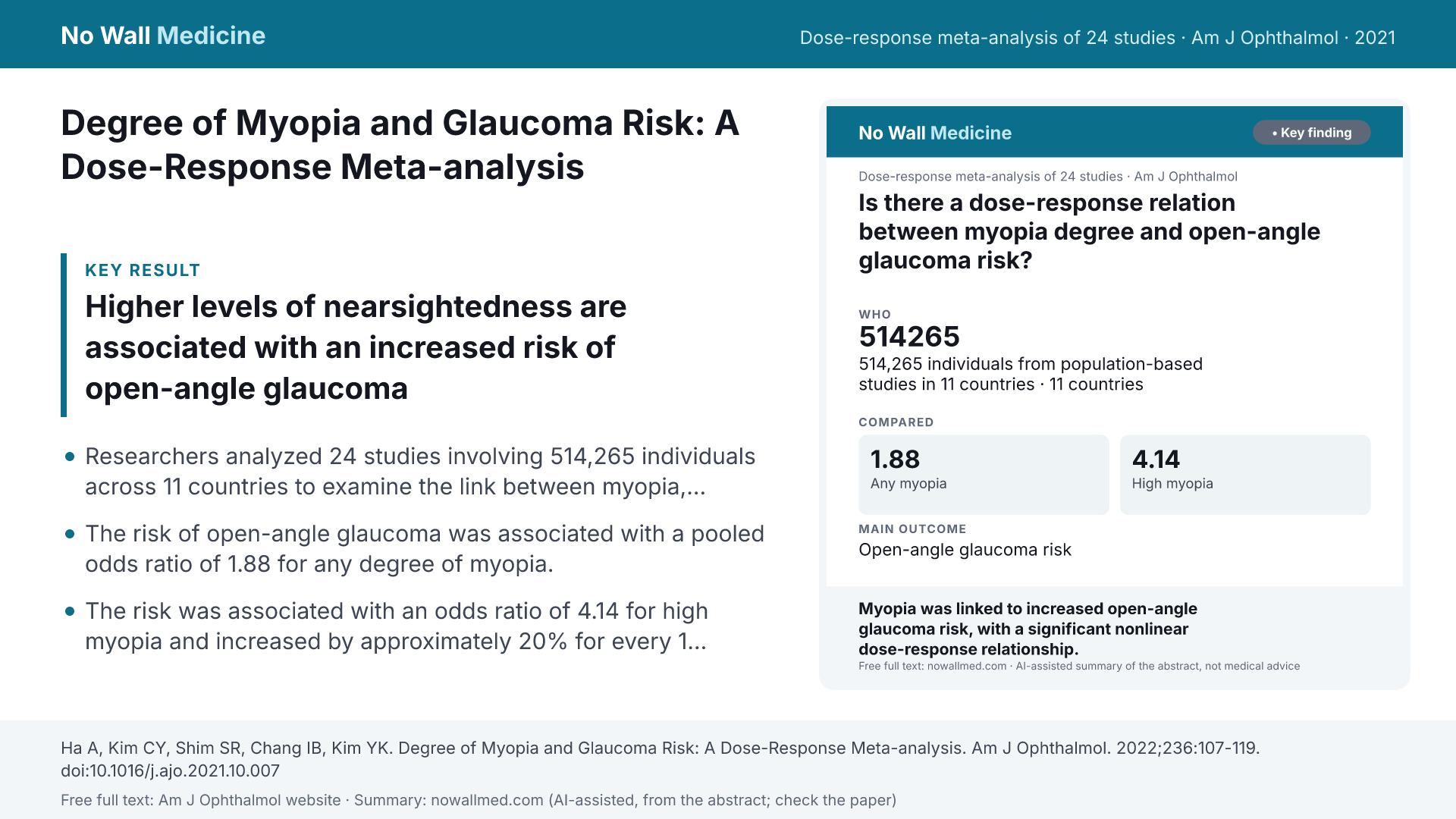
Higher levels of nearsightedness are associated with an increased risk of open-angle glaucoma
Degree of Myopia and Glaucoma Risk: A Dose-Response Meta-analysis
Dose-response meta-analysisHarm found
Is there a dose-response relation between myopia degree and open-angle glaucoma risk?
Who
514265
514,265 individuals from 24 studies · 11 countries
Compared
1.50Low myopia (95% CI, 1.29-1.76)
1.69Moderate myopia (95% CI, 1.33-2.15)
2.27Moderate-to-high myopia (95% CI, 1.74-2.96)
4.14High myopia (95% CI, 2.57-6.69)
Main outcome
Open-angle glaucoma risk
Result: odds ratio 1.21 (95% CI, 1.15-1.28) per 1 diopter decrease
Bottom line: Glaucoma risk increases by approximately 20% for each 1 diopter increase in myopia, with risk accelerating in high myopia.
Am J Ophthalmol · 2021-10-11Download image

Clinical question: Is there a dose-response relation between myopia degree and open-angle glaucoma risk?
Why it matters: It was unknown if a dose-response relationship exists between the specific degree of nearsightedness and the risk of developing open-angle glaucoma.
Key points
- Researchers analyzed 24 studies involving 514,265 individuals across 11 countries to examine the link between myopia, or nearsightedness, and open-angle glaucoma.
- The risk of open-angle glaucoma was associated with a pooled odds ratio of 1.88 for any degree of myopia.
- The risk was associated with an odds ratio of 4.14 for high myopia and increased by approximately 20% for every 1 diopter decrease in spherical equivalent.
Headline and key points written with AI from the paper’s abstract, with every number checked against it. Read the paper before relying on them.
Was this summary helpful?
Subject terms
Cite this article
Ha A, Kim CY, Shim SR, Chang IB, Kim YK. Degree of Myopia and Glaucoma Risk: A Dose-Response Meta-analysis. Am J Ophthalmol. 2021. doi:10.1016/j.ajo.2021.10.007
Spotted a mistake? Suggest a correction