Accelerated weight-bearing after knee ligament reconstruction was linked to higher knee laxity and bone tunnel widening
Delayed versus Accelerated Weight-bearing Rehabilitation Protocol Following Anterior Cruciate Ligament Reconstruction: A Systematic Review and Meta-analysis
Systematic review and meta-analysisHarm found
Does accelerated versus delayed weight-bearing rehabilitation after anterior cruciate ligament reconstruction affect clinical outcomes?
Who
Adult patients after anterior cruciate ligament reconstruction
Compared
Accelerated weight-bearing: higher risk of knee laxity
Delayed weight-bearing
Main outcome
Knee function, laxity, range of movement, quadriceps, and bone tunnel enlargement
Bottom line: Accelerated weight-bearing may cause more serious knee laxity and bone tunnel widening than delayed weight-bearing.
J Rehabil Med · 2022-02-14Download image
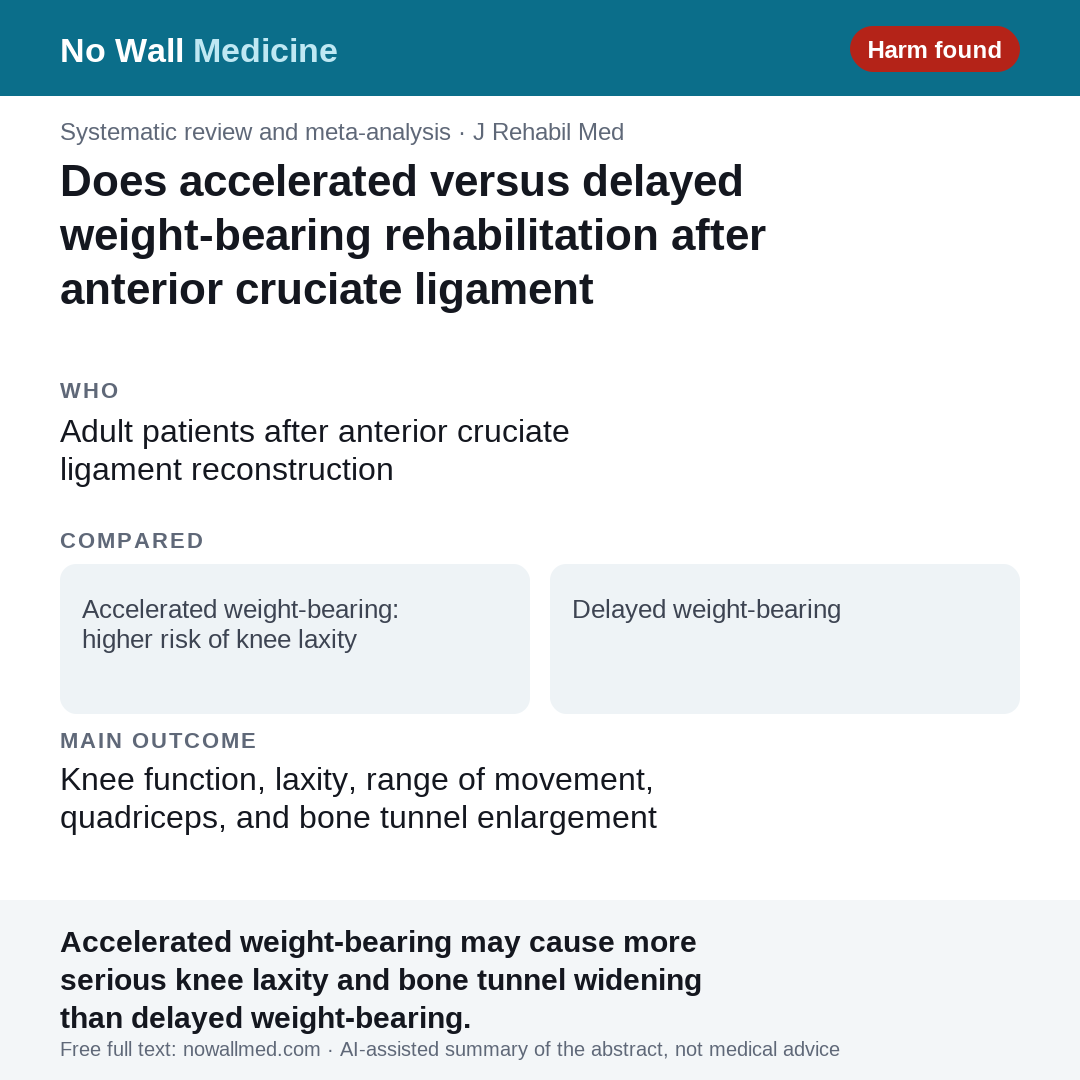
Clinical question: Does accelerated versus delayed weight-bearing rehabilitation after anterior cruciate ligament reconstruction affect clinical outcomes?
Why it matters: It was unknown whether starting weight-bearing exercises earlier or later after anterior cruciate ligament reconstruction affects knee stability, function, or bone tunnel enlargement.
Key points
- Researchers analyzed nine studies comparing accelerated versus delayed weight-bearing rehabilitation protocols following anterior cruciate ligament reconstruction in adult patients.
- Accelerated weight-bearing was associated with a higher risk of knee laxity and bone tunnel enlargement compared to delayed weight-bearing.
- Accelerated weight-bearing may be linked to higher International Knee Documentation Committee Subjective Knee Form scores, but no statistical differences were found for Lysholm, Tegner, or Knee Injury and Osteoarthritis Outcome Score results within 2 years.
Headline and key points written with AI from the paper’s abstract, with every number checked against it. Read the paper before relying on them.
Was this summary helpful?
Subject terms
Cite this article
Fan Z, Yan J, Zhou Z, Gao Y, Tang J, Li Y. Delayed versus Accelerated Weight-bearing Rehabilitation Protocol Following Anterior Cruciate Ligament Reconstruction: A Systematic Review and Meta-analysis. J Rehabil Med. 2022. doi:10.2340/jrm.v53.1438
Spotted a mistake? Suggest a correction
Top studies every Monday
The week’s key trials and guidelines in your specialties, plus any topics you follow. By email, free.
Get the weekly digest