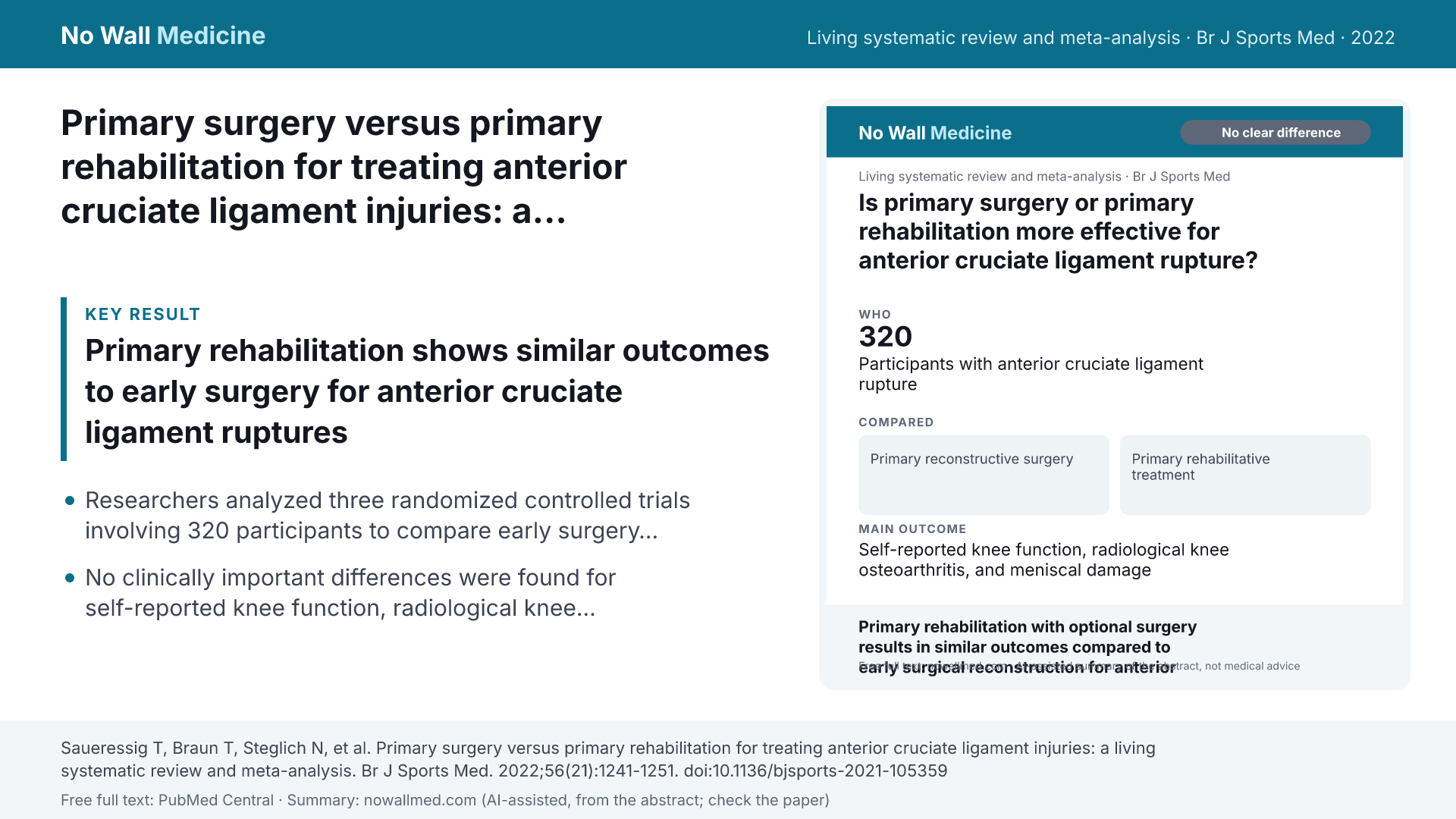
Primary rehabilitation shows similar outcomes to early surgery for anterior cruciate ligament ruptures
Primary surgery versus primary rehabilitation for treating anterior cruciate ligament injuries: a living systematic review and meta-analysis
Living systematic review and meta-analysisNo clear difference
Is primary surgery or primary rehabilitation more effective for anterior cruciate ligament rupture?
Who
320
Participants with anterior cruciate ligament rupture
Compared
Primary reconstructive surgery
Primary rehabilitative treatment
Main outcome
Self-reported knee function, radiological knee osteoarthritis, and meniscal damage
Result: OR (95% CrI): 1.45 (0.30 to 5.17) for radiological knee osteoarthritis
Bottom line: Primary rehabilitation with optional surgery results in similar outcomes compared to early surgical reconstruction for anterior cruciate ligament rupture.
Br J Sports Med · 2022-08-29 · Save PNG
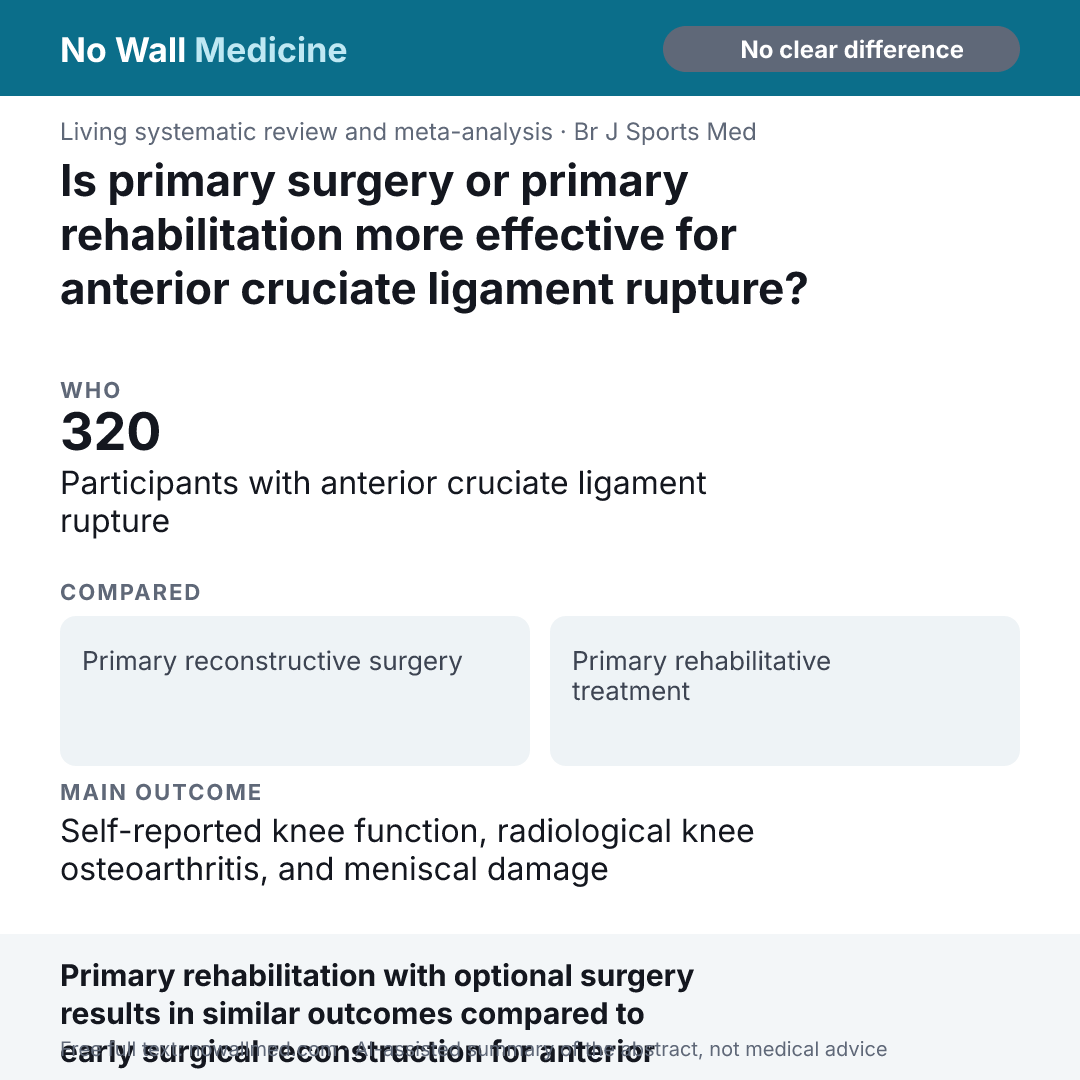
Clinical question: Is primary surgery or primary rehabilitation more effective for anterior cruciate ligament rupture?
Key points
- Researchers analyzed three randomized controlled trials involving 320 participants to compare early surgery against primary rehabilitation for anterior cruciate ligament ruptures.
- No clinically important differences were found for self-reported knee function, radiological knee osteoarthritis (OR 1.45, 95% CrI: 0.30 to 5.17), or meniscal damage (OR: 0.85, 95% CI: 0.45 to 1.62).
- The analysis found no differences between the two treatment approaches for any other secondary outcome measured.
Limitation the authors note: The certainty of evidence for the findings was low to very low.
Headline and key points written with AI from the paper’s abstract, with every number checked against it. Read the paper before relying on them.
Was this summary helpful?
Abstract
Objective
Compare the effectiveness of primarily surgical versus primarily rehabilitative management for anterior cruciate ligament (ACL) rupture. Design
Living systematic review and meta-analysis. Data sources
Six databases, six trial registries and prior systematic reviews. Forward and backward citation tracking was employed. Eligibility criteria
Randomised controlled trials that compared primary reconstructive surgery and primary rehabilitative treatment with or without optional reconstructive surgery. Data synthesis
Bayesian random effects meta-analysis with empirical priors for the OR and standardised mean difference and 95% credible intervals (CrI), Cochrane RoB2, and the Grading of Recommendations Assessment, Development and Evaluation approach to judge the certainty of evidence. Results
Of 9514 records, 9 reports of three studies (320 participants in total) were included. No clinically important differences were observed at any follow-up for self-reported knee function (low to very low certainty of evidence). For radiological knee osteoarthritis, we found no effect at very low certainty of evidence in the long term (OR (95% CrI): 1.45 (0.30 to 5.17), two studies). Meniscal damage showed no effect at low certainty of evidence (OR: 0.85 (95% CI 0.45 to 1.62); one study) in the long term. No differences were observed between treatments for any other secondary outcome. Three ongoing randomised controlled trials were identified. Conclusions
There is low to very low certainty of evidence that primary rehabilitation with optional surgical reconstruction results in similar outcome measures as early surgical reconstruction for ACL rupture. The findings challenge a historical paradigm that anatomic instability should be addressed with primary surgical stabilisation to provide optimal outcomes. Prospero registration number
CRD42021256537.
Abstract reproduced under the article’s CC BY NC licence.
Subject terms
Headline, design, result, key points, caveat and citation as plain text.
Cite this article
Saueressig T, Braun T, Steglich N, et al. Primary surgery versus primary rehabilitation for treating anterior cruciate ligament injuries: a living systematic review and meta-analysis. Br J Sports Med. 2022;56(21):1241-1251. doi:10.1136/bjsports-2021-105359
Spotted a mistake? Suggest a correction