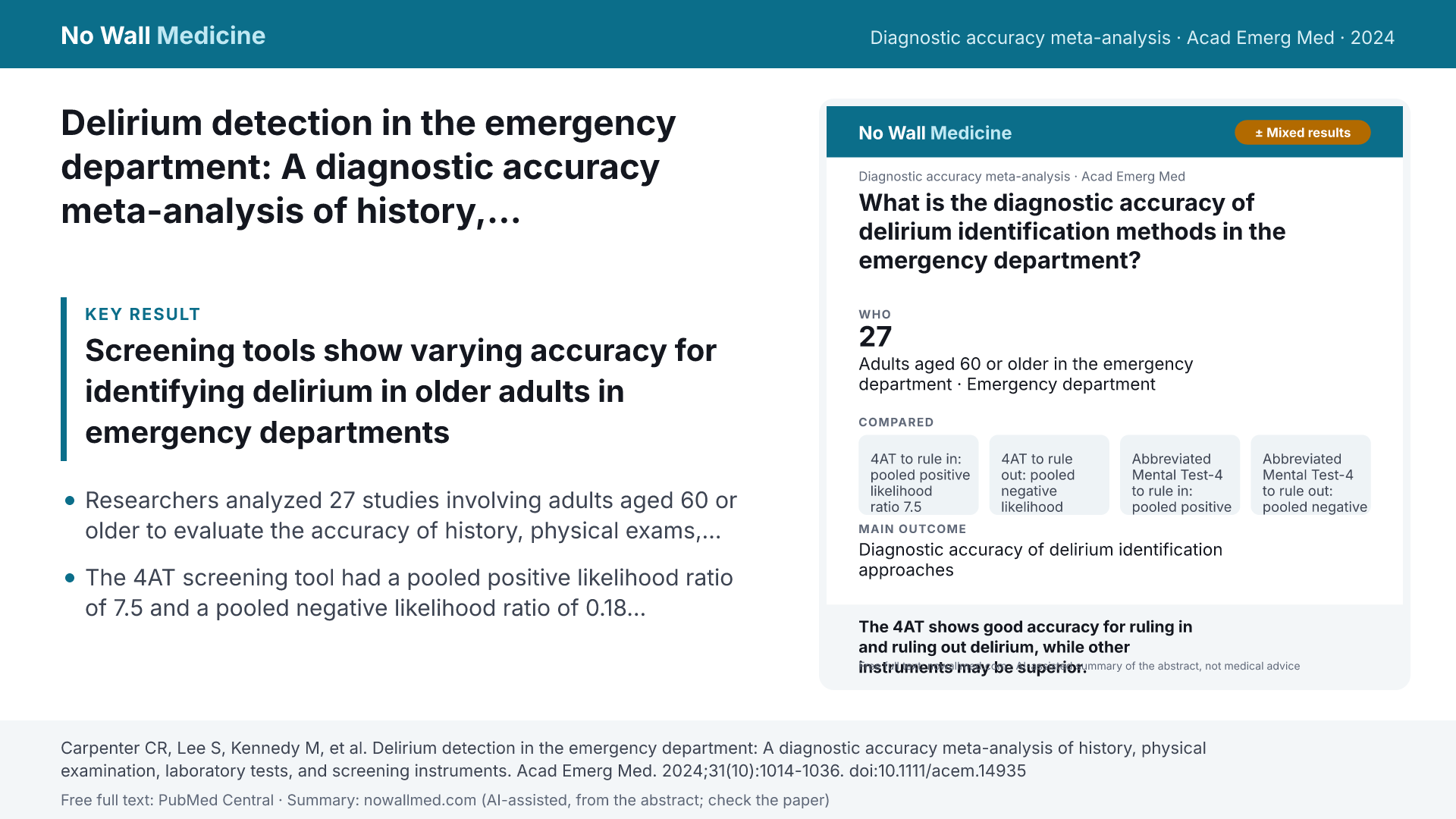
Screening tools show varying accuracy for identifying delirium in older adults in emergency departments
Delirium detection in the emergency department: A diagnostic accuracy meta-analysis of history, physical examination, laboratory tests, and screening instruments
Diagnostic accuracy meta-analysisMixed results
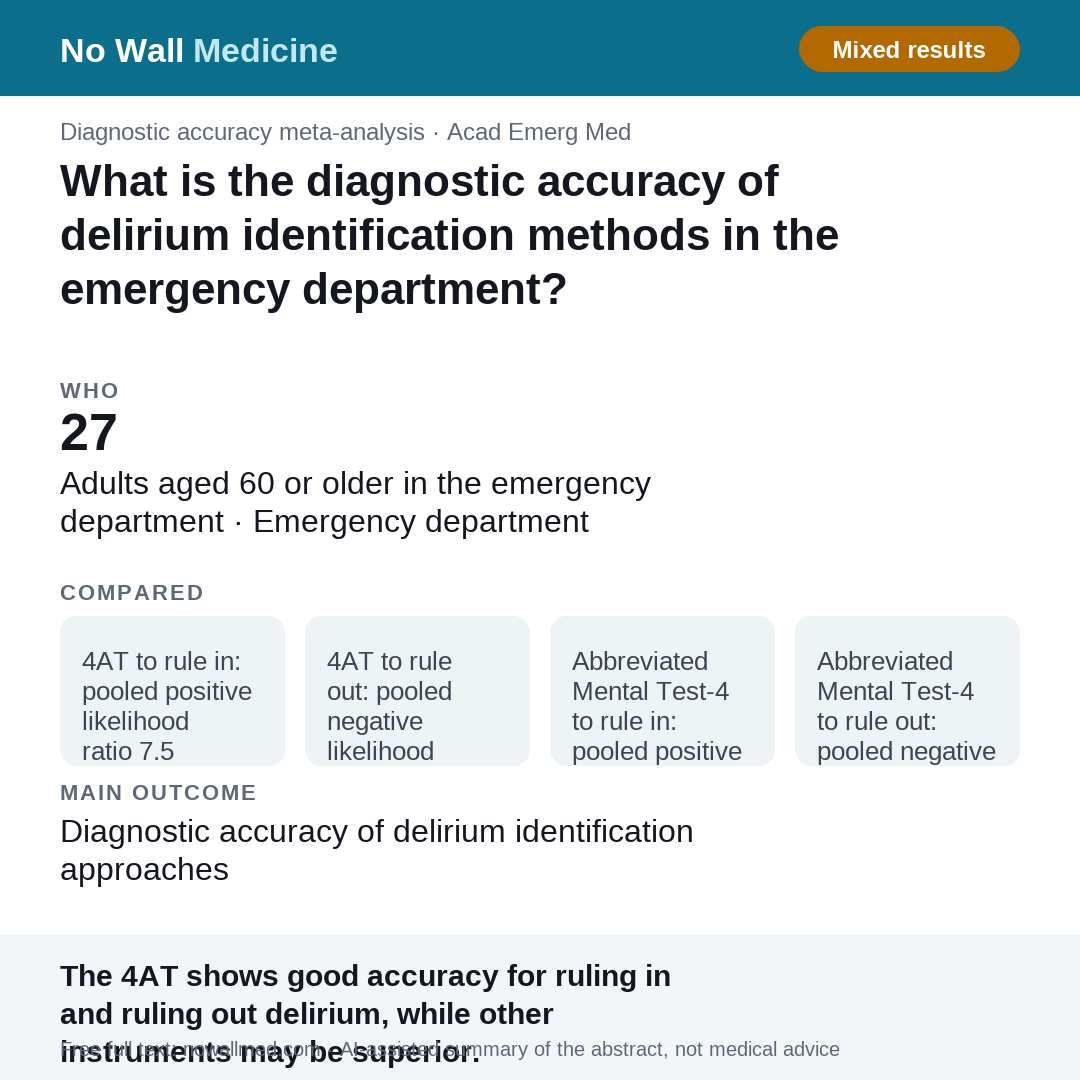
What is the diagnostic accuracy of delirium identification methods in the emergency department?
Who
27
Adults aged 60 or older in the emergency department · Emergency department
Compared
4AT to rule in: pooled positive likelihood ratio 7.5
4AT to rule out: pooled negative likelihood ratio 0.18
Abbreviated Mental Test-4 to rule in: pooled positive likelihood ratio 4.3
Abbreviated Mental Test-4 to rule out: pooled negative likelihood ratio 0.22
Main outcome
Diagnostic accuracy of delirium identification approaches
Result: 4AT LR+ 7.5 (95% CI 2.7-20.7), LR- 0.18 (95% CI 0.09-0.34)
Bottom line: The 4AT shows good accuracy for ruling in and ruling out delirium, while other instruments may be superior.
Limitation: Accuracy of some superior screening tools is based on single-center studies.
Acad Emerg Med · 2024-05-16Download image
Clinical question: What is the diagnostic accuracy of delirium identification methods in the emergency department?
Why it matters: The diagnostic accuracy of history, physical examination, laboratory testing, and specific screening instruments for identifying delirium in the emergency department was not fully quantified.
Key points
- Researchers analyzed 27 studies involving adults aged 60 or older to evaluate the accuracy of history, physical exams, and screening tools for delirium.
- The 4AT screening tool had a pooled positive likelihood ratio of 7.5 and a pooled negative likelihood ratio of 0.18 for delirium.
- The Abbreviated Mental Test-4 had a pooled positive likelihood ratio of 4.3, which was lower than the 4AT result.
Limitation the authors note: The accuracy of some superior screening tools was based on single-center studies.
Headline and key points written with AI from the paper’s abstract, with every number checked against it. Read the paper before relying on them.
Was this summary helpful?
Subject terms
Cite this article
Carpenter CR, Lee S, Kennedy M, et al. Delirium detection in the emergency department: A diagnostic accuracy meta-analysis of history, physical examination, laboratory tests, and screening instruments. Acad Emerg Med. 2024. doi:10.1111/acem.14935
Spotted a mistake? Suggest a correction