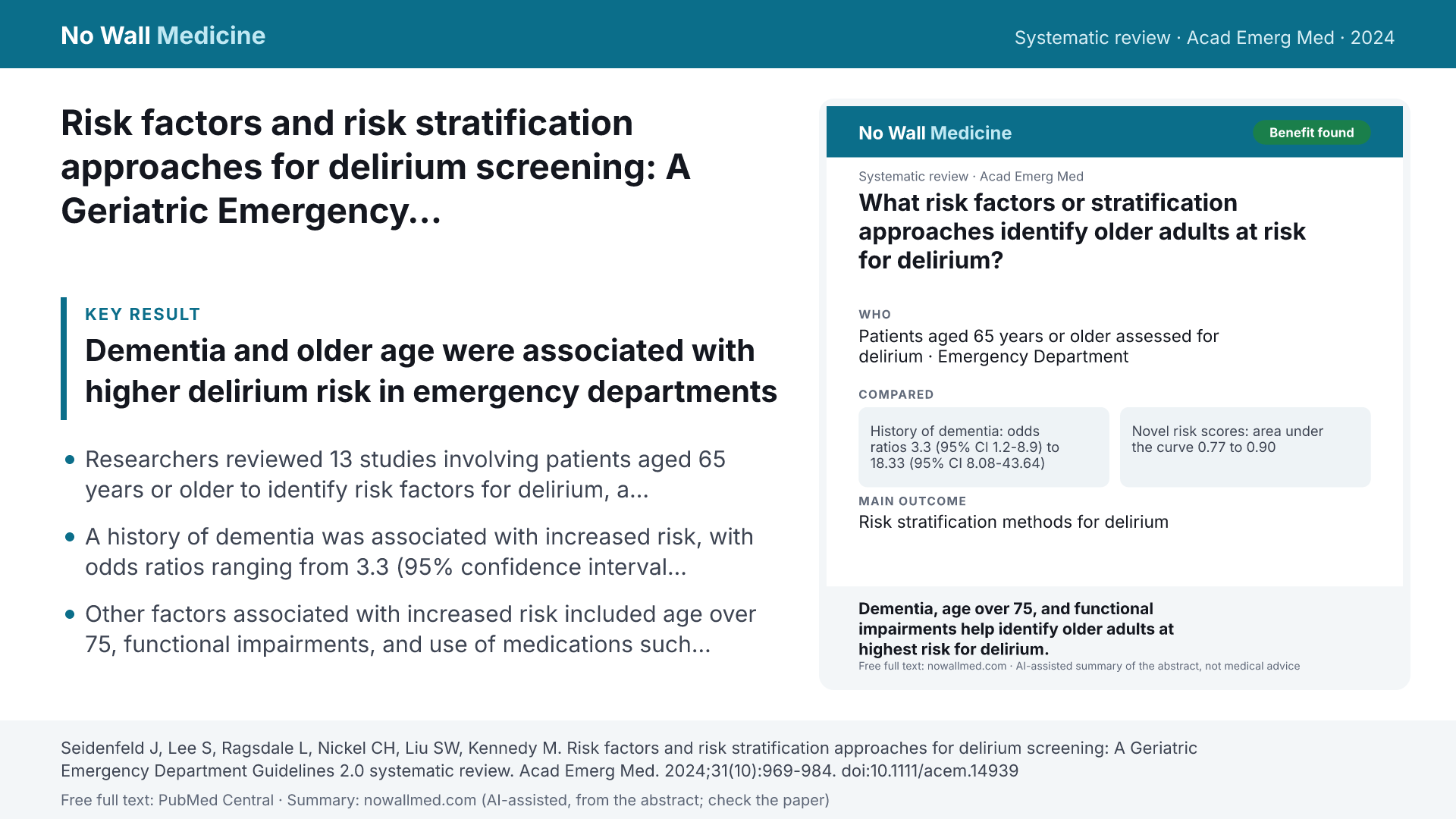
Dementia and older age were associated with higher delirium risk in emergency departments
Risk factors and risk stratification approaches for delirium screening: A Geriatric Emergency Department Guidelines 2.0 systematic review
Systematic reviewBenefit found
What risk factors or stratification approaches identify older adults at risk for delirium?
Who
Patients aged 65 years or older assessed for delirium · Emergency Department
Compared
History of dementia: odds ratios 3.3 (95% CI 1.2-8.9) to 18.33 (95% CI 8.08-43.64)
Novel risk scores: area under the curve 0.77 to 0.90
Main outcome
Risk stratification methods for delirium
Bottom line: Dementia, age over 75, and functional impairments help identify older adults at highest risk for delirium.
Limitation: No studies evaluated implementation of risk stratification or patient-oriented outcomes.
Acad Emerg Med · 2024-06-07Download image
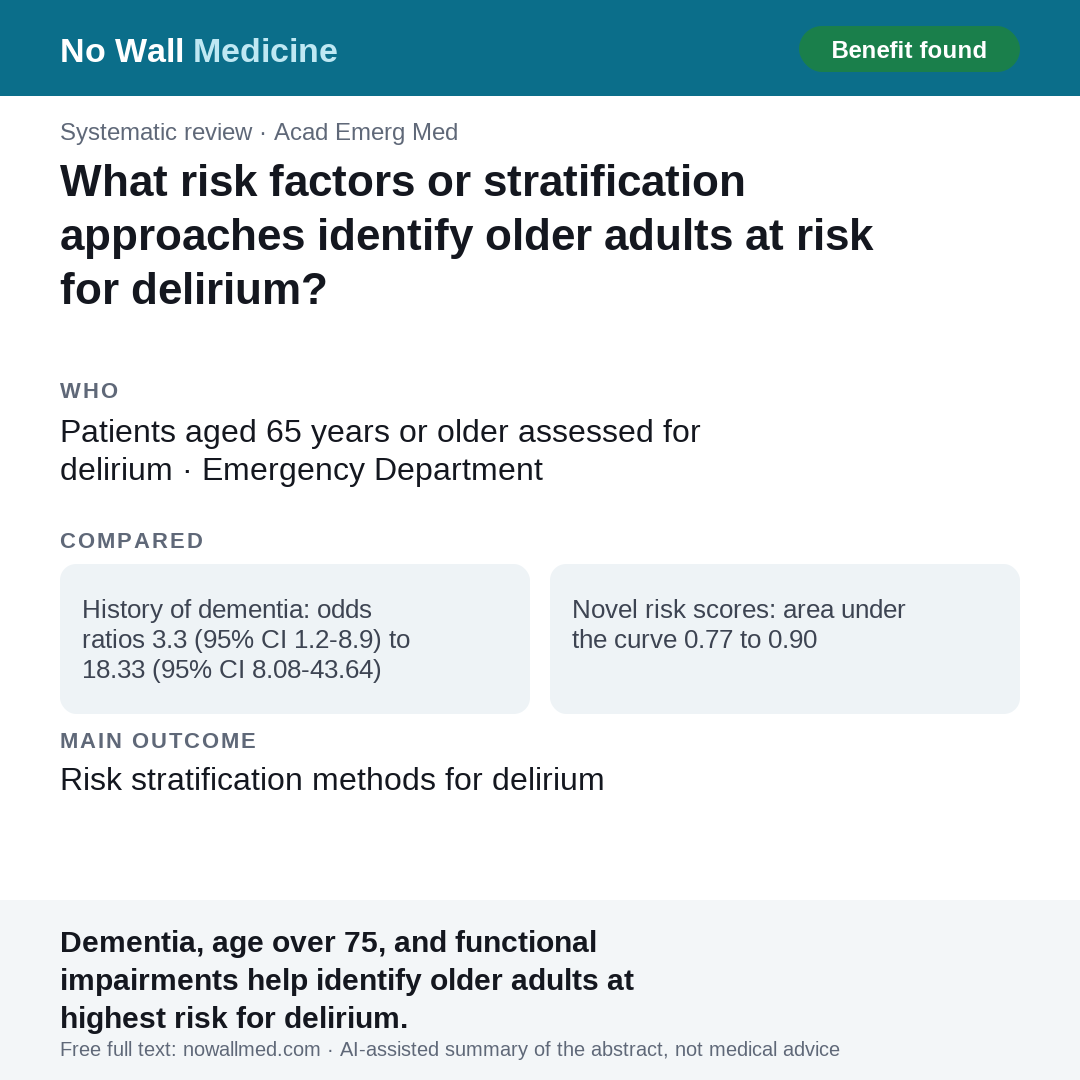
Clinical question: What risk factors or stratification approaches identify older adults at risk for delirium?
Why it matters: It is unknown which specific risk factors or scoring methods best identify older adults who would benefit from targeted delirium screening in emergency departments.
Key points
- Researchers reviewed 13 studies involving patients aged 65 years or older to identify risk factors for delirium, a state of sudden confusion.
- A history of dementia was associated with increased risk, with odds ratios ranging from 3.3 (95% confidence interval [CI] 1.2-8.9) to 18.33 (95% CI 8.08-43.64).
- Other factors associated with increased risk included age over 75, functional impairments, and use of medications such as antipsychotics, antidepressants, and opioids.
Limitation the authors note: No studies evaluated the implementation of risk stratification methods or evaluated patient-oriented outcomes.
Headline and key points written with AI from the paper’s abstract, with every number checked against it. Read the paper before relying on them.
Was this summary helpful?
Subject terms
Cite this article
Seidenfeld J, Lee S, Ragsdale L, Nickel CH, Liu SW, Kennedy M. Risk factors and risk stratification approaches for delirium screening: A Geriatric Emergency Department Guidelines 2.0 systematic review. Acad Emerg Med. 2024. doi:10.1111/acem.14939
Spotted a mistake? Suggest a correction
Top studies every Monday
The week’s key trials and guidelines in your specialties, plus any topics you follow. By email, free.
Get the weekly digest