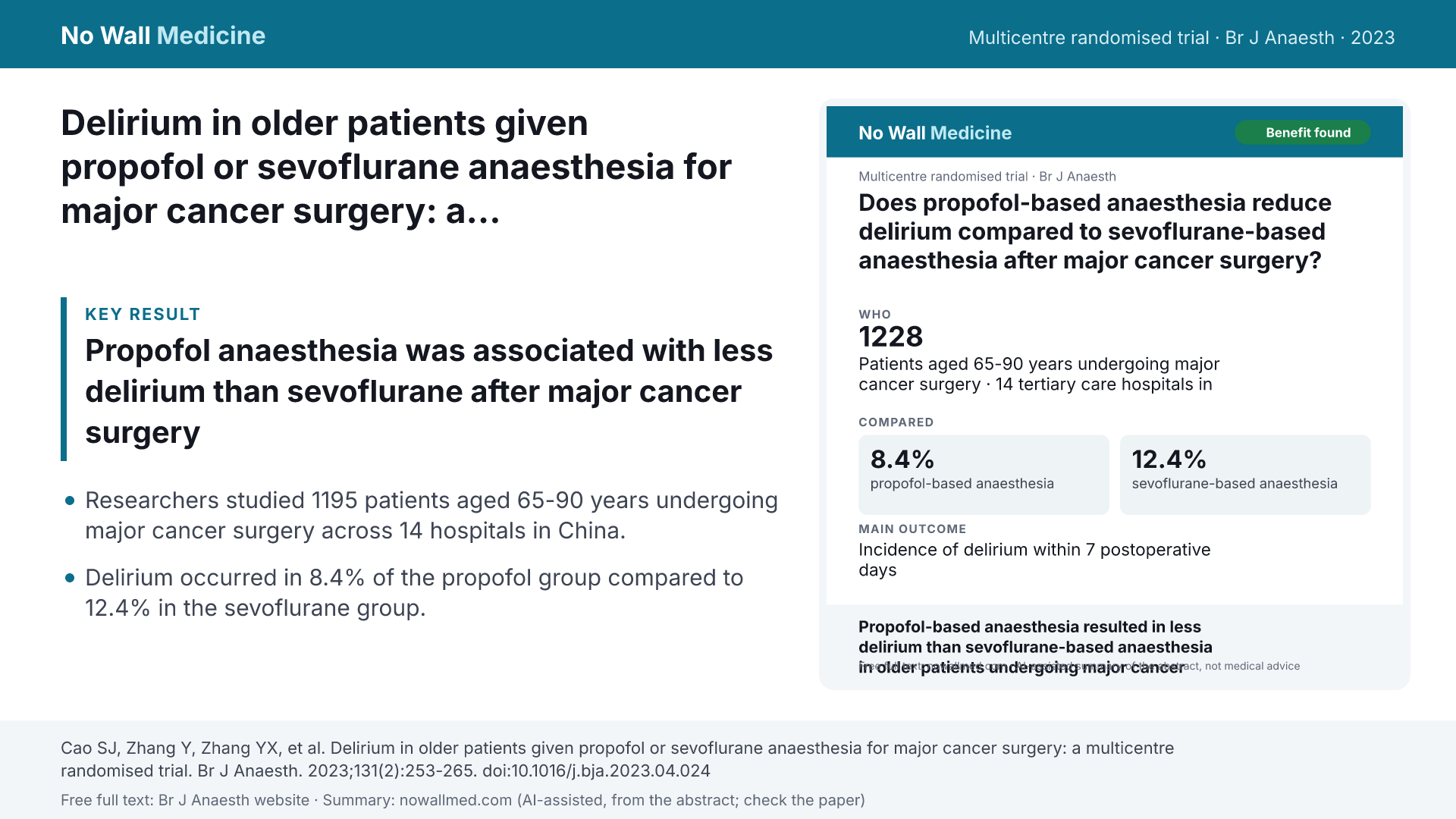
Propofol anaesthesia was associated with less delirium than sevoflurane after major cancer surgery
Delirium in older patients given propofol or sevoflurane anaesthesia for major cancer surgery: a multicentre randomised trial
Multicentre randomised trialBenefit found
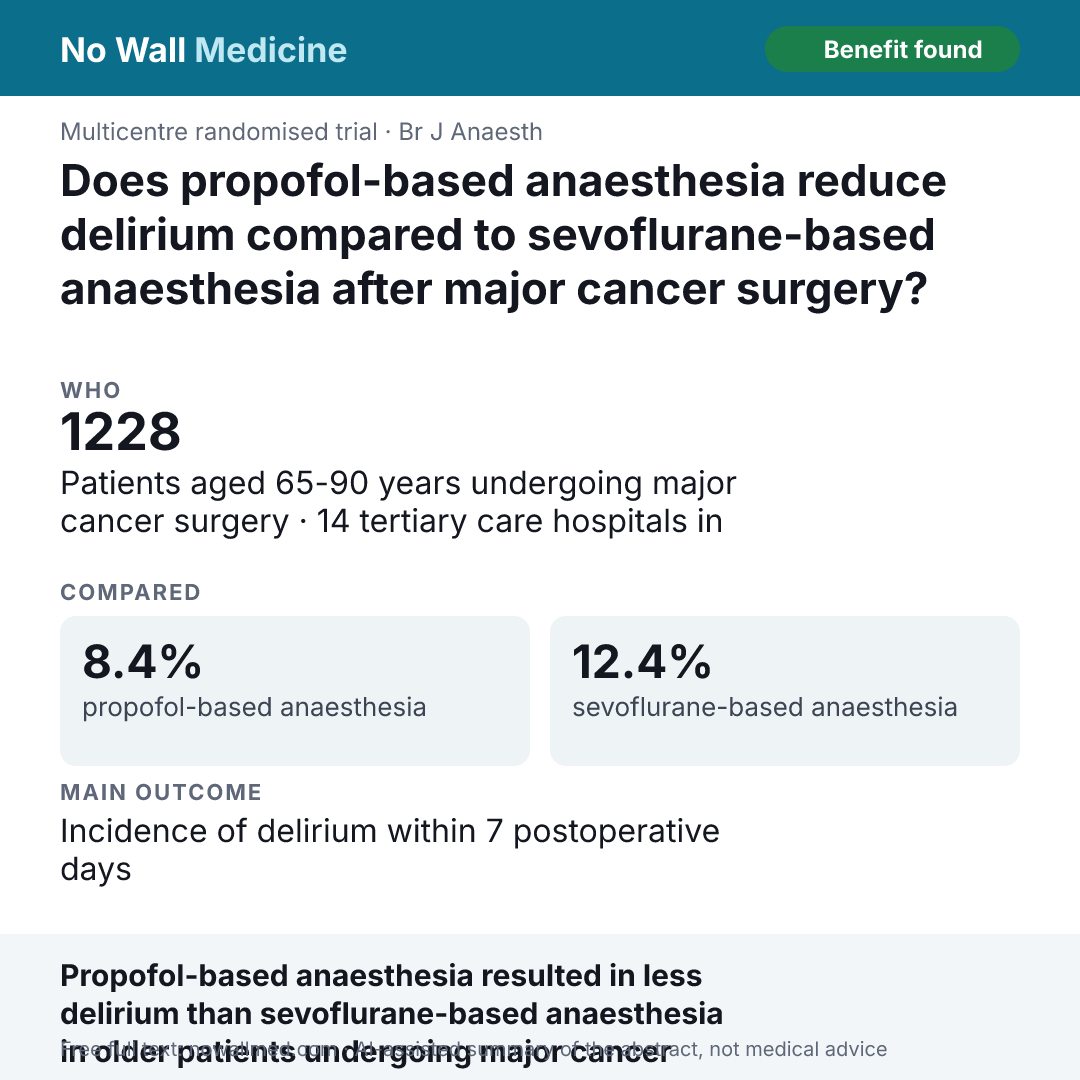
Does propofol-based anaesthesia reduce delirium compared to sevoflurane-based anaesthesia after major cancer surgery?
Who
1228
Patients aged 65-90 years undergoing major cancer surgery · 14 tertiary care hospitals in China
Compared
8.4%propofol-based anaesthesia (50/597)
12.4%sevoflurane-based anaesthesia (74/597)
Main outcome
Incidence of delirium within 7 postoperative days
Result: relative risk 0.68 (95% CI 0.48-0.95)
Bottom line: Propofol-based anaesthesia resulted in less delirium than sevoflurane-based anaesthesia in older patients undergoing major cancer surgery.
Br J Anaesth · 2023-06-04 · NCT02662257 · ChiCTR-IPR-15006209
Same trial (ChiCTR-IPR-15006209, NCT02662257)
Papers we list that report this registered trial, oldest first. Read a secondary analysis alongside the main results.
- Main results Benefit found
This paper Br J Anaesth 2023-06 - Longer follow-up No clear difference
Propofol and sevoflurane anaesthesia showed similar long-term survival in older cancer surgery patients Br J Anaesth 2023-06
Headline and visual abstract written with AI from the paper’s abstract, with every number checked against it. Read the paper before relying on them.
Was this summary helpful?
Subject terms
Cite this article
Cao SJ, Zhang Y, Zhang YX, et al. Delirium in older patients given propofol or sevoflurane anaesthesia for major cancer surgery: a multicentre randomised trial. Br J Anaesth. 2023;131(2):253-265. doi:10.1016/j.bja.2023.04.024
Spotted a mistake? Suggest a correction