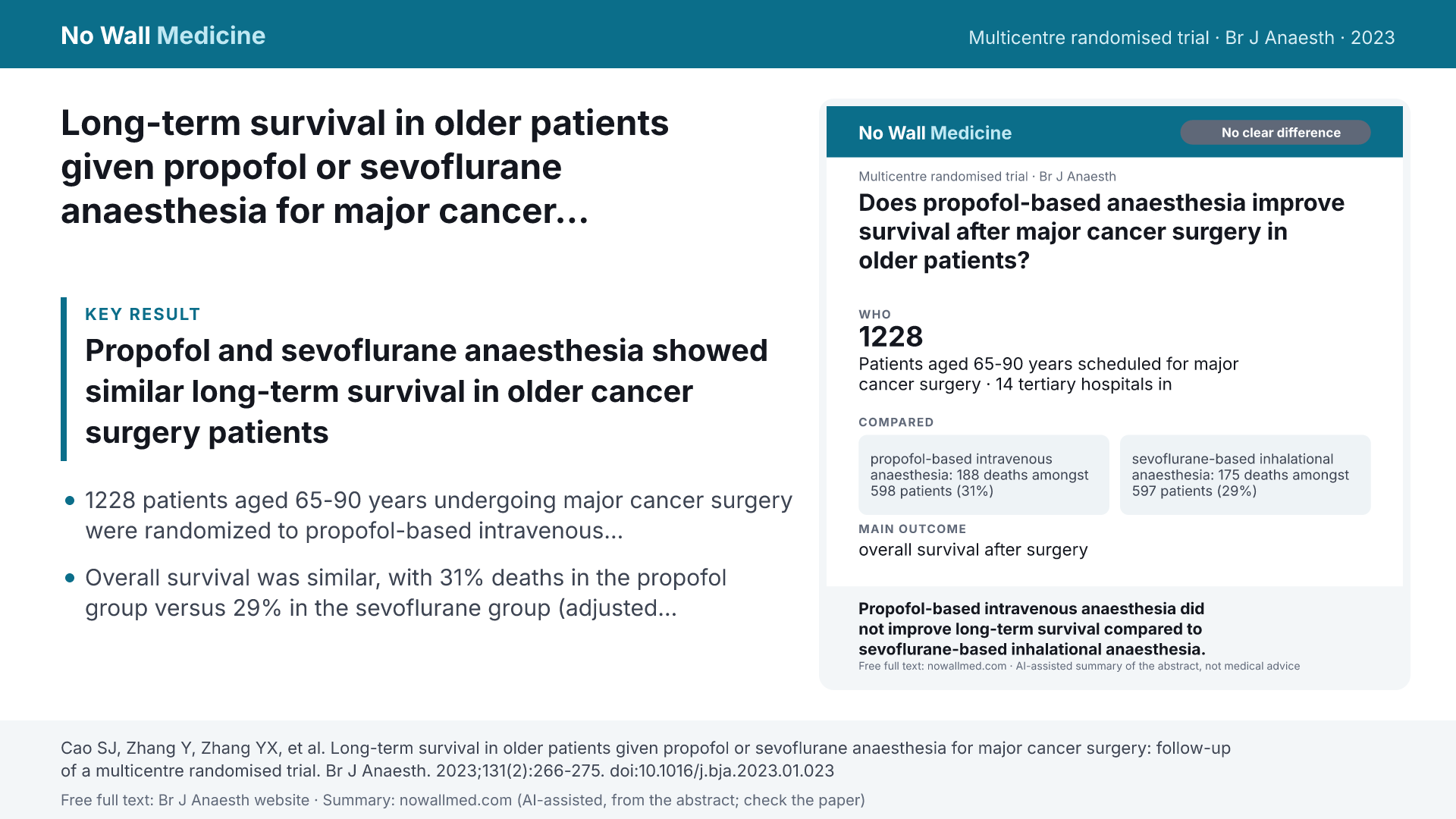
Propofol and sevoflurane anaesthesia showed similar long-term survival in older cancer surgery patients
Long-term survival in older patients given propofol or sevoflurane anaesthesia for major cancer surgery: follow-up of a multicentre randomised trial
Multicentre randomised trialNo clear difference
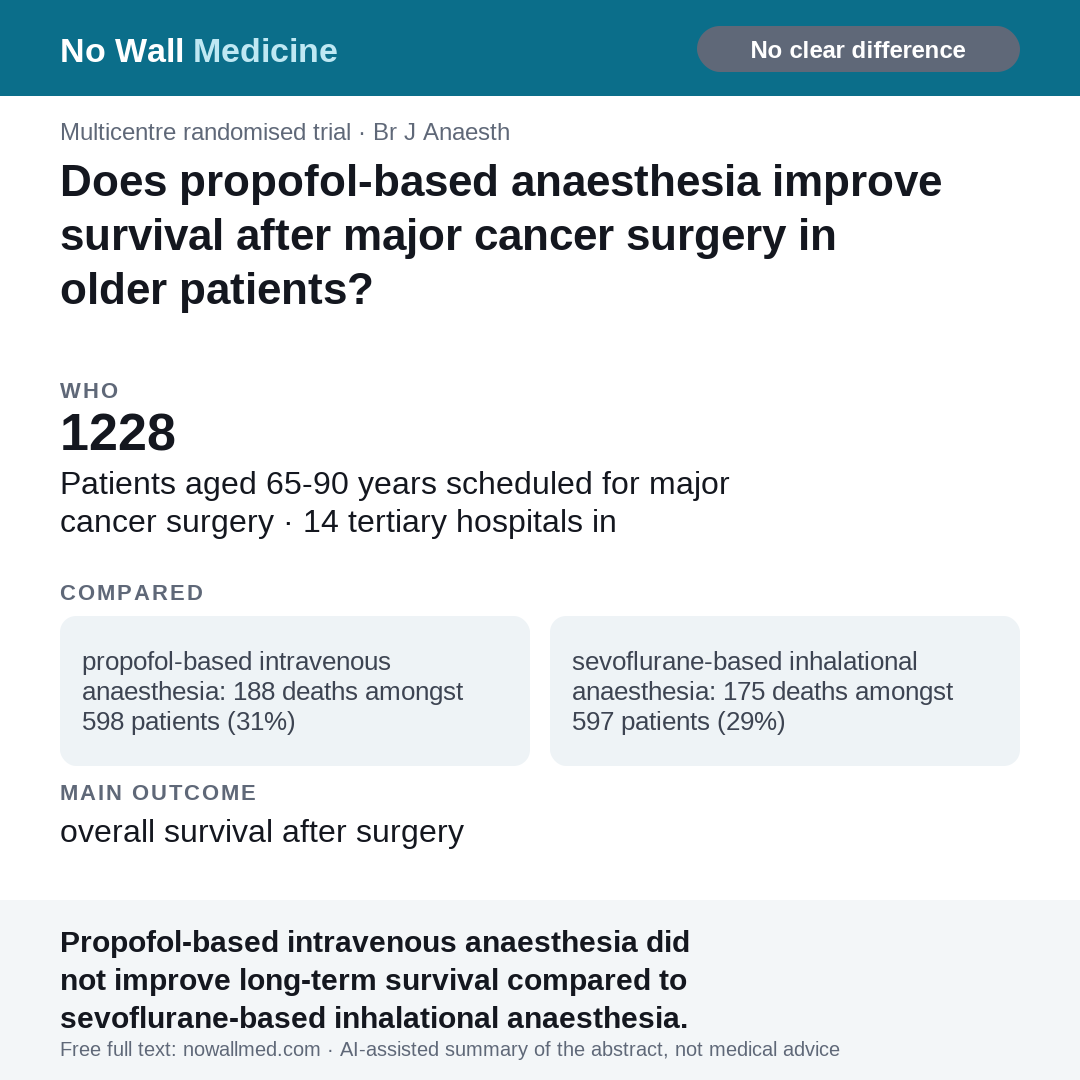
Does propofol-based anaesthesia improve survival after major cancer surgery in older patients?
Who
1228
Patients aged 65-90 years scheduled for major cancer surgery · 14 tertiary hospitals in China
Compared
propofol-based intravenous anaesthesia: 188 deaths amongst 598 patients (31%)
sevoflurane-based inhalational anaesthesia: 175 deaths amongst 597 patients (29%)
Main outcome
overall survival after surgery
Result: adjusted hazard ratio 1.02 (95% CI 0.83-1.26)
Bottom line: Propofol-based intravenous anaesthesia did not improve long-term survival compared to sevoflurane-based inhalational anaesthesia.
Br J Anaesth · 2023-06-04Download image
Clinical question: Does propofol-based anaesthesia improve survival after major cancer surgery in older patients?
Key points
- 1228 patients aged 65-90 years undergoing major cancer surgery were randomized to propofol-based intravenous or sevoflurane-based inhalational anaesthesia.
- Overall survival was similar, with 31% deaths in the propofol group versus 29% in the sevoflurane group (adjusted hazard ratio 1.02; P=0.834).
- Recurrence-free and event-free survival also showed no significant difference between the two anaesthesia groups.
Headline and key points written with AI from the paper’s abstract, with every number checked against it. Read the paper before relying on them.
Was this summary helpful?
Subject terms
Cite this article
Cao SJ, Zhang Y, Zhang YX, et al. Long-term survival in older patients given propofol or sevoflurane anaesthesia for major cancer surgery: follow-up of a multicentre randomised trial. Br J Anaesth. 2023. doi:10.1016/j.bja.2023.01.023
Spotted a mistake? Suggest a correction