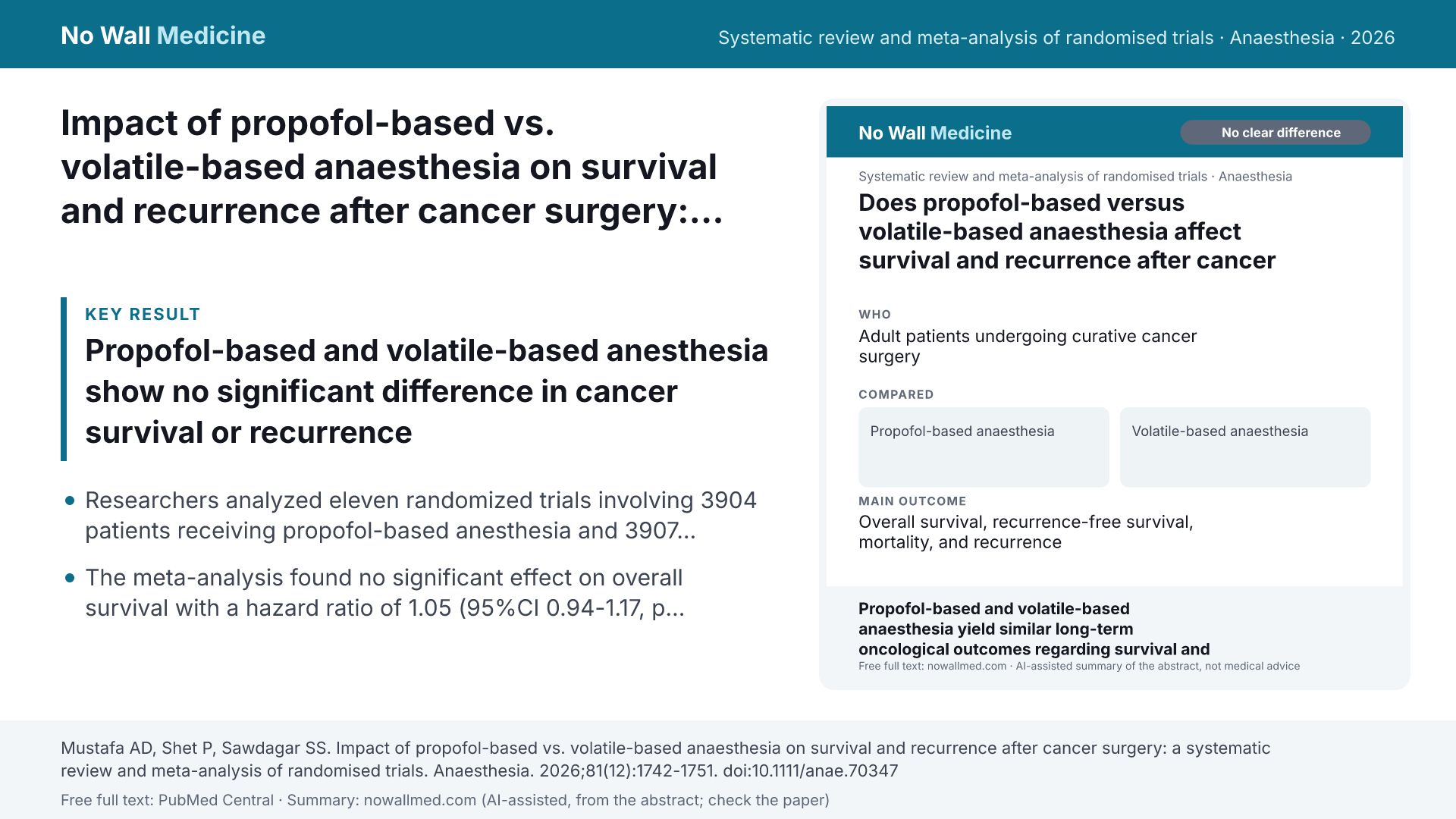
Propofol-based and volatile-based anesthesia show no significant difference in cancer survival or recurrence
Impact of propofol-based vs. volatile-based anaesthesia on survival and recurrence after cancer surgery: a systematic review and meta-analysis of randomised trials
Systematic review and meta-analysis of randomised trialsNo clear difference
Does propofol-based versus volatile-based anaesthesia affect survival and recurrence after cancer surgery?
Who
Adult patients undergoing curative cancer surgery
Compared
Propofol-based anaesthesia
Volatile-based anaesthesia
Main outcome
Overall survival, recurrence-free survival, mortality, and recurrence
Result: hazard ratio 1.05 (95%CI 0.94-1.17)
Bottom line: Propofol-based and volatile-based anaesthesia yield similar long-term oncological outcomes regarding survival and recurrence.
Anaesthesia · 2026-08-17Download image
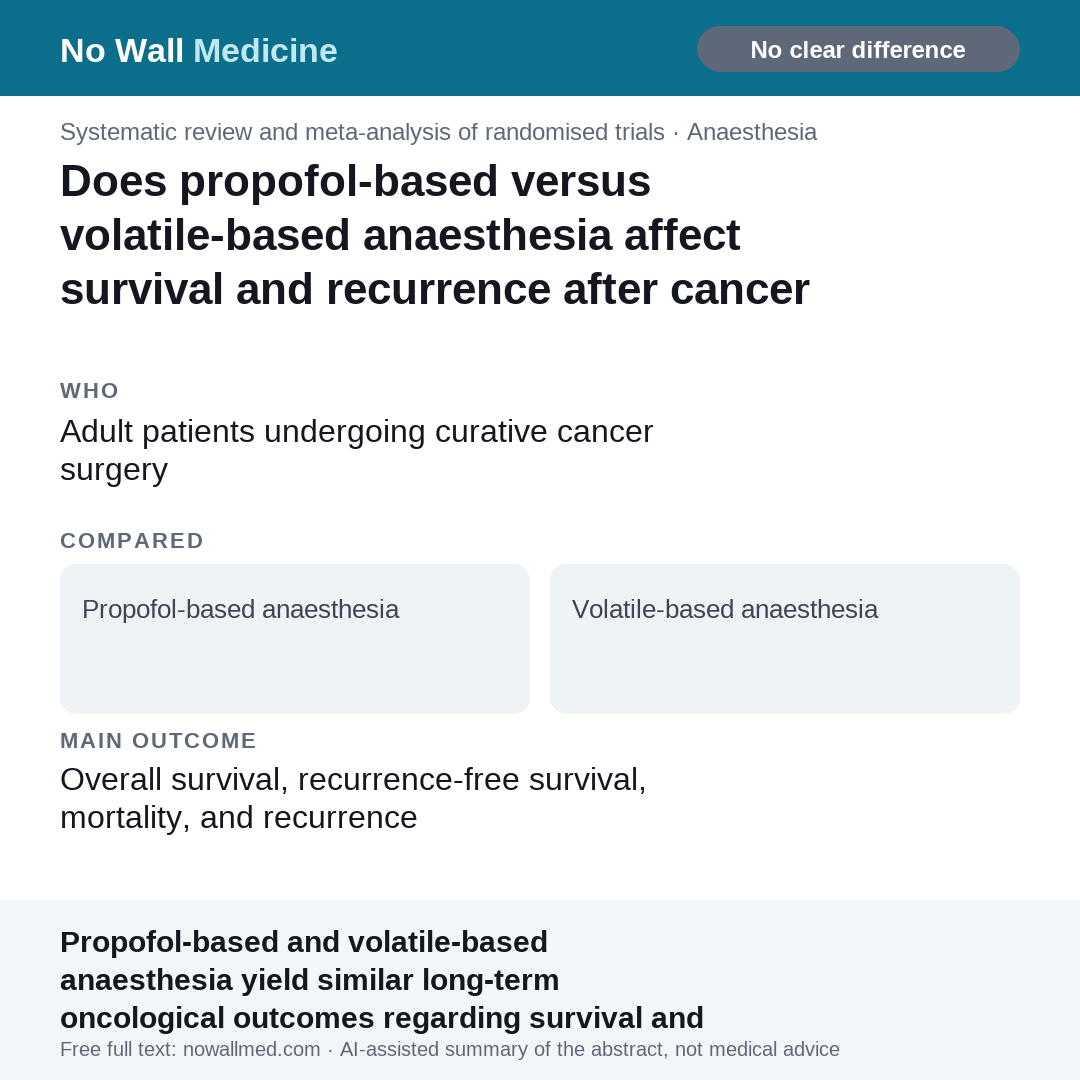
Clinical question: Does propofol-based versus volatile-based anaesthesia affect survival and recurrence after cancer surgery?
Why it matters: Conflicting evidence exists regarding whether using propofol-based anesthesia improves outcomes compared to volatile-based anesthesia after curative cancer surgery.
Key points
- Researchers analyzed eleven randomized trials involving 3904 patients receiving propofol-based anesthesia and 3907 patients receiving volatile-based anesthesia during cancer surgery.
- The meta-analysis found no significant effect on overall survival with a hazard ratio of 1.05 (95%CI 0.94-1.17, p = 0.42) or recurrence-free survival with a hazard ratio of 1.06 (95%CI 0.95-1.19, p = 0.31).
- There was no significant difference found for mortality with a relative risk of 1.03 (95%CI 0.94-1.13, p = 0.48) or for cancer recurrence with a relative risk of 0.92 (95%CI 0.76-1.12, p = 0.41).
Headline and key points written with AI from the paper’s abstract, with every number checked against it. Read the paper before relying on them.
Was this summary helpful?
Subject terms
Cite this article
Mustafa AD, Shet P, Sawdagar SS. Impact of propofol-based vs. volatile-based anaesthesia on survival and recurrence after cancer surgery: a systematic review and meta-analysis of randomised trials. Anaesthesia. 2026. doi:10.1111/anae.70347
Spotted a mistake? Suggest a correction