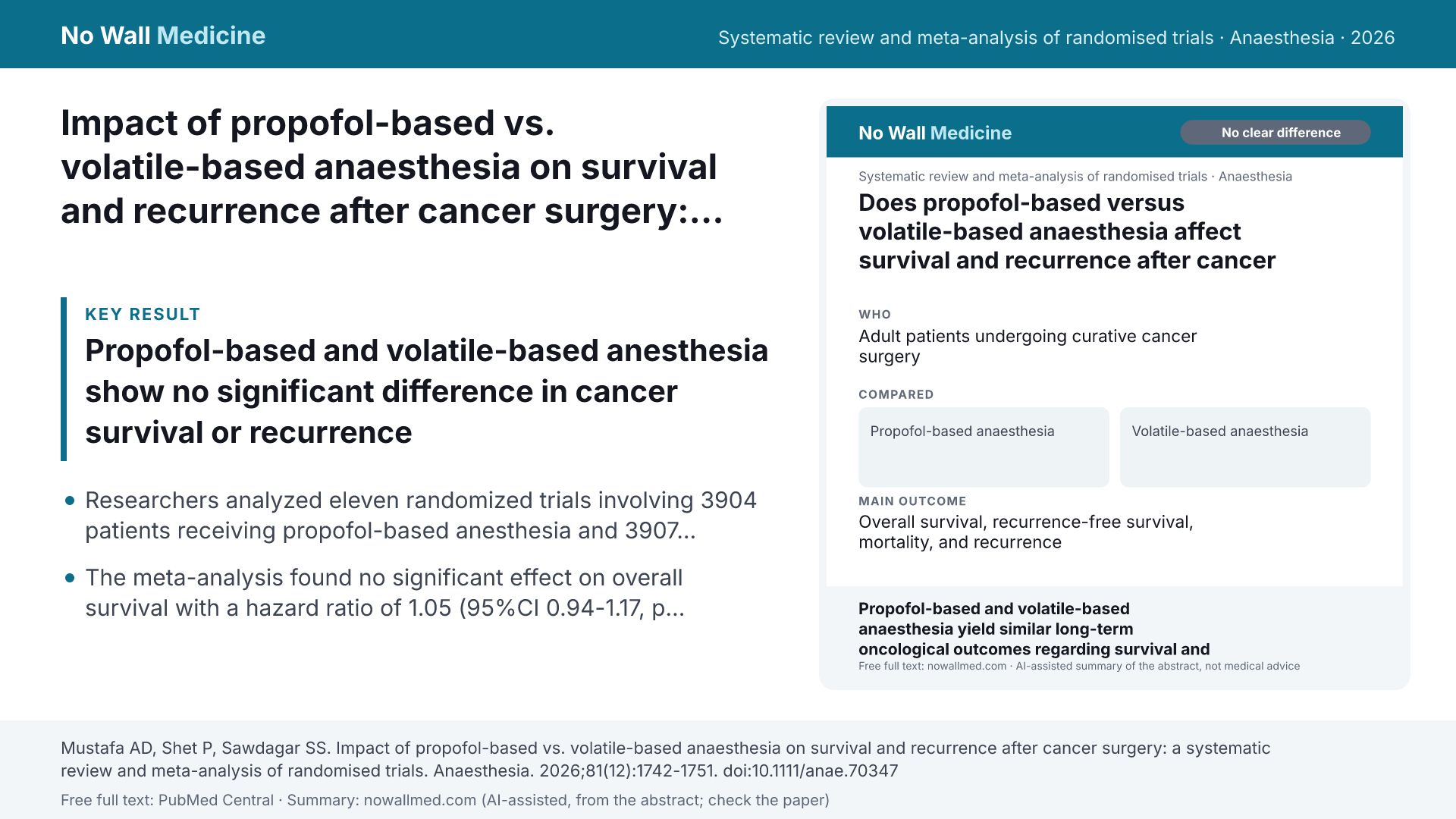
Impact of propofol-based vs. volatile-based anaesthesia on survival and recurrence after cancer surgery: a systematic review and meta-analysis of randomised trials
Key result: Propofol-based and volatile-based anesthesia show no significant difference in cancer survival or recurrence
Key points
- Researchers analyzed eleven randomized trials involving 3904 patients receiving propofol-based anesthesia and 3907 patients receiving volatile-based anesthesia during cancer surgery.
- The meta-analysis found no significant effect on overall survival with a hazard ratio of 1.05 (95%CI 0.94-1.17, p = 0.42) or recurrence-free survival with a hazard ratio of 1.06 (95%CI 0.95-1.19, p = 0.31).
- There was no significant difference found for mortality with a relative risk of 1.03 (95%CI 0.94-1.13, p = 0.48) or for cancer recurrence with a relative risk of 0.92 (95%CI 0.76-1.12, p = 0.41).
Why it matters: Conflicting evidence exists regarding whether using propofol-based anesthesia improves outcomes compared to volatile-based anesthesia after curative cancer surgery.
Discussion prompts
- Would these patients look like yours? Who was left out?
- Is the main outcome one that matters to patients?
- Is the difference large enough to change what you do?
Cite: Mustafa AD, Shet P, Sawdagar SS. Impact of propofol-based vs. volatile-based anaesthesia on survival and recurrence after cancer surgery: a systematic review and meta-analysis of randomised trials. Anaesthesia. 2026;81(12):1742-1751. doi:10.1111/anae.70347
Free full text: PubMed Central · Summary and visual abstract: nowallmed.com/a/impact-of-propofol-based-vs-volatile-based-anaesthesia-on-survival-1w1cyn1/ (AI-assisted from the abstract; check the paper before relying on it).