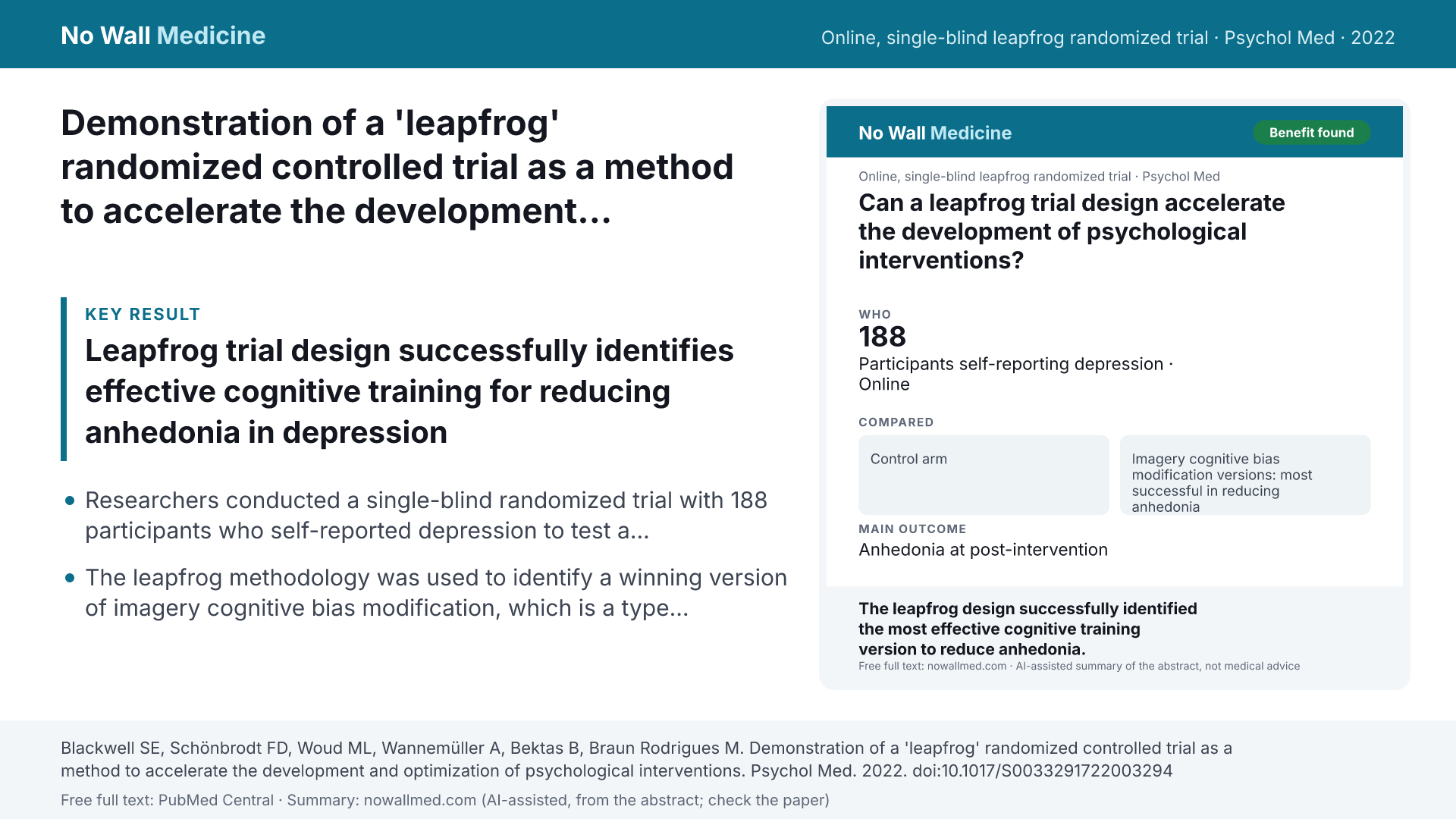
Demonstration of a 'leapfrog' randomized controlled trial as a method to accelerate the development and optimization of psychological interventions
Key result: Leapfrog trial design successfully identifies effective cognitive training for reducing anhedonia in depression
Key points
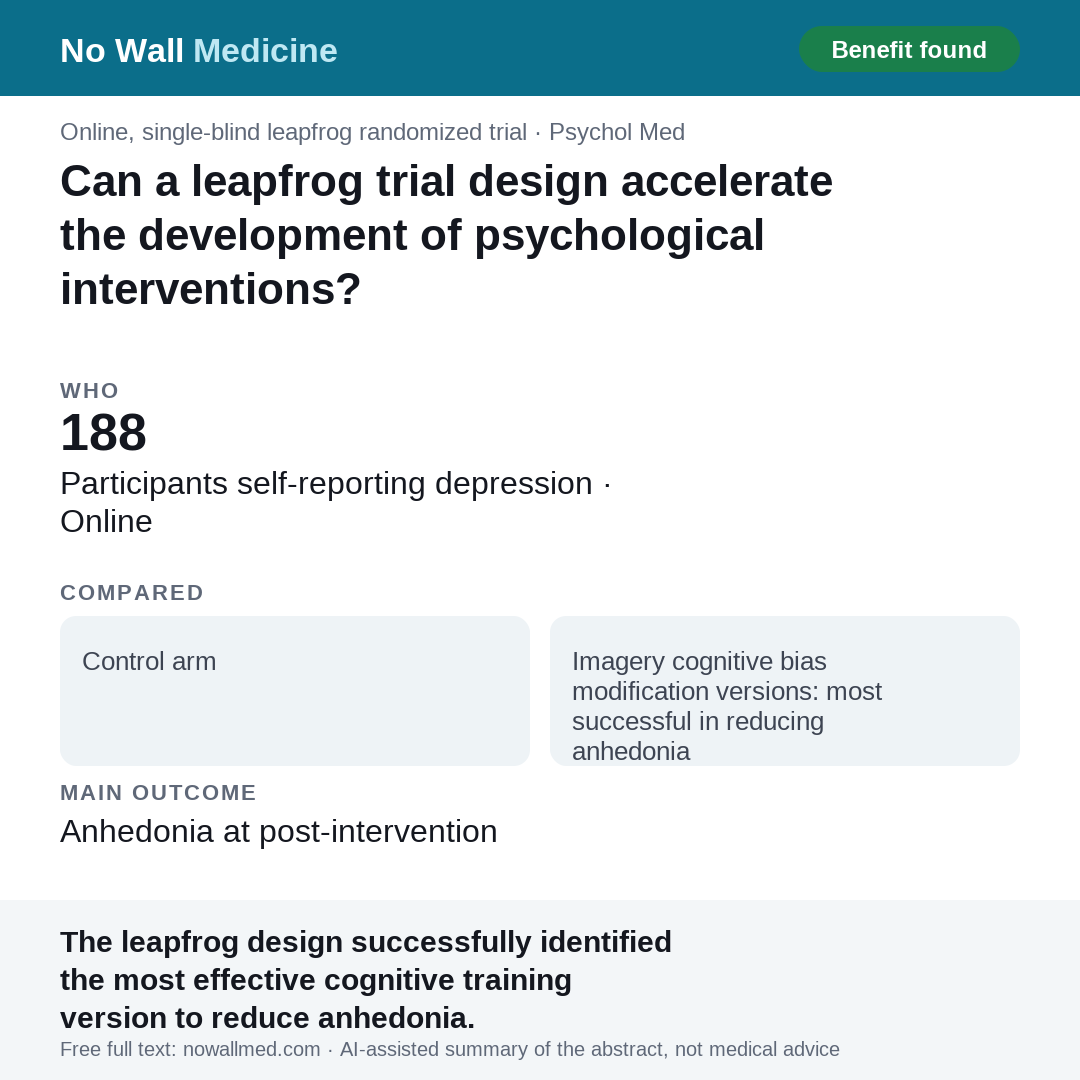
- Researchers conducted a single-blind randomized trial with 188 participants who self-reported depression to test a new adaptive trial design.
- The leapfrog methodology was used to identify a winning version of imagery cognitive bias modification, which is a type of cognitive training, for reducing anhedonia.
- The trial successfully implemented a process to eliminate or replace intervention arms based on sequential Bayesian analyses.
Why it matters: The current pace of standard treatment development is considered inadequate to address the global mental health burden.
Discussion prompts
- Would these patients look like yours? Who was left out?
- Is the main outcome one that matters to patients?
- Is the difference large enough to change what you do?
Cite: Blackwell SE, Schönbrodt FD, Woud ML, Wannemüller A, Bektas B, Braun Rodrigues M. Demonstration of a 'leapfrog' randomized controlled trial as a method to accelerate the development and optimization of psychological interventions. Psychol Med. 2022. doi:10.1017/S0033291722003294
Free full text: PubMed Central · Summary and visual abstract: nowallmed.com/a/demonstration-of-a-leapfrog-randomized-controlled-trial-as-a-method-hy09lm/ (AI-assisted from the abstract; check the paper before relying on it).