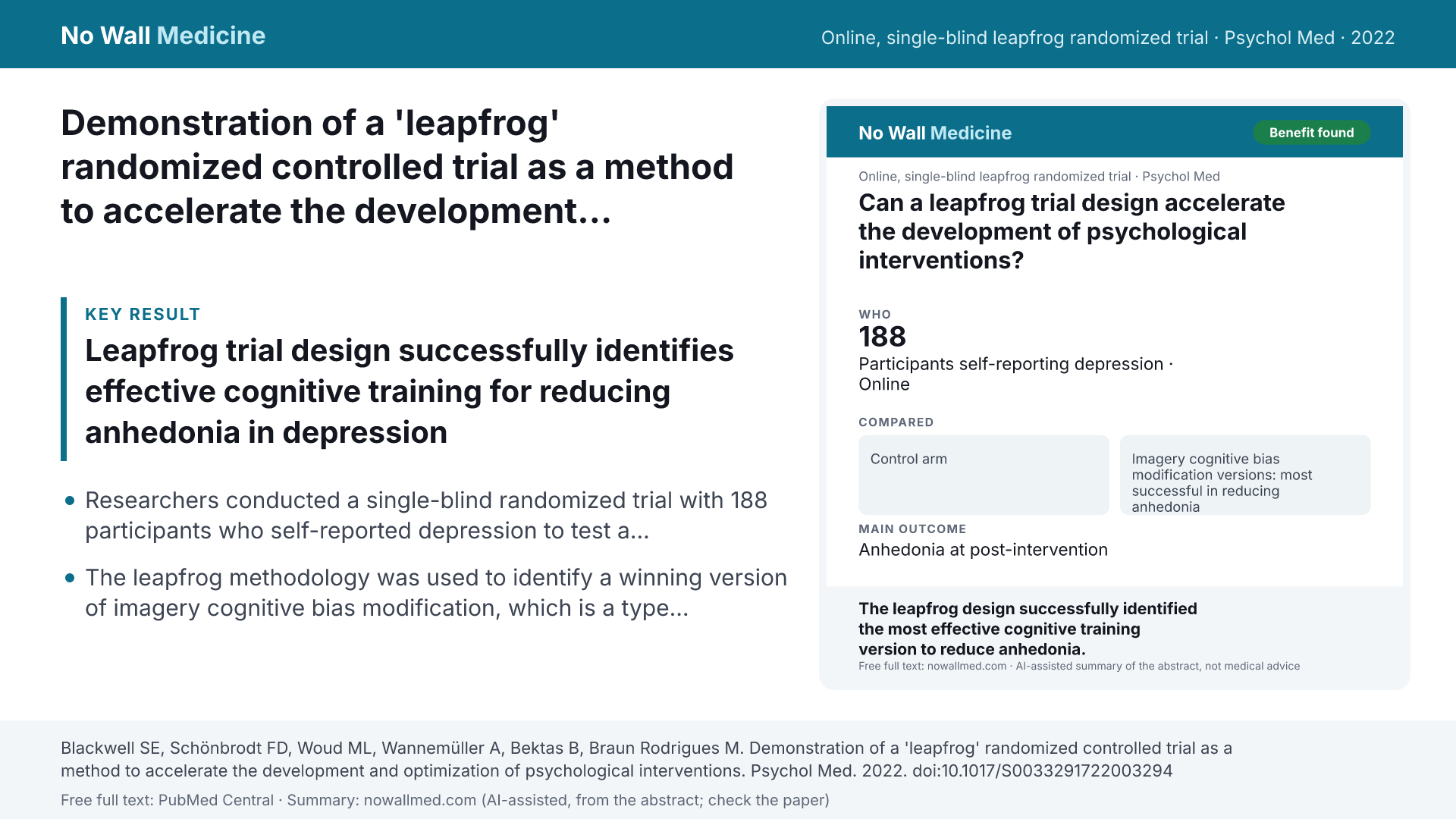
Leapfrog trial design successfully identifies effective cognitive training for reducing anhedonia in depression
Demonstration of a 'leapfrog' randomized controlled trial as a method to accelerate the development and optimization of psychological interventions
Online, single-blind leapfrog randomized trialBenefit found
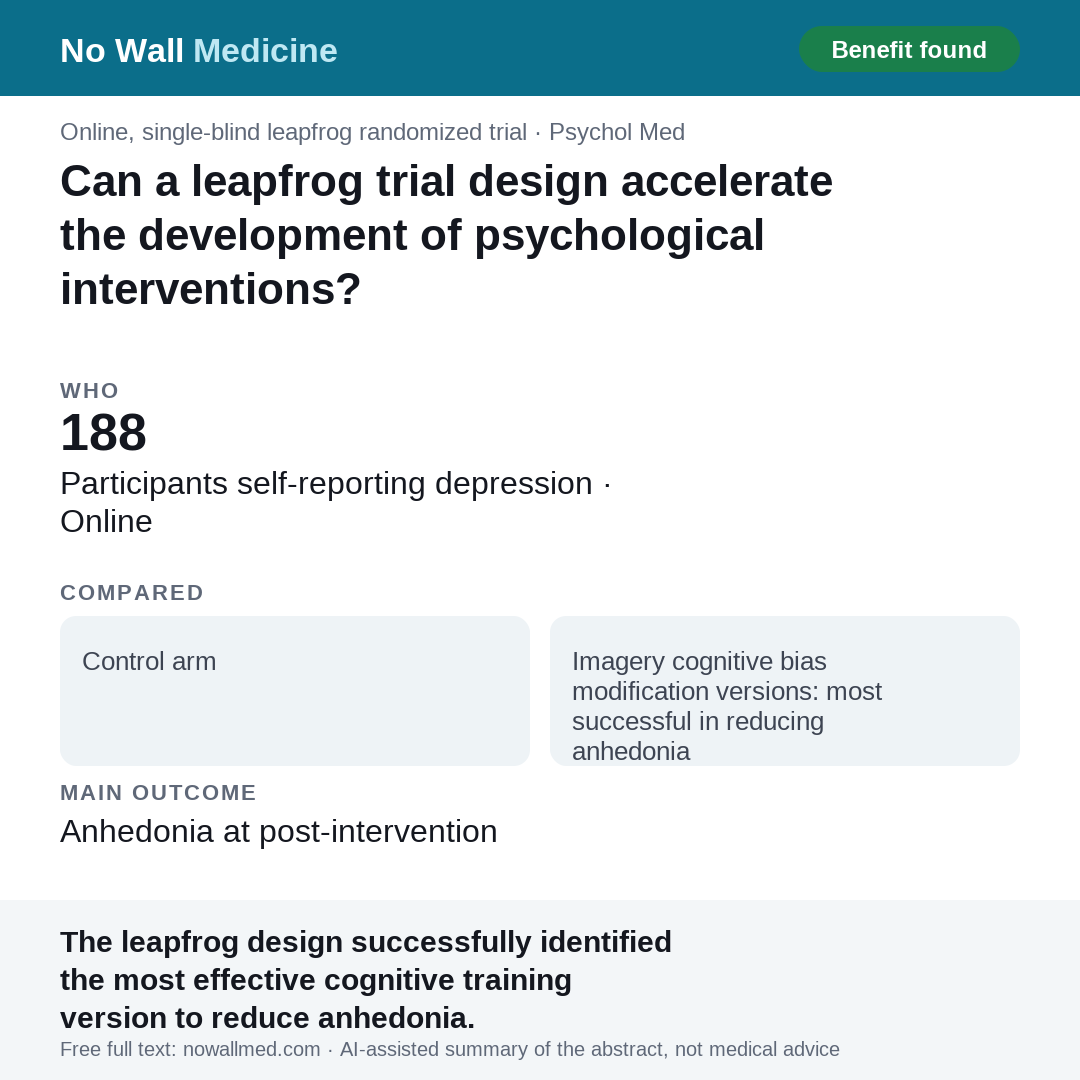
Can a leapfrog trial design accelerate the development of psychological interventions?
Who
188
Participants self-reporting depression · Online
Compared
Control arm
Imagery cognitive bias modification versions: most successful in reducing anhedonia
Main outcome
Anhedonia at post-intervention
Bottom line: The leapfrog design successfully identified the most effective cognitive training version to reduce anhedonia.
Psychol Med · 2022-11-04Download image
Clinical question: Can a leapfrog trial design accelerate the development of psychological interventions?
Why it matters: The current pace of standard treatment development is considered inadequate to address the global mental health burden.
Key points
- Researchers conducted a single-blind randomized trial with 188 participants who self-reported depression to test a new adaptive trial design.
- The leapfrog methodology was used to identify a winning version of imagery cognitive bias modification, which is a type of cognitive training, for reducing anhedonia.
- The trial successfully implemented a process to eliminate or replace intervention arms based on sequential Bayesian analyses.
Headline and key points written with AI from the paper’s abstract, with every number checked against it. Read the paper before relying on them.
Was this summary helpful?
Subject terms
Cite this article
Blackwell SE, Schönbrodt FD, Woud ML, Wannemüller A, Bektas B, Braun Rodrigues M. Demonstration of a 'leapfrog' randomized controlled trial as a method to accelerate the development and optimization of psychological interventions. Psychol Med. 2022. doi:10.1017/S0033291722003294
Spotted a mistake? Suggest a correction
Top studies every Monday
The week’s key trials and guidelines in your specialties, plus any topics you follow. By email, free.
Get the weekly digest