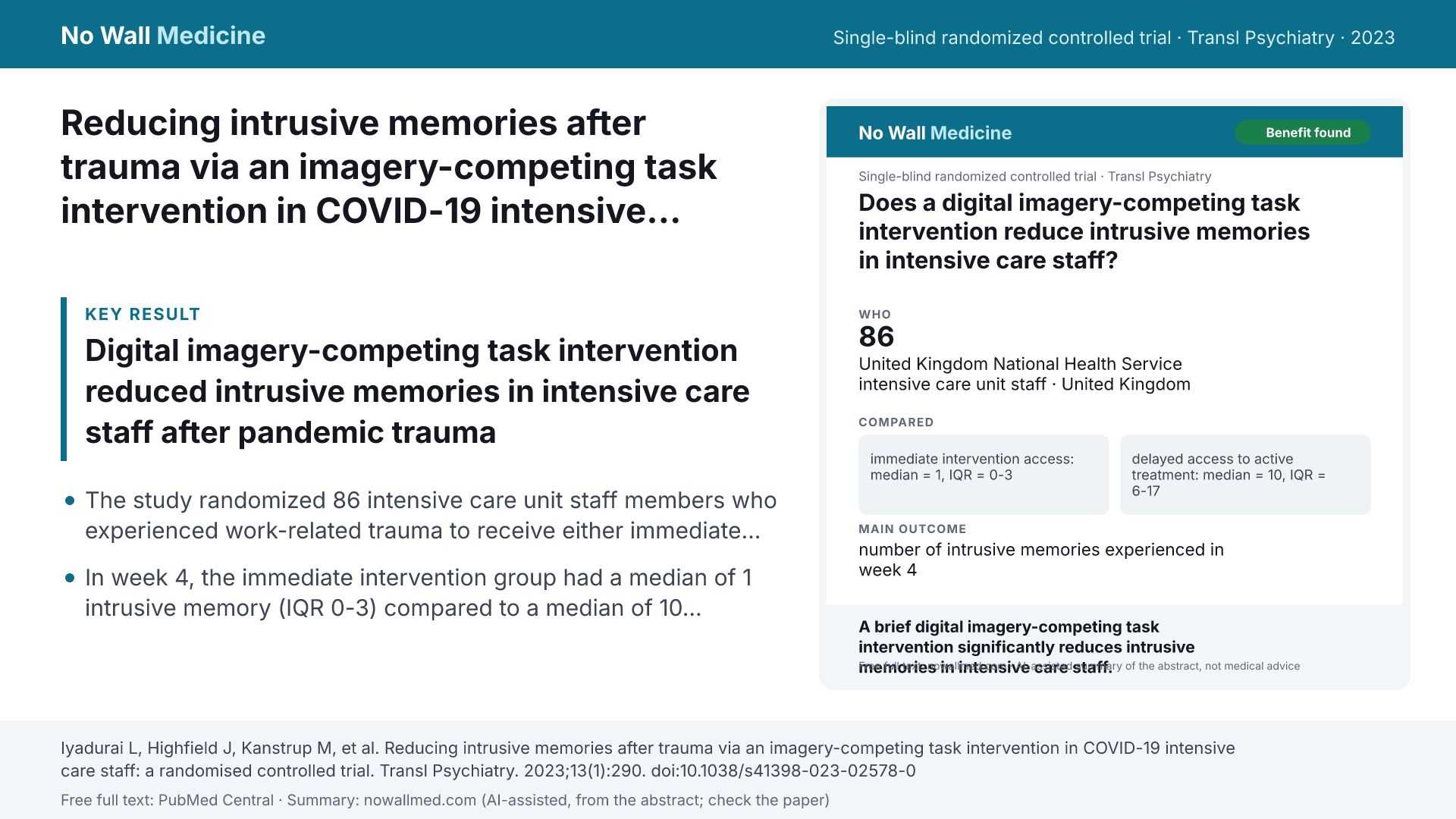
Digital imagery-competing task intervention reduced intrusive memories in intensive care staff after pandemic trauma
Reducing intrusive memories after trauma via an imagery-competing task intervention in COVID-19 intensive care staff: a randomised controlled trial
Single-blind randomized controlled trialBenefit found
Does a digital imagery-competing task intervention reduce intrusive memories in intensive care staff?
Who
86
United Kingdom National Health Service intensive care unit staff · United Kingdom
Compared
immediate intervention access: median = 1, IQR = 0-3
delayed access to active treatment: median = 10, IQR = 6-17
Main outcome
number of intrusive memories experienced in week 4
Result: incidence rate ratio 0.31, 95% CI: 0.20-0.48
Bottom line: A brief digital imagery-competing task intervention significantly reduces intrusive memories in intensive care staff.
Transl Psychiatry · 2023-09-01Download image
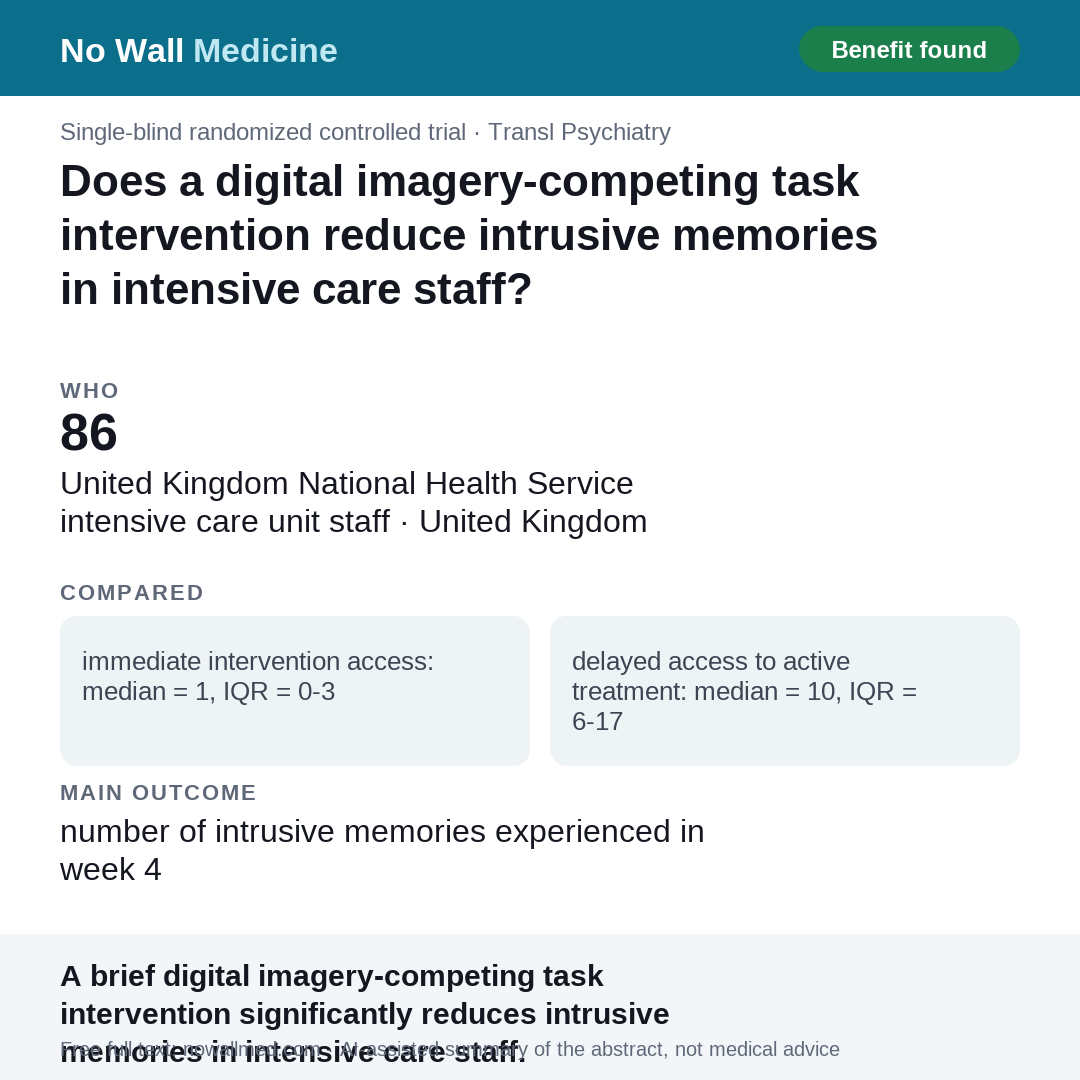
Clinical question: Does a digital imagery-competing task intervention reduce intrusive memories in intensive care staff?
Why it matters: It was unknown if a brief, remotely-delivered digital imagery-competing task could reduce distressing intrusive memories in intensive care staff exposed to repeated trauma.
Key points
- The study randomized 86 intensive care unit staff members who experienced work-related trauma to receive either immediate or delayed access to a digital imagery-competing task intervention.
- In week 4, the immediate intervention group had a median of 1 intrusive memory (IQR 0-3) compared to a median of 10 (IQR 6-17) in the delayed group.
- The intervention was associated with changes in post-traumatic stress disorder symptoms, insomnia, anxiety, work engagement, burnout, and quality of life.
Headline and key points written with AI from the paper’s abstract, with every number checked against it. Read the paper before relying on them.
Was this summary helpful?
Subject terms
Cite this article
Iyadurai L, Highfield J, Kanstrup M, et al. Reducing intrusive memories after trauma via an imagery-competing task intervention in COVID-19 intensive care staff: a randomised controlled trial. Transl Psychiatry. 2023. doi:10.1038/s41398-023-02578-0
Spotted a mistake? Suggest a correction