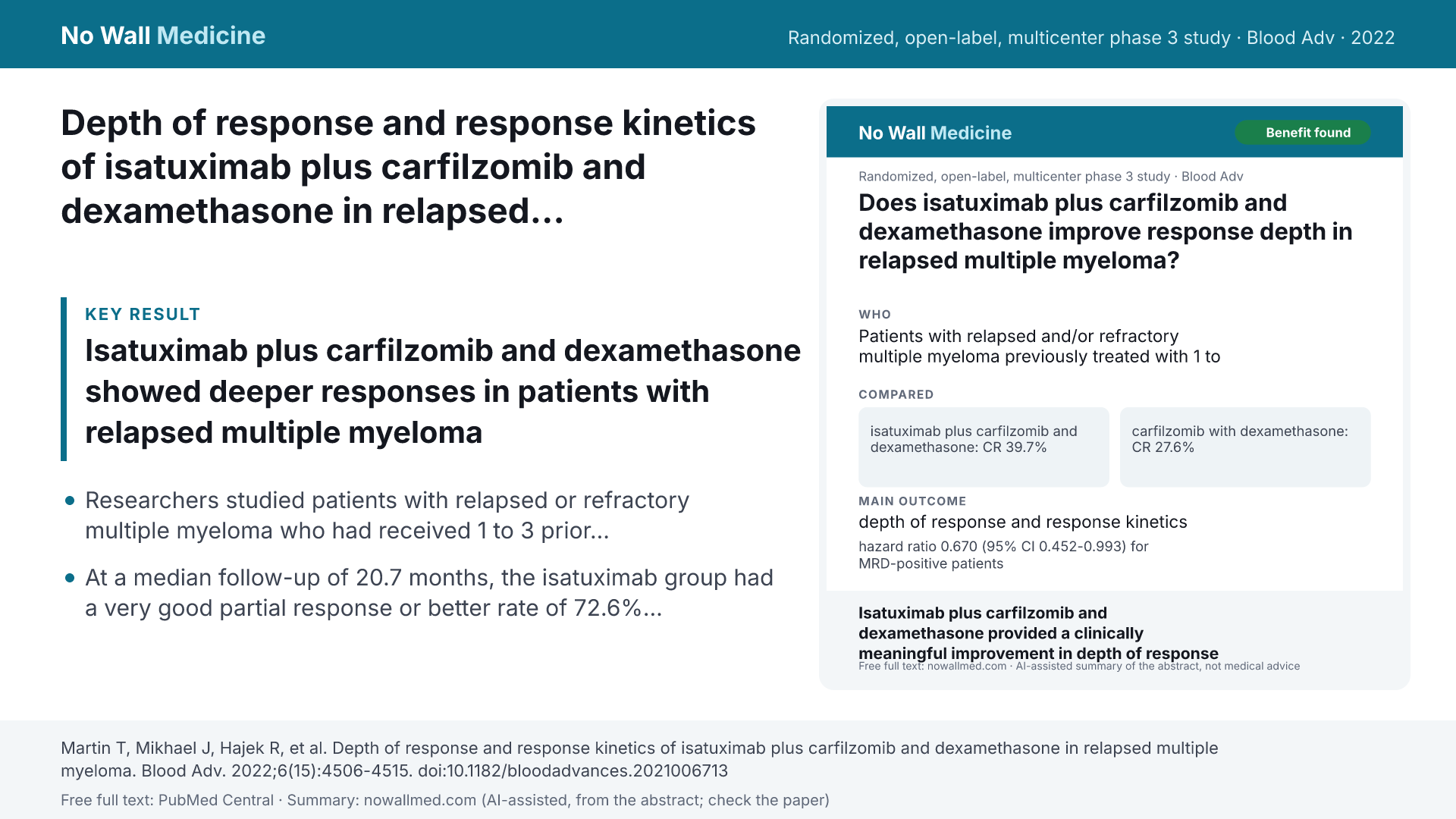
Isatuximab plus carfilzomib and dexamethasone showed deeper responses in patients with relapsed multiple myeloma
Depth of response and response kinetics of isatuximab plus carfilzomib and dexamethasone in relapsed multiple myeloma
Randomized, open-label, multicenter phase 3 studyBenefit found
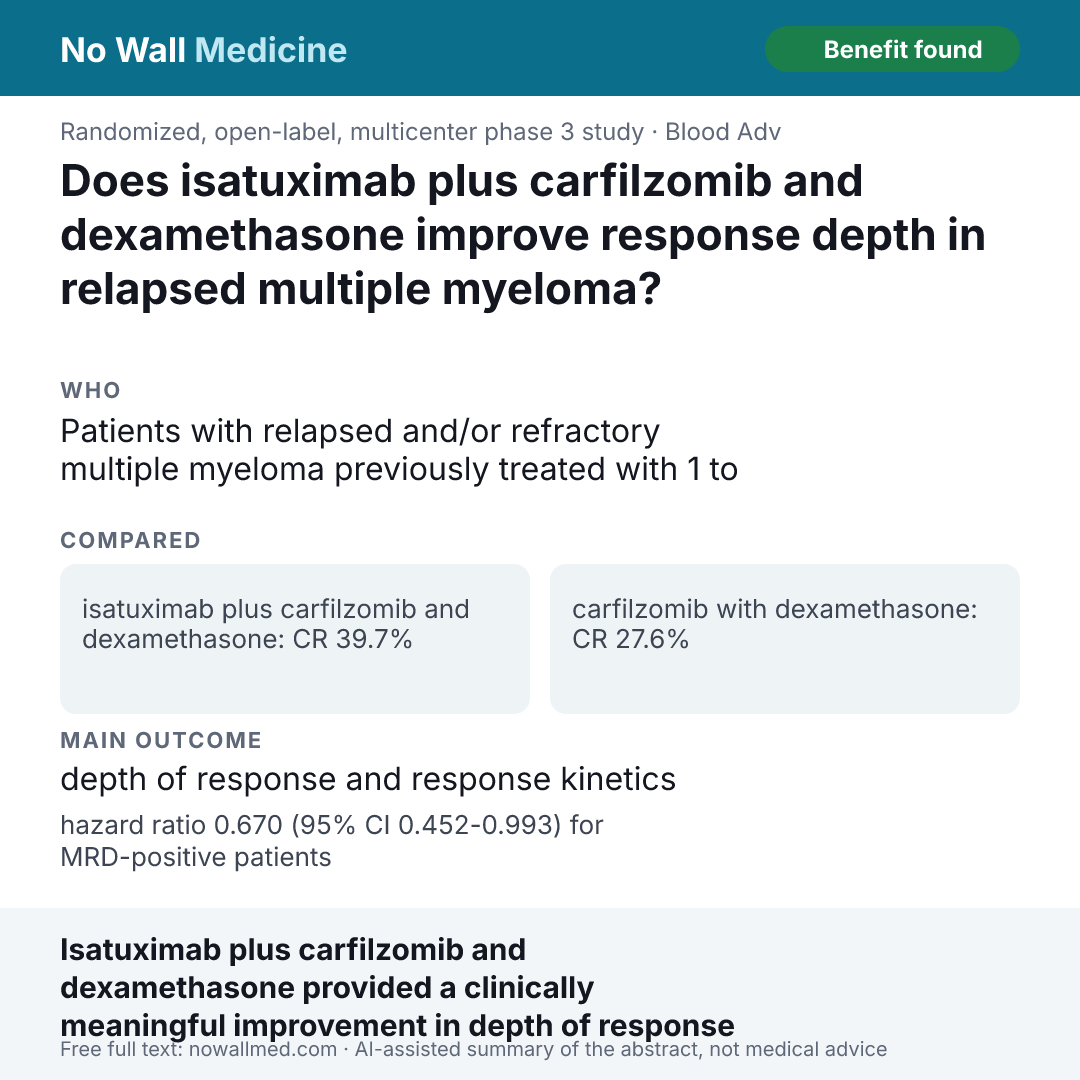
Does isatuximab plus carfilzomib and dexamethasone improve response depth in relapsed multiple myeloma?
Who
Patients with relapsed and/or refractory multiple myeloma previously treated with 1 to 3 lines · multicenter
Compared
isatuximab plus carfilzomib and dexamethasone: CR 39.7%
carfilzomib with dexamethasone: CR 27.6%
Main outcome
depth of response and response kinetics
Result: hazard ratio 0.670 (95% CI 0.452-0.993) for MRD-positive patients
Bottom line: Isatuximab plus carfilzomib and dexamethasone provided a clinically meaningful improvement in depth of response compared to carfilzomib and dexamethasone.
Blood Adv · 2022-05-21 · Save PNG
Clinical question: Does isatuximab plus carfilzomib and dexamethasone improve response depth in relapsed multiple myeloma?
Why it matters: The depth of response and how quickly patients respond to isatuximab plus carfilzomib and dexamethasone compared to carfilzomib and dexamethasone was not fully characterized.
Key points
- Researchers studied patients with relapsed or refractory multiple myeloma who had received 1 to 3 prior treatments, comparing isatuximab plus carfilzomib and dexamethasone to carfilzomib and dexamethasone alone.
- At a median follow-up of 20.7 months, the isatuximab group had a very good partial response or better rate of 72.6% compared to 56.1% in the carfilzomib group.
- The complete response rate was 39.7% with isatuximab plus carfilzomib and dexamethasone versus 27.6% with carfilzomib and dexamethasone, and minimal residual disease negativity occurred in 29.6% versus 13.0% of patients.
Headline and key points written with AI from the paper’s abstract, with every number checked against it. Read the paper before relying on them.
Was this summary helpful?
Abstract
The IKEMA study (Randomized, Open Label, Multicenter Study Assessing the Clinical Benefit of Isatuximab Combined With Carfilzomib [Kyprolis®] and Dexamethasone Versus Carfilzomib With Dexamethasone in Patients With Relapse and/or Refractory Multiple Myeloma Previously Treated With 1 to 3 Prior Lines; #NCT03275285) was a randomized, open-label, multicenter phase 3 study investigating isatuximab plus carfilzomib and dexamethasone (Isa-Kd) vs Kd in patients with relapsed multiple myeloma. This subanalysis analyzed the depth of response of Isa-Kd vs Kd. The primary end point was progression-free survival (PFS); secondary end points included overall response rate, very good partial response or better (≥VGPR) rate, complete response (CR) rate, and minimal residual disease (MRD) negativity rate (assessed in patients with ≥VGPR by next-generation sequencing at a 10-5 sensitivity level). At a median follow-up of 20.7 months, deeper responses were observed in the Isa-Kd arm vs the Kd arm, with ≥VGPR 72.6% vs 56.1% and CR of 39.7% vs 27.6%, respectively. MRD negativity occurred in 53 (29.6%) of 179 patients in the Isa-Kd arm vs 16 (13.0%) of 123 patients in the Kd arm, with 20.1% (Isa-Kd, 36 of 179 patients) vs 10.6% (Kd, 13 of 123 patients) reaching MRD-negative CR status. Achieving MRD negativity resulted in better PFS in both arms. A positive PFS treatment effect was seen with Isa-Kd in both MRD-negative patients (hazard ratio, 0.578; 95% CI, 0.052-6.405) and MRD-positive patients (hazard ratio, 0.670; 95% CI, 0.452-0.993). Exploratory analysis indicates that both current CR and MRD-negative CR rates are underestimated due to M-protein interference (potential adjusted CR rate, 45.8%; potential adjusted MRD-negative CR rate, 24.0%). In conclusion, there was a clinically meaningful improvement in depth of response with Isa-Kd. The CR rate in Isa-Kd was 39.7%. Mass spectrometry suggests that the potential adjusted CR rate could reach an unprecedented 45.8% of patients treated with Isa-Kd.
Abstract reproduced under the article’s CC BY NC ND licence.
Subject terms
Headline, design, result, key points, caveat and citation as plain text.
Cite this article
Martin T, Mikhael J, Hajek R, et al. Depth of response and response kinetics of isatuximab plus carfilzomib and dexamethasone in relapsed multiple myeloma. Blood Adv. 2022;6(15):4506-4515. doi:10.1182/bloodadvances.2021006713
Spotted a mistake? Suggest a correction