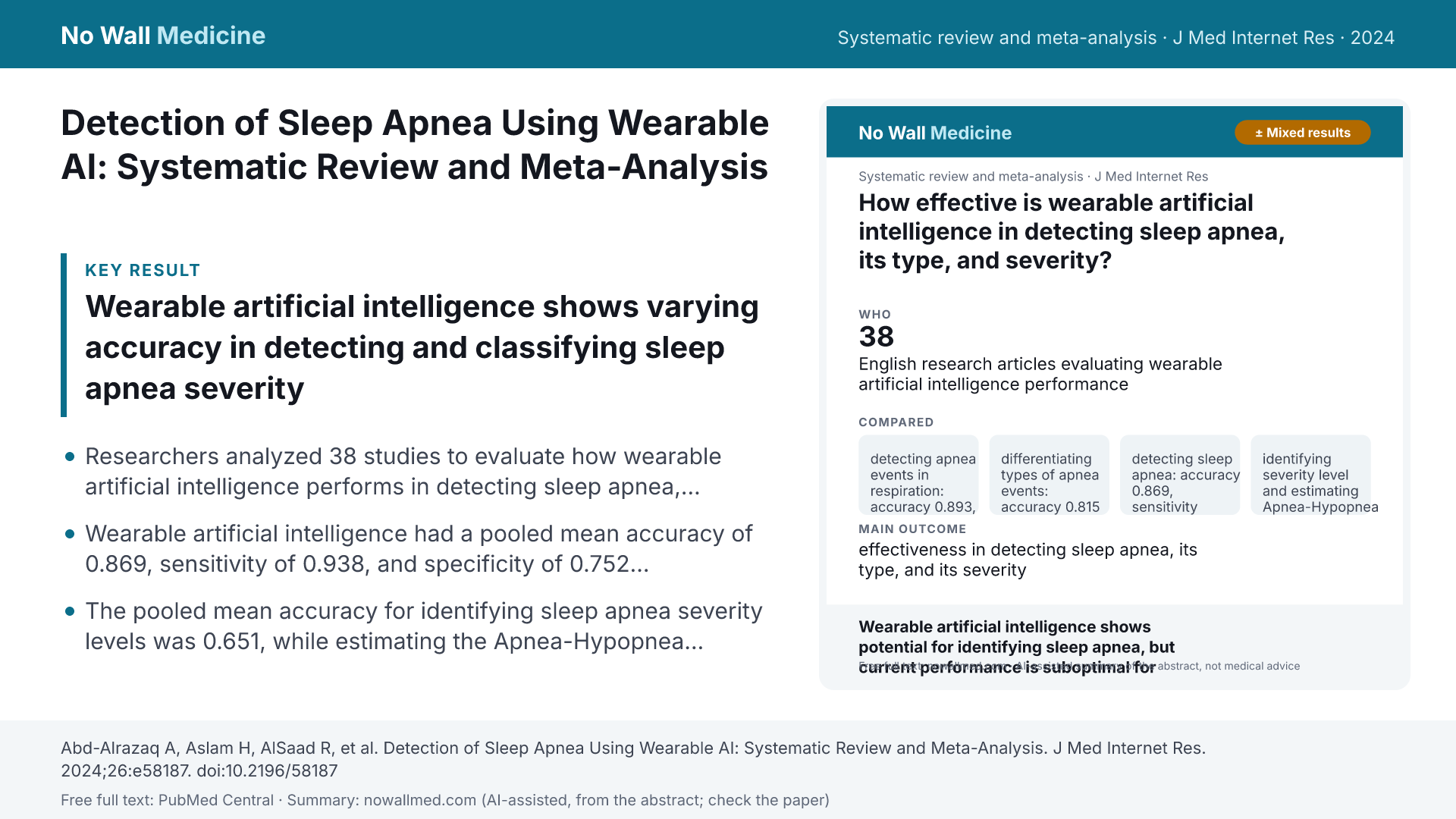
Wearable artificial intelligence shows varying accuracy in detecting and classifying sleep apnea severity
Detection of Sleep Apnea Using Wearable AI: Systematic Review and Meta-Analysis
Systematic review and meta-analysisMixed results
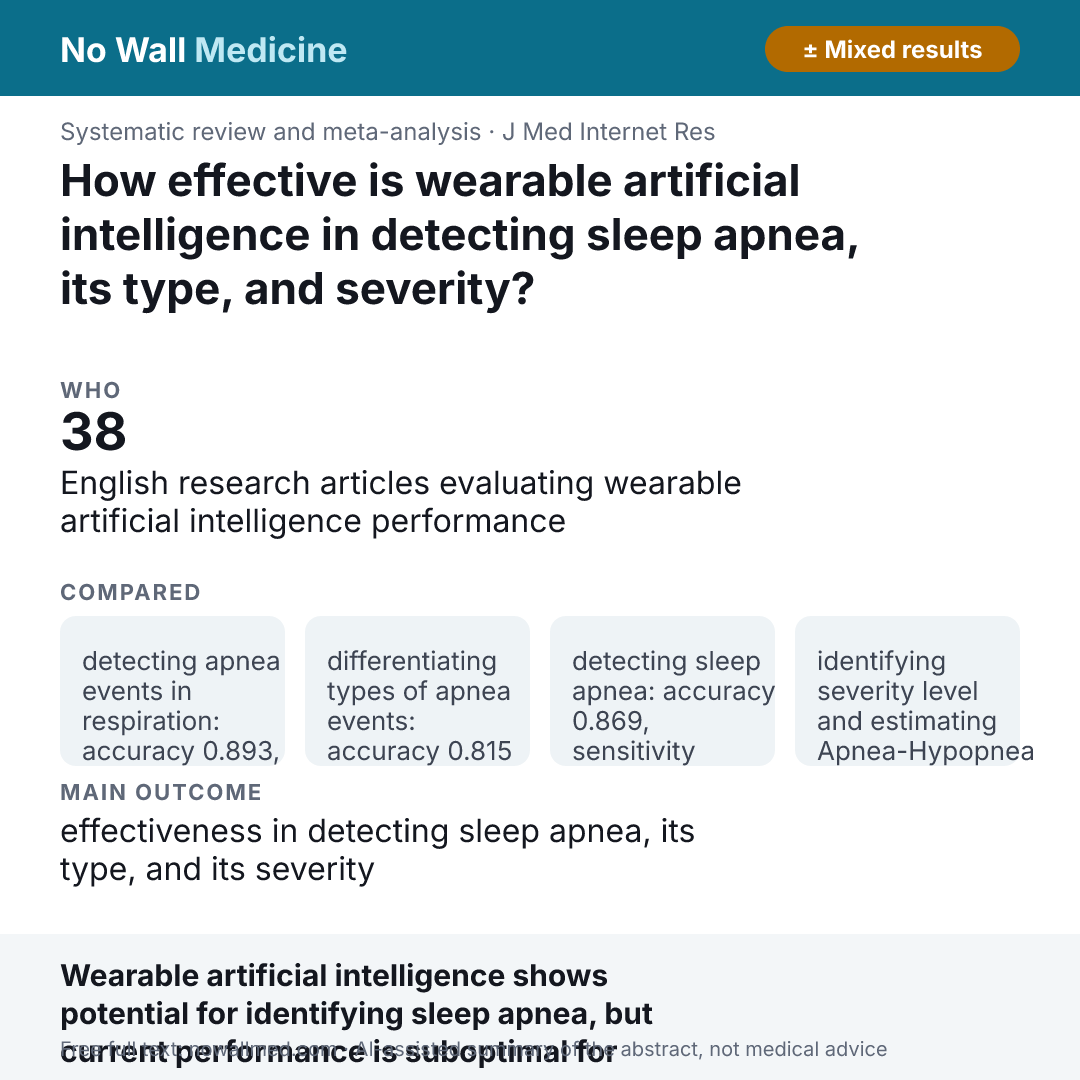
How effective is wearable artificial intelligence in detecting sleep apnea, its type, and severity?
Who
38
English research articles evaluating wearable artificial intelligence performance
Compared
detecting apnea events in respiration: accuracy 0.893, sensitivity 0.793, specificity 0.947
differentiating types of apnea events: accuracy 0.815
detecting sleep apnea: accuracy 0.869, sensitivity 0.938, specificity 0.752
identifying severity level and estimating Apnea-Hypopnea Index: accuracy 0.651 and 0.877
Main outcome
effectiveness in detecting sleep apnea, its type, and its severity
Bottom line: Wearable artificial intelligence shows potential for identifying sleep apnea, but current performance is suboptimal for routine clinical use.
Limitation: Subgroup analyses found different moderators of performance for different outcomes.
J Med Internet Res · 2024-09-10 · Save PNG
Clinical question: How effective is wearable artificial intelligence in detecting sleep apnea, its type, and severity?
Key points
- Researchers analyzed 38 studies to evaluate how wearable artificial intelligence performs in detecting sleep apnea, its type, and its severity.
- Wearable artificial intelligence had a pooled mean accuracy of 0.869, sensitivity of 0.938, and specificity of 0.752 for detecting sleep apnea.
- The pooled mean accuracy for identifying sleep apnea severity levels was 0.651, while estimating the Apnea-Hypopnea Index score was 0.877.
Headline and key points written with AI from the paper’s abstract, with every number checked against it. Read the paper before relying on them.
Was this summary helpful?
Subject terms
Headline, design, result, key points, caveat and citation as plain text.
Cite this article
Abd-Alrazaq A, Aslam H, AlSaad R, et al. Detection of Sleep Apnea Using Wearable AI: Systematic Review and Meta-Analysis. J Med Internet Res. 2024;26:e58187. doi:10.2196/58187
Spotted a mistake? Suggest a correction